
Software de gestión de suelo para promotores fotovoltaicos y eólicos
Qué hace un software de gestión de suelo que no hace un GIS ni un gestor de contratos, cómo encajan los instrumentos españoles y el Catastro, y cuándo un promotor lo necesita.
Sherpa is now Navorda. Same team, same technology, a new name. Read the announcement

Founder, CabSan Solutions
Founded CabSan Solutions in March 2019 in Spain. More than ten years of IT consulting in the energy sector since October 2013, with a strategy and IT background from Accenture.
LinkedInQué hace un software de gestión de suelo que no hace un GIS ni un gestor de contratos, cómo encajan los instrumentos españoles y el Catastro, y cuándo un promotor lo necesita.
La cadena de autorizaciones española, los hitos administrativos que la hacen implacable, por qué la hoja de cálculo falla a partir de diez proyectos y cómo seguir los permisos contra líneas base aprobadas.
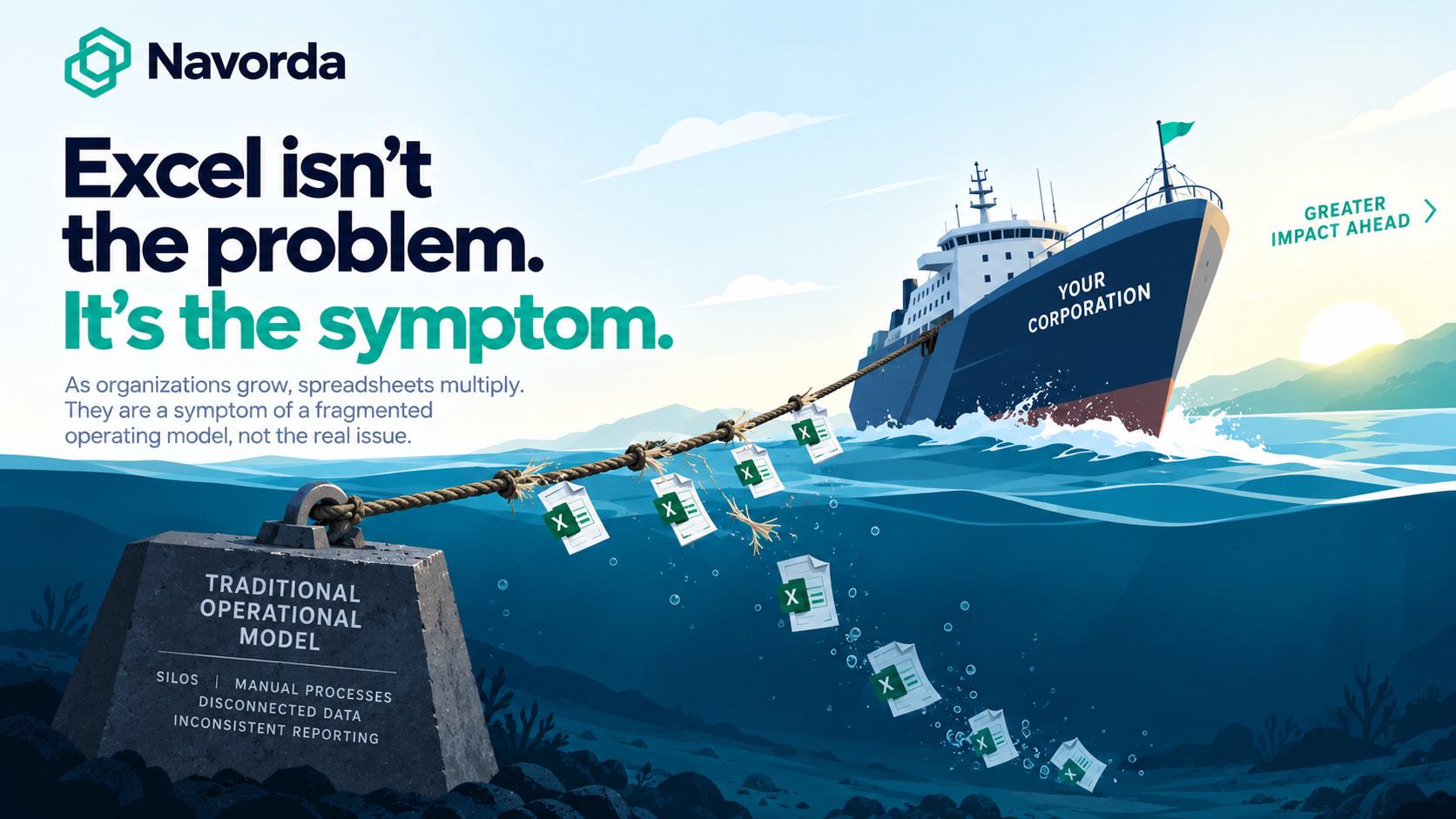
Excel no es el problema: es el síntoma. Las cuatro familias de alternativas para seguir una cartera de proyectos renovables, qué se gana y qué se pierde con cada una, y cuándo quedarse en la hoja.

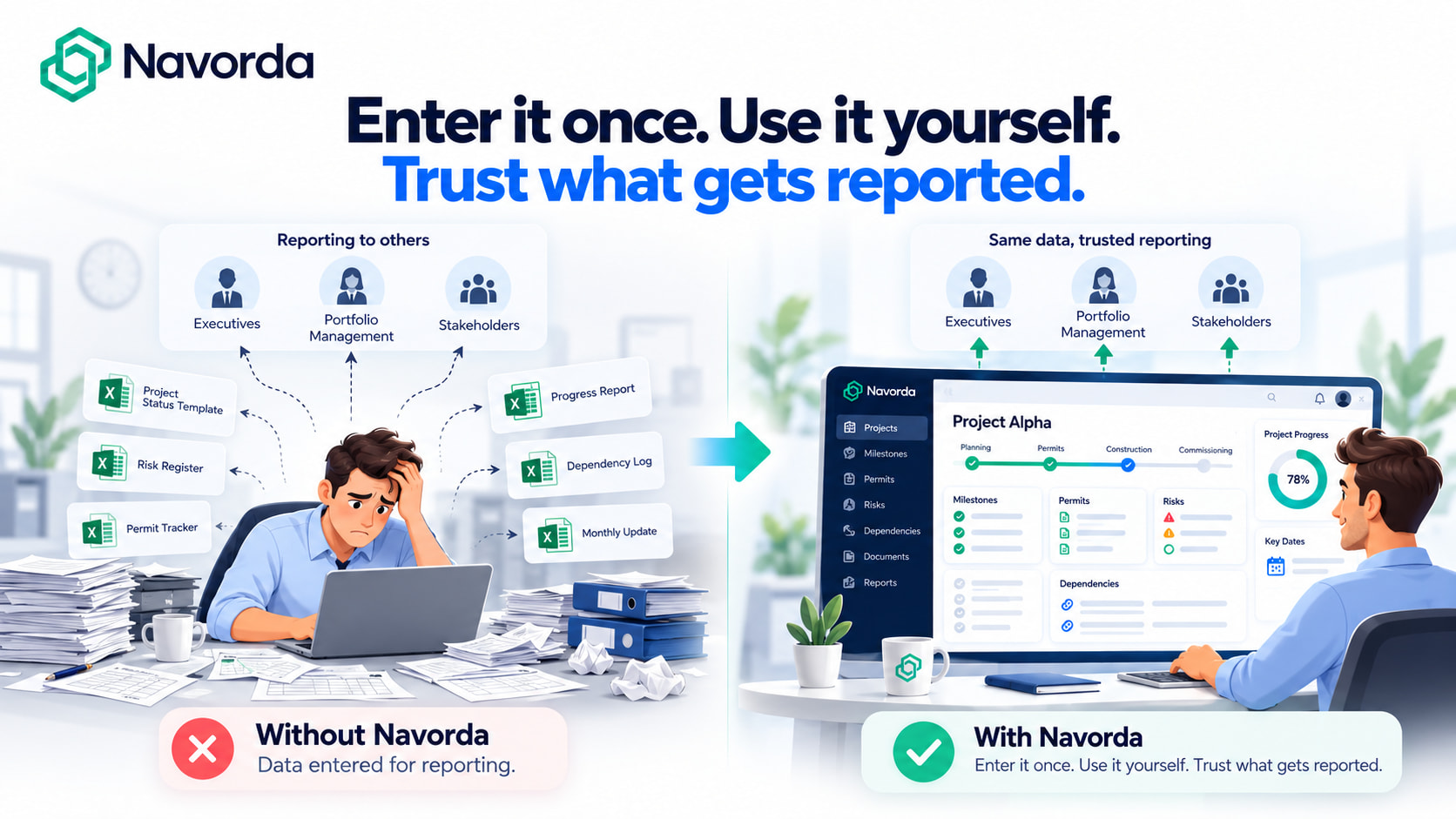
Project Managers should not maintain data only so somebody else can report on it. Enter project reality once, use it to run the project, and trust that management sees the same governed information.

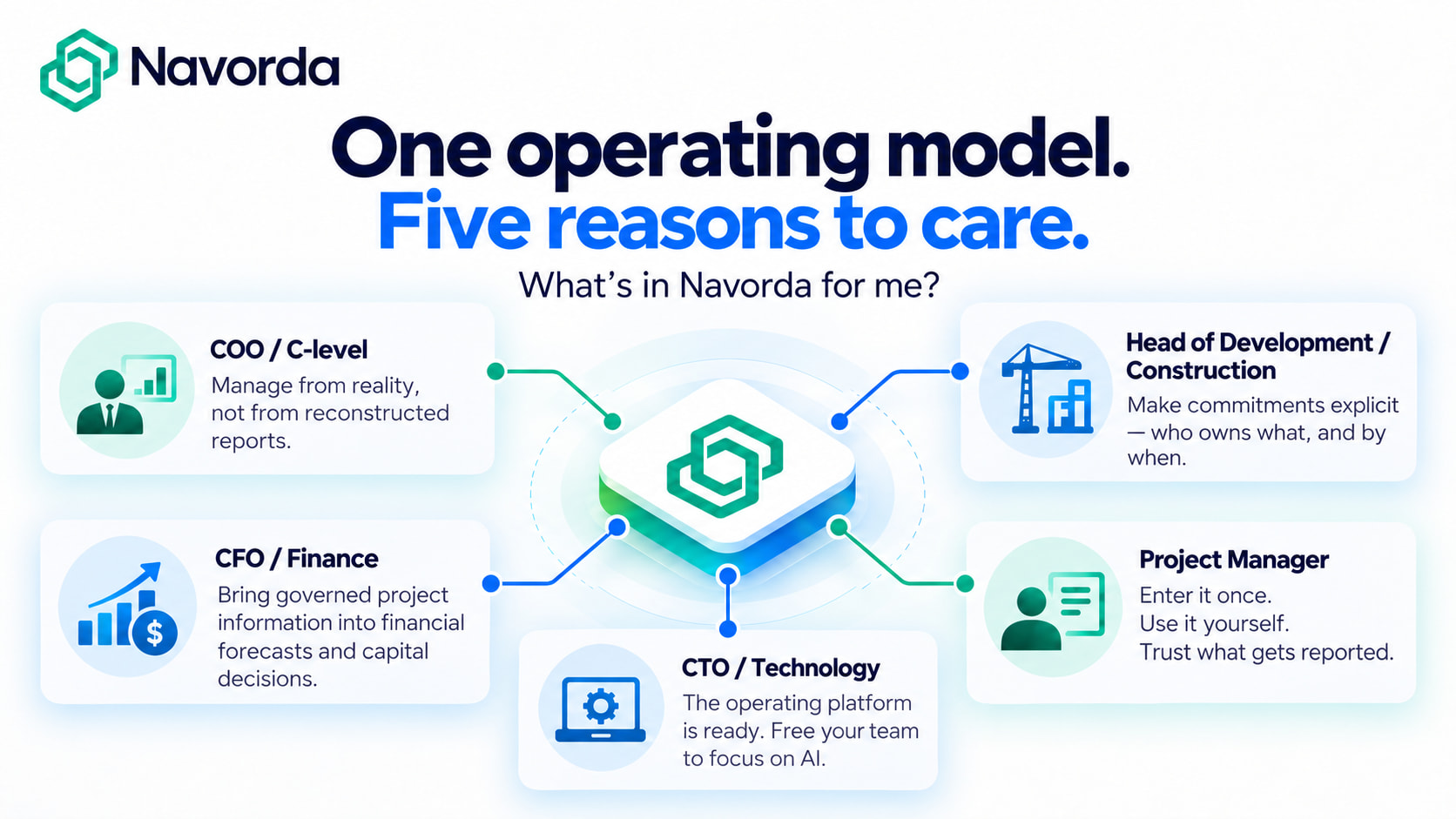
One governed operating model, five perspectives: less duplicated work for Project Managers, clearer commitments for Heads, better decisions for COOs, stronger financial visibility for CFOs and trusted operational context for CTOs.

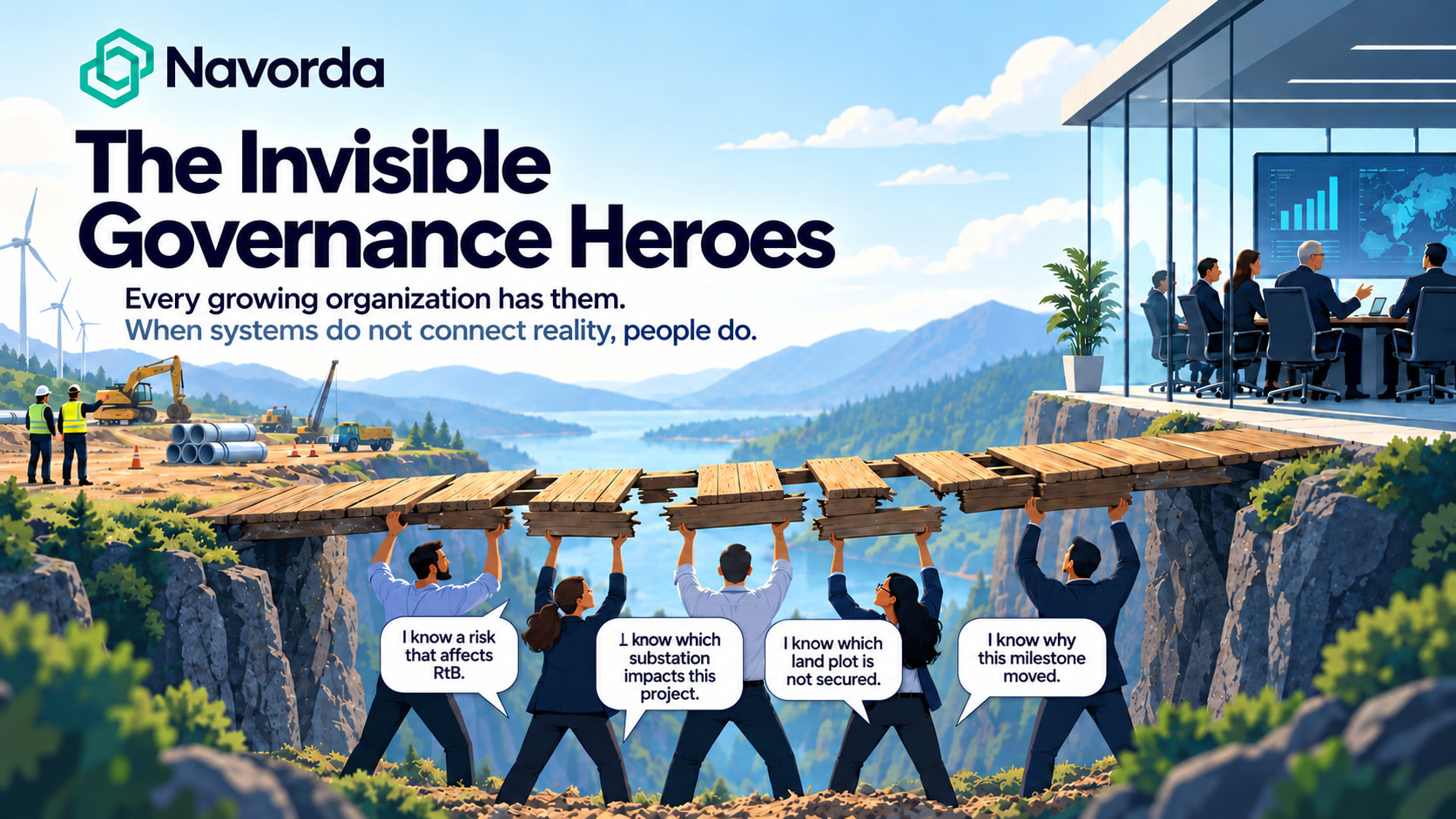
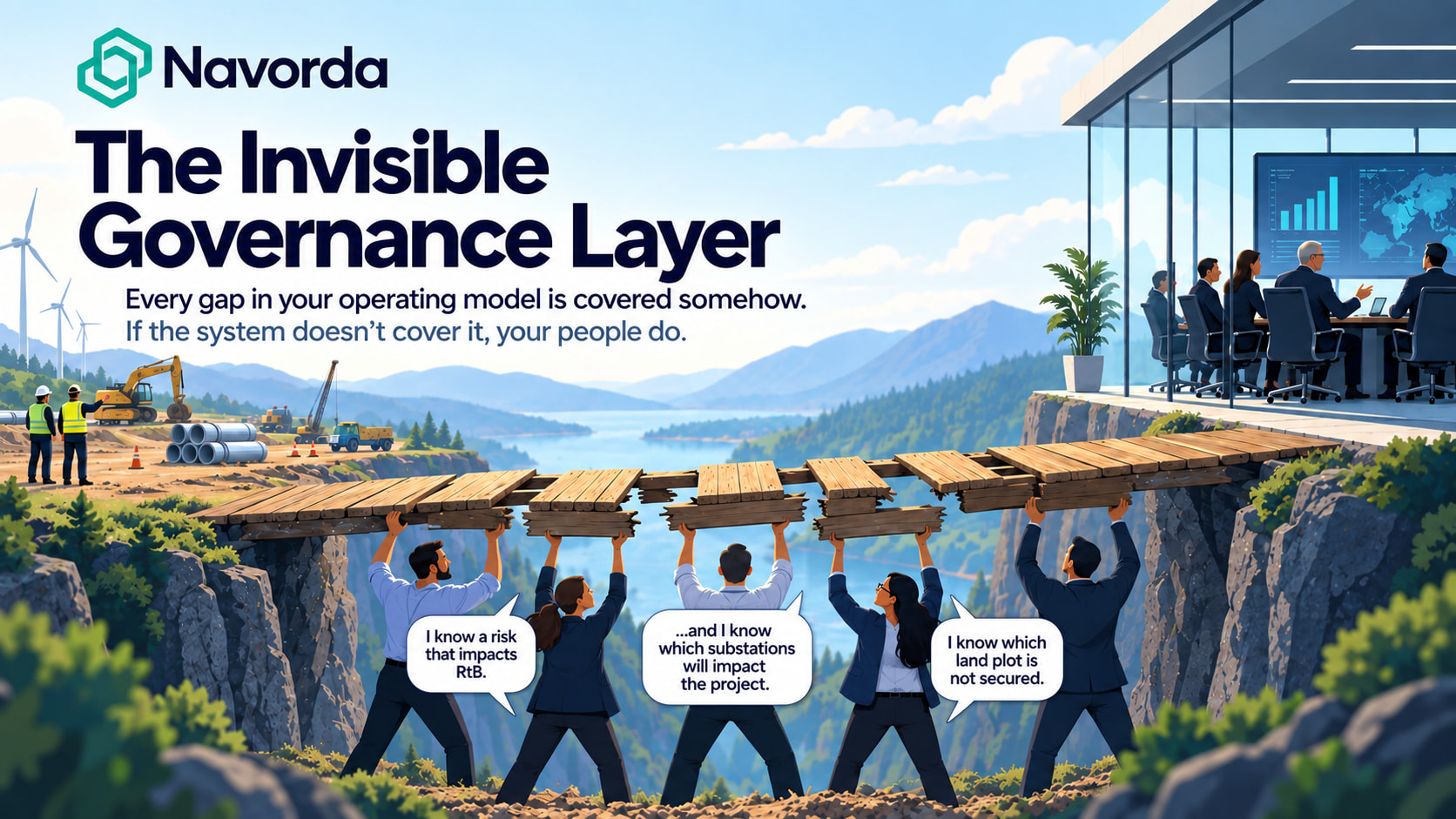
Every growing organization has people who quietly reconcile project reality, connect dependencies and make reporting work. They are invisible governance heroes — and better governance should amplify their expertise, not replace it. Keep the heroes. Remove the unnecessary heroics.

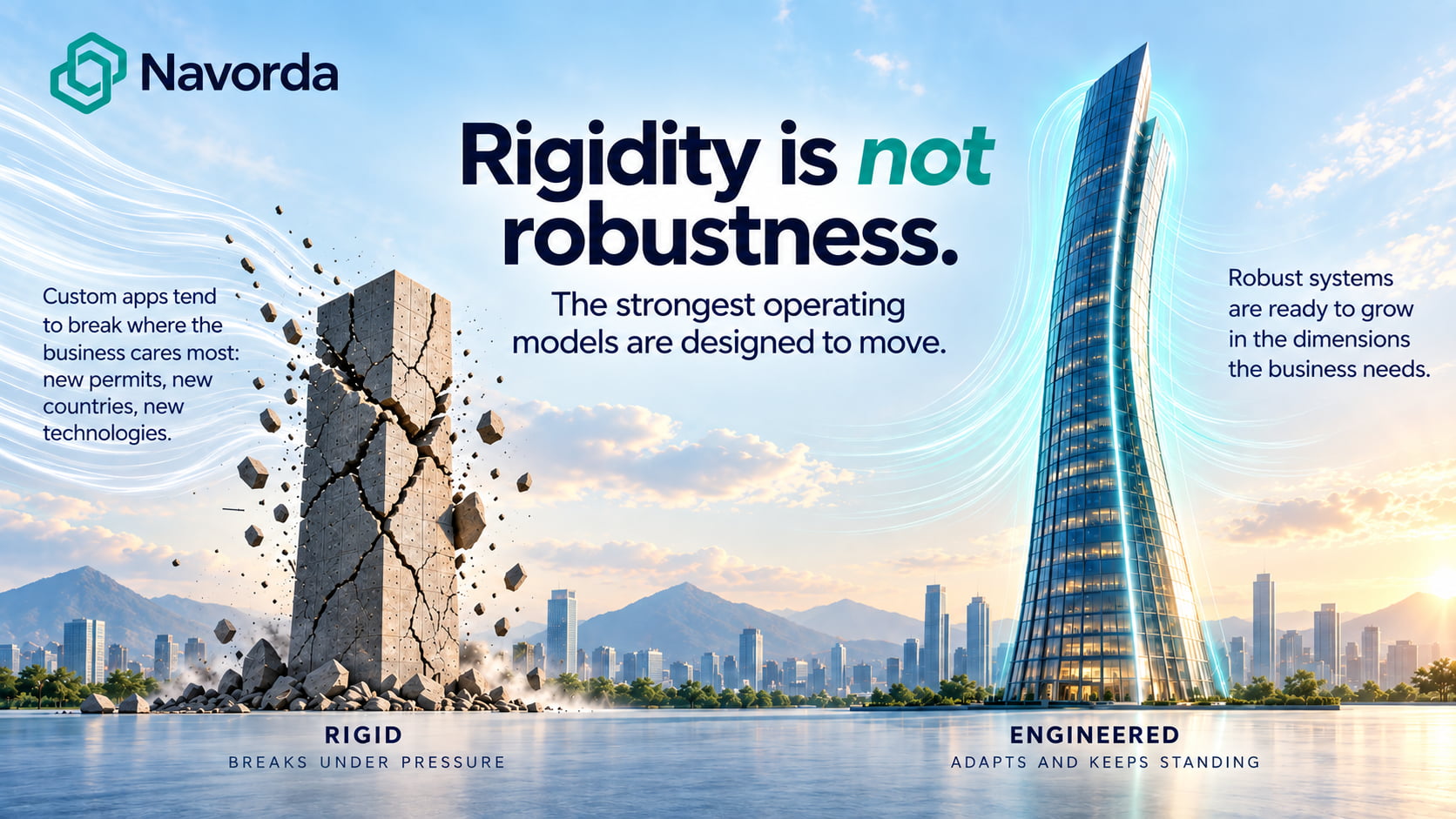
The strongest operating models are not those that resist change. They are those that preserve governance while the business keeps changing.

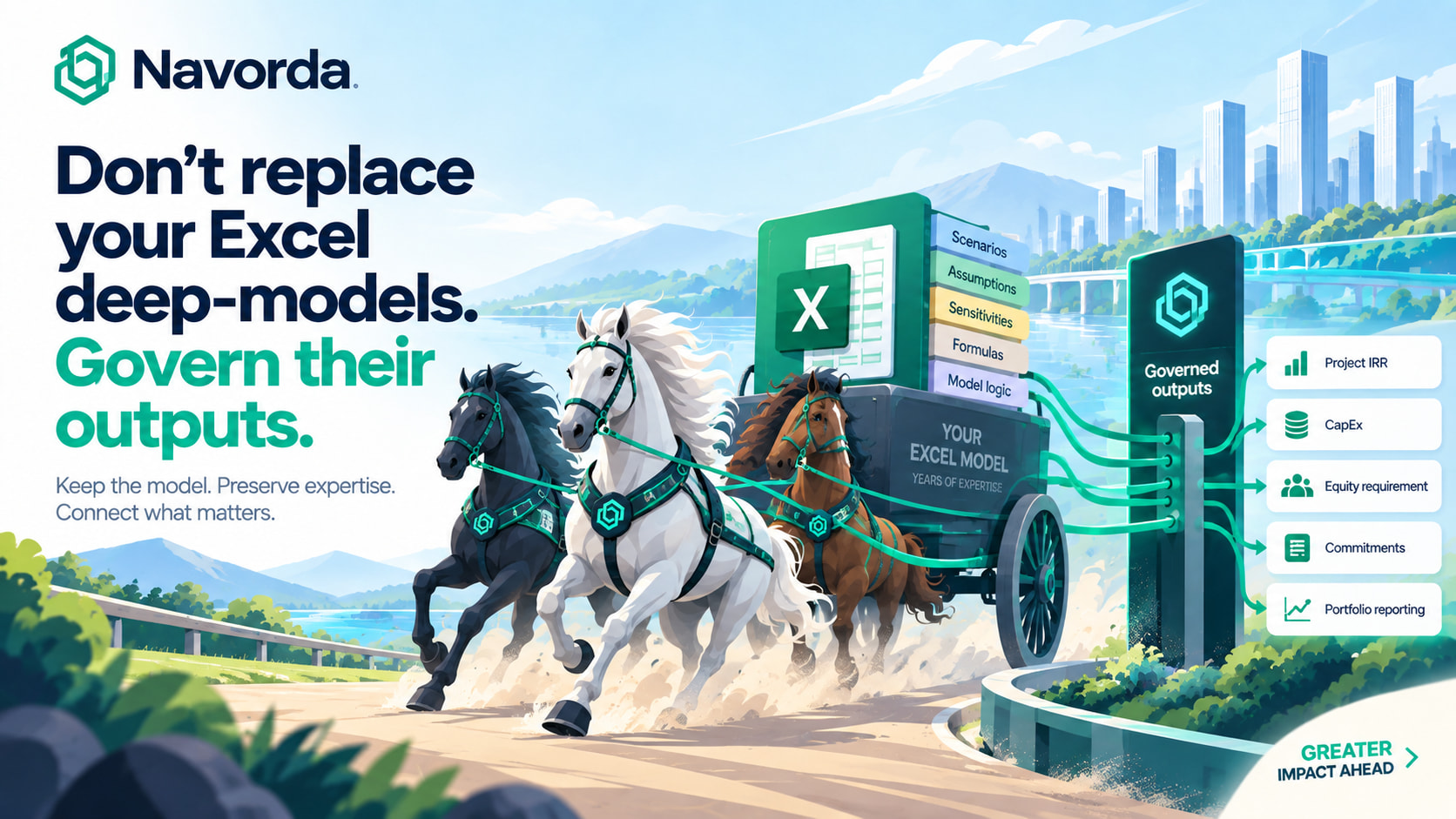
Some Excel files contain years of expertise. Digital transformation should not destroy what already works.

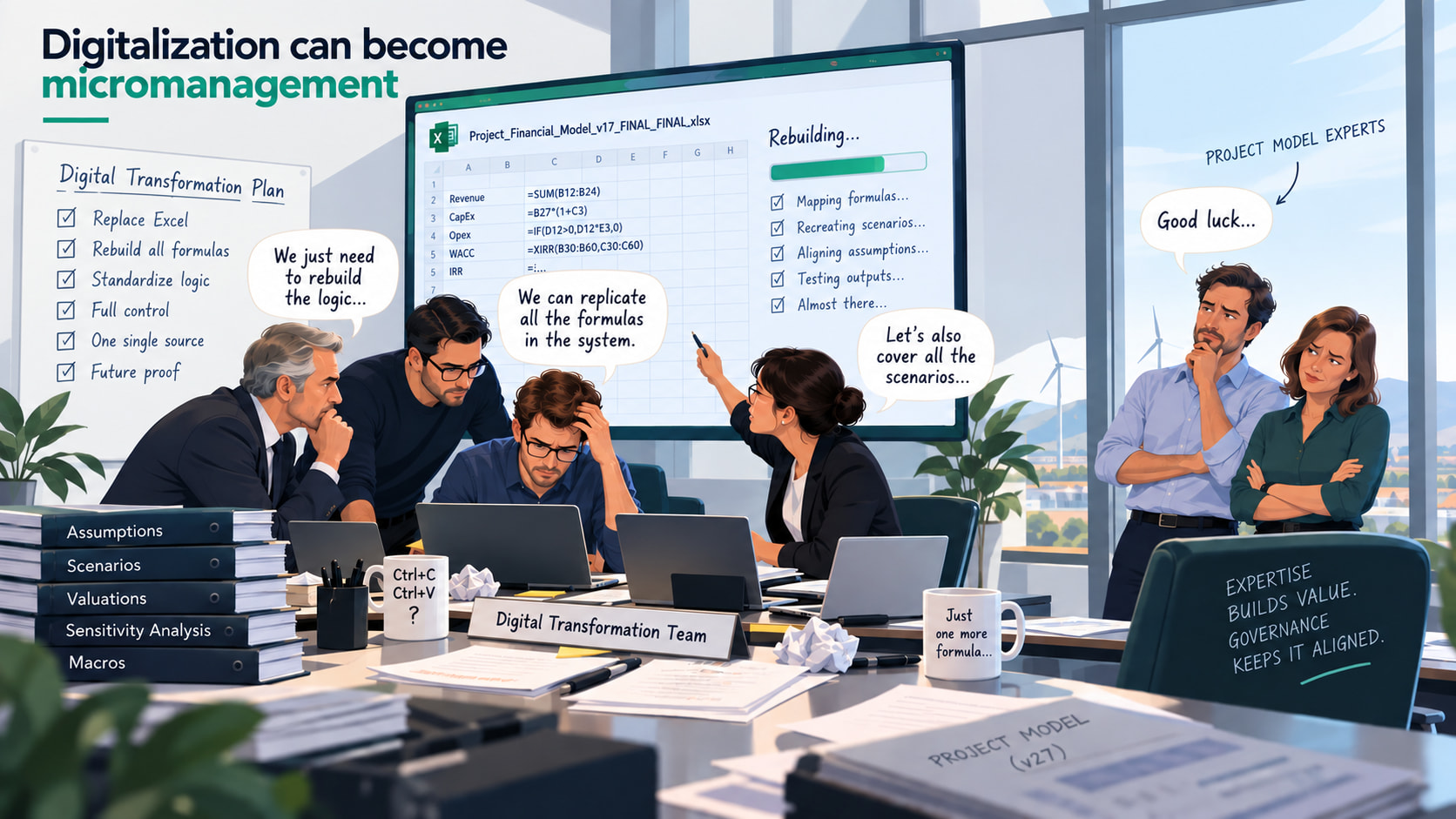
Rebuilding a financial model in the corporate system feels like governance. Often it is digital micromanagement. Keep the model; govern its inputs and outputs.

Every gap in your operating model is covered somehow. If the system doesn’t cover it, your people do. That accumulated effort creates an invisible governance layer around the organization — and growth turns hidden effort into structural risk.
A renewable developer usually manages schedule and project money through two reporting systems. But money is causally linked to development events: a permit triggers a fee, NtP triggers an EPC payment, COD starts a commercial obligation. When the event moves and the forecast stays, the organization gradually operates two versions of reality — reconciled by hand, after the date has already moved.
Every AI feature is a data flow before it is a feature. Navorda’s agents run on AWS Bedrock in the same EU region as your data — Frankfurt — with IAM roles instead of API keys, no training on your prompts, and a deterministic rule engine that decides while the AI explains. AI privacy is an architecture decision, not a policy page.

The hidden governance problem inside growing energy developers: growth increases the distance between where reality happens and where decisions are made. Reality must flow upstream. Decisions and accountability must flow downstream.

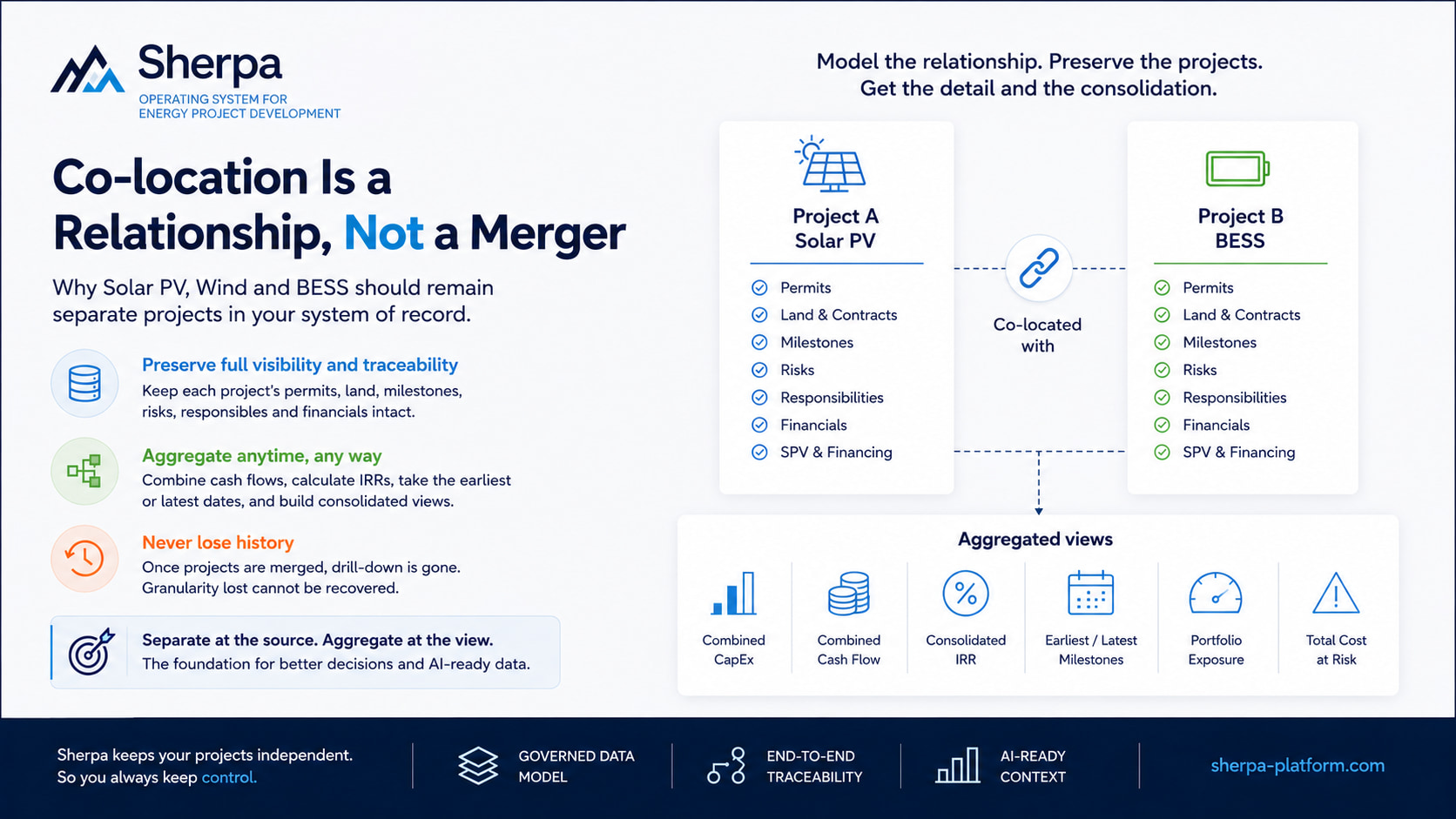
If a BESS is attached to an existing Solar PV plant or Wind Farm, should both be managed as one project? Merging can seem convenient — they may share a grid connection, land, permits, an SPV or a development team, and a single spreadsheet row makes life easier. But convenience at the spreadsheet level creates a much bigger problem at the portfolio level: you lose information that may never be reconstructed.
A signed offtake agreement is a promise with a date on it. The project that has to keep that promise usually lives in a different system — so when a permit moves, nobody can say what was already sold, to whom, and from when. The gap between contracted and delivered megawatts is a governance problem, and it is where the commercial cost of a development delay quietly accumulates.
The IEA expects data-center electricity consumption to roughly double by 2030, and in some major European cities a grid connection now takes seven to ten years. So developers are building the power themselves — and discovering that a contracted megawatt is a promise, while a delivered megawatt is a development project that finished on time.
Land that sold for $10,000 an acre now trades for up to $1 million — and the dirt didn't change. What changed is what's attached to it: grid rights, permits, and a credible path to generation. Powered land is not found, it is manufactured — by exactly the development governance energy teams already know.
In some major European cities a grid connection now takes seven to ten years — so data centers are bringing their own power. But behind-the-meter is not a shortcut around development discipline: it is a portfolio of interdependent generation, storage and grid projects, and in Europe the permits still rule the schedule.

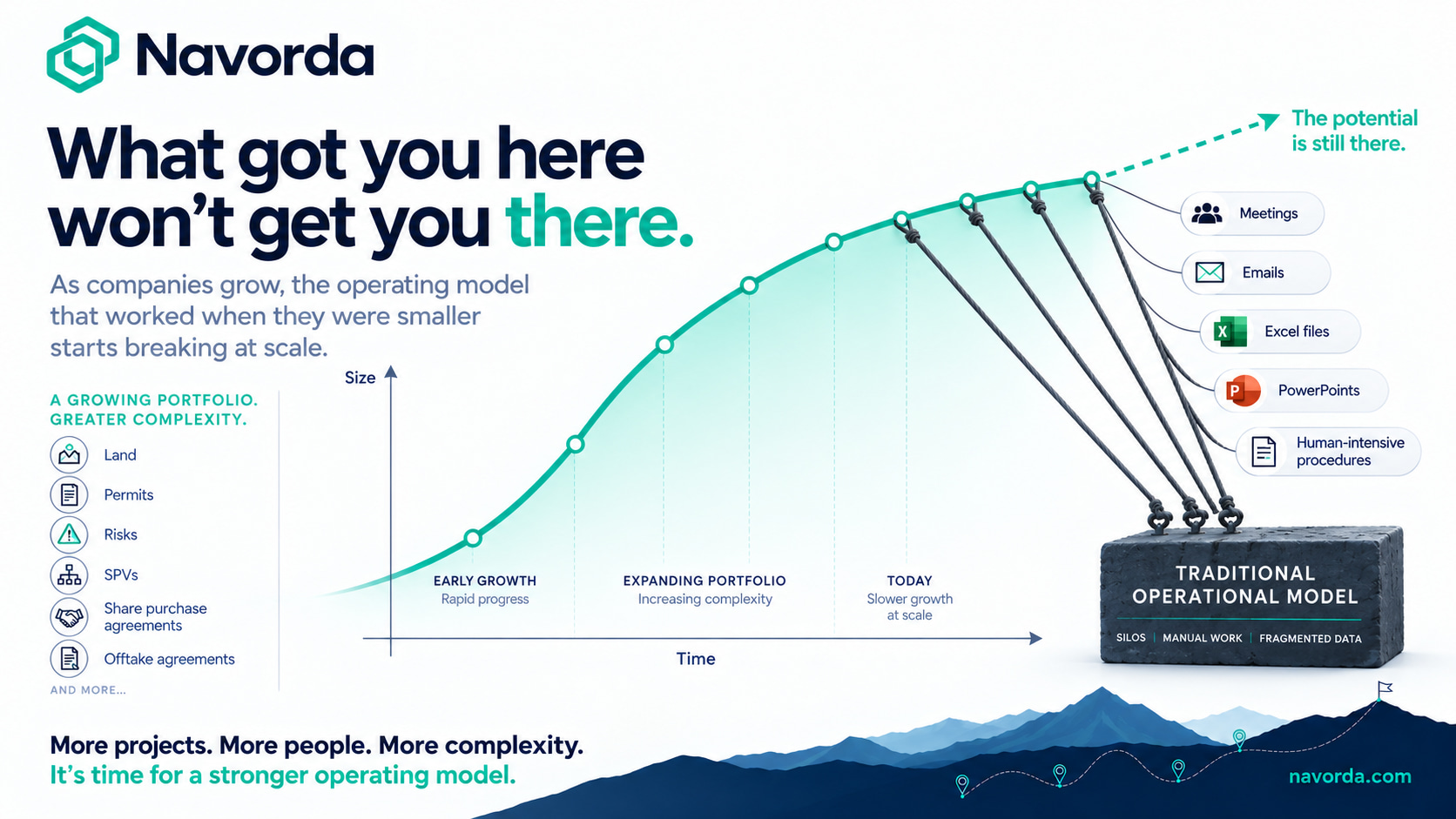
As energy developers scale, spreadsheets multiply. Excel is not the problem: it is the symptom of an operating model that fails to govern ownership and change.
Most land management software encodes US lease law: options, county recording, royalty payments. European land control runs on different legal instruments, public cadastres and multi-authority permitting chains — and the difference is structural, not cosmetic. Here is what actually changes, and what to check before you shortlist.
Every Spanish land contract starts with a 20-character parcel ID, every project finances against a registered surface right, and every grid access permit lives or dies by a statutory milestone chain backed by a €40/kW guarantee. An operational guide to Spanish land and permitting for developers — and why the workflow has to run as one system.
Italy consolidated its renewable permitting into three regimes with the Testo Unico FER — and then spent 2025 and 2026 litigating what regions may and may not do with them. An operational guide to AU, PAS, aree idonee and the 300+ GW connection queue, and why baseline-tracked permitting matters most where timelines are least predictable.

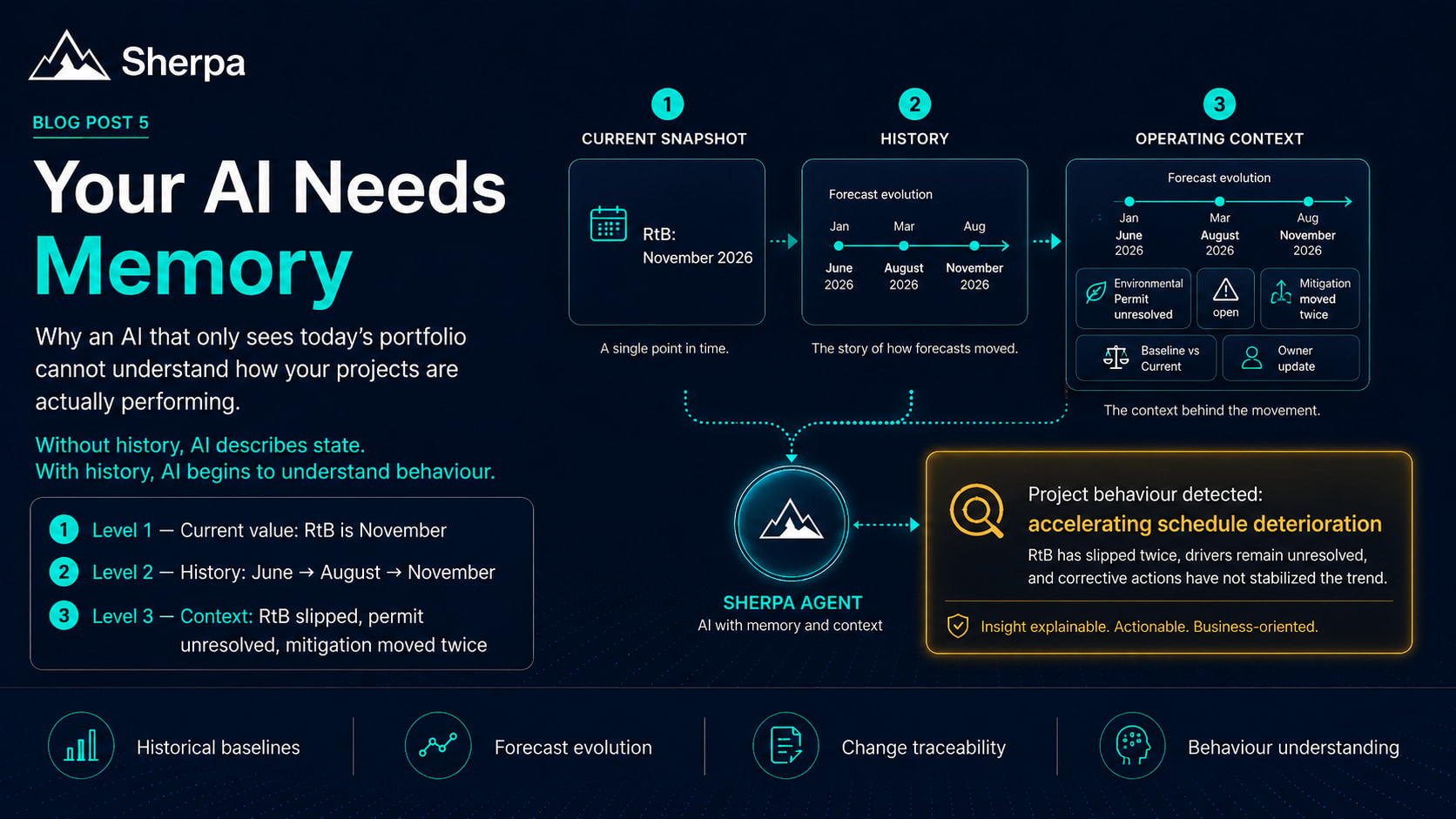
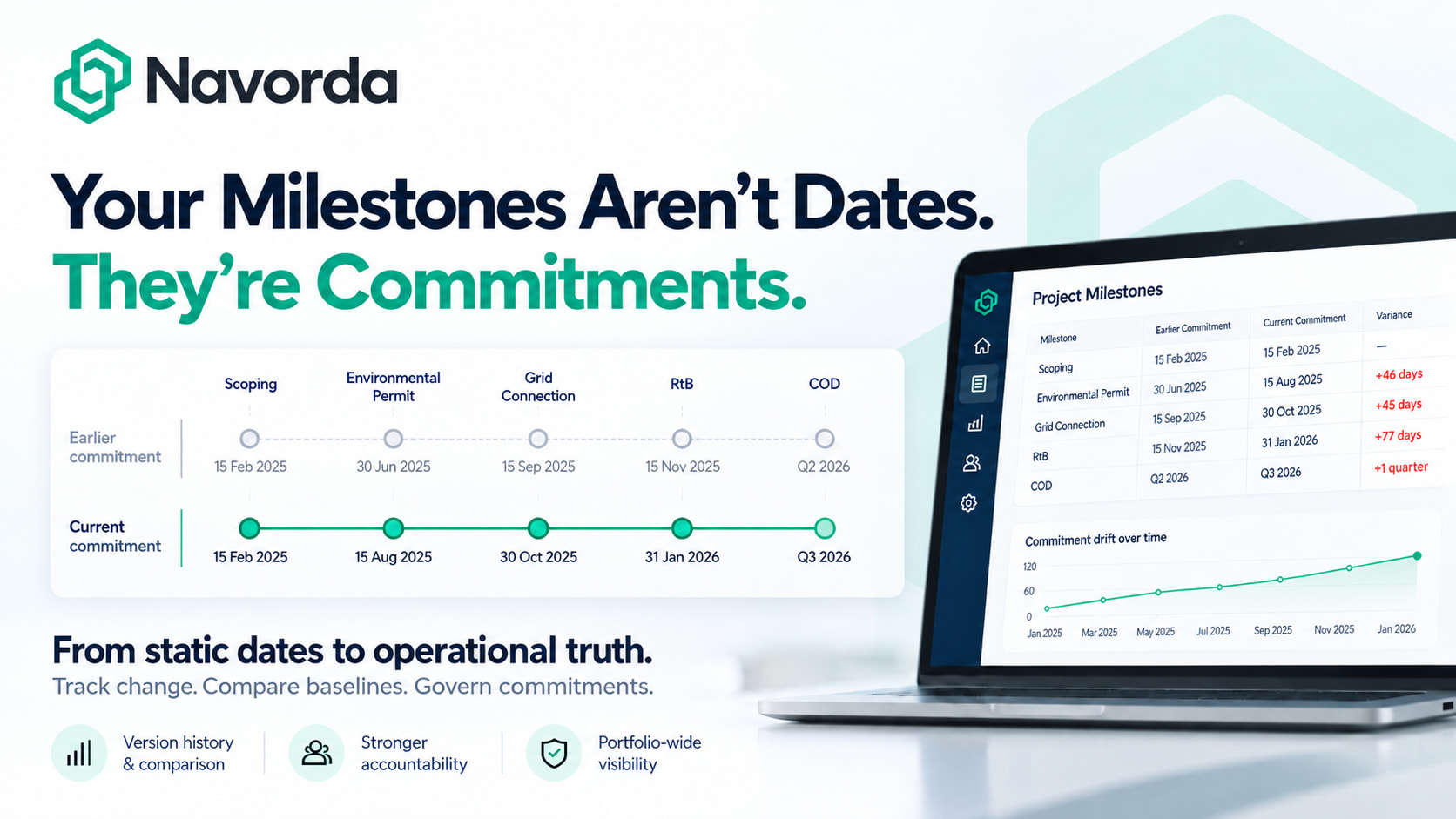
Why an AI that only sees today's portfolio cannot understand how your projects are actually performing. RtB in November can be a stable plan or the fifth revision of the year — the current value is identical, the meaning is completely different. History is the capability you cannot retrofit.

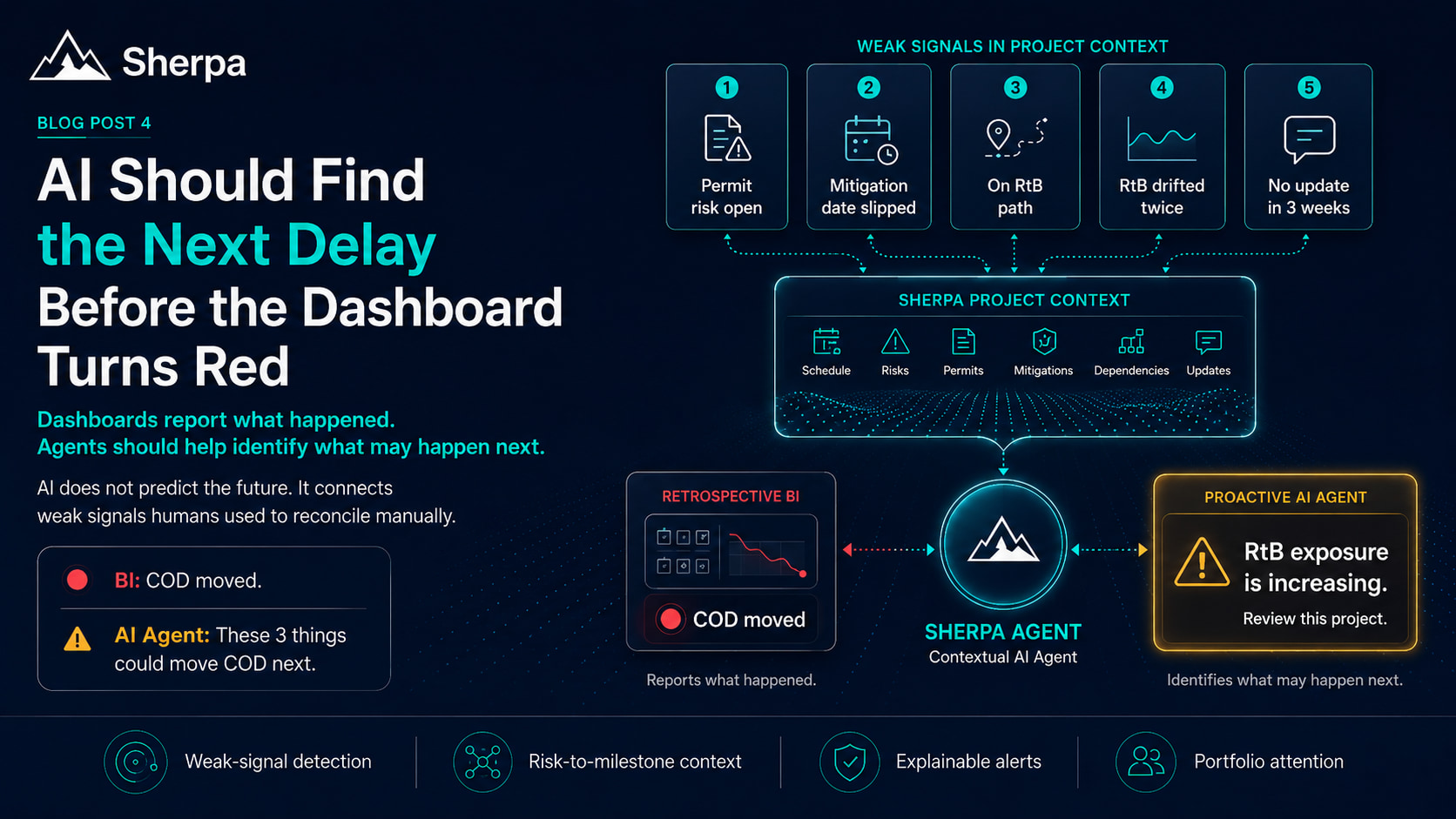
BI reports that Project X is delayed — useful, and late. The interesting question is what happened in the weeks before the box turned red: the open permit risk, the mitigation that slipped again, the RtB that already drifted twice, the three silent weeks. AI should connect those signals while there is still time to act.

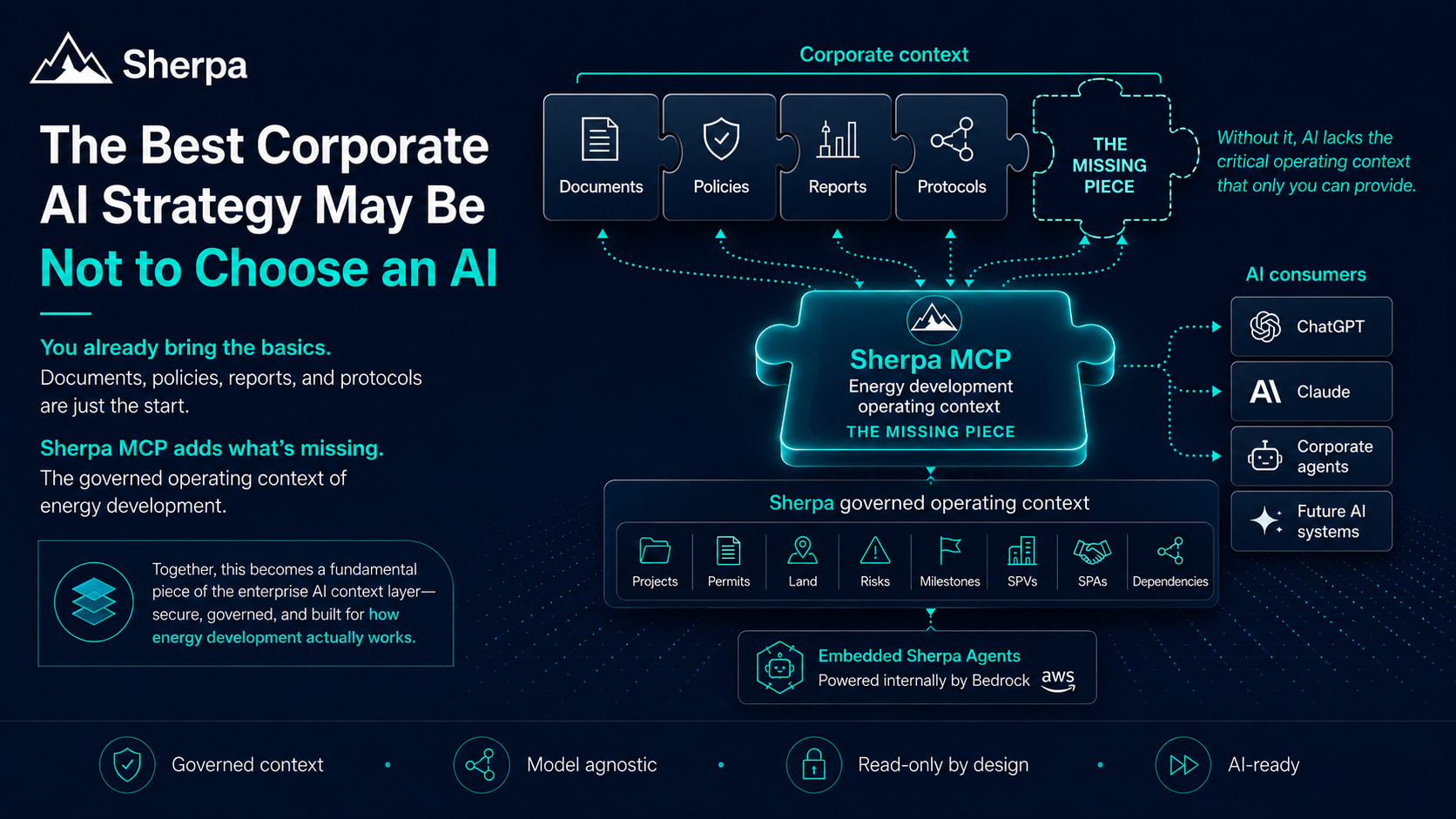
Why the durable enterprise-AI decision may not be the model you choose — but the context you make available to it. Models will change extraordinarily fast; your projects, permits and milestones will remain. Own the context, not the interface.

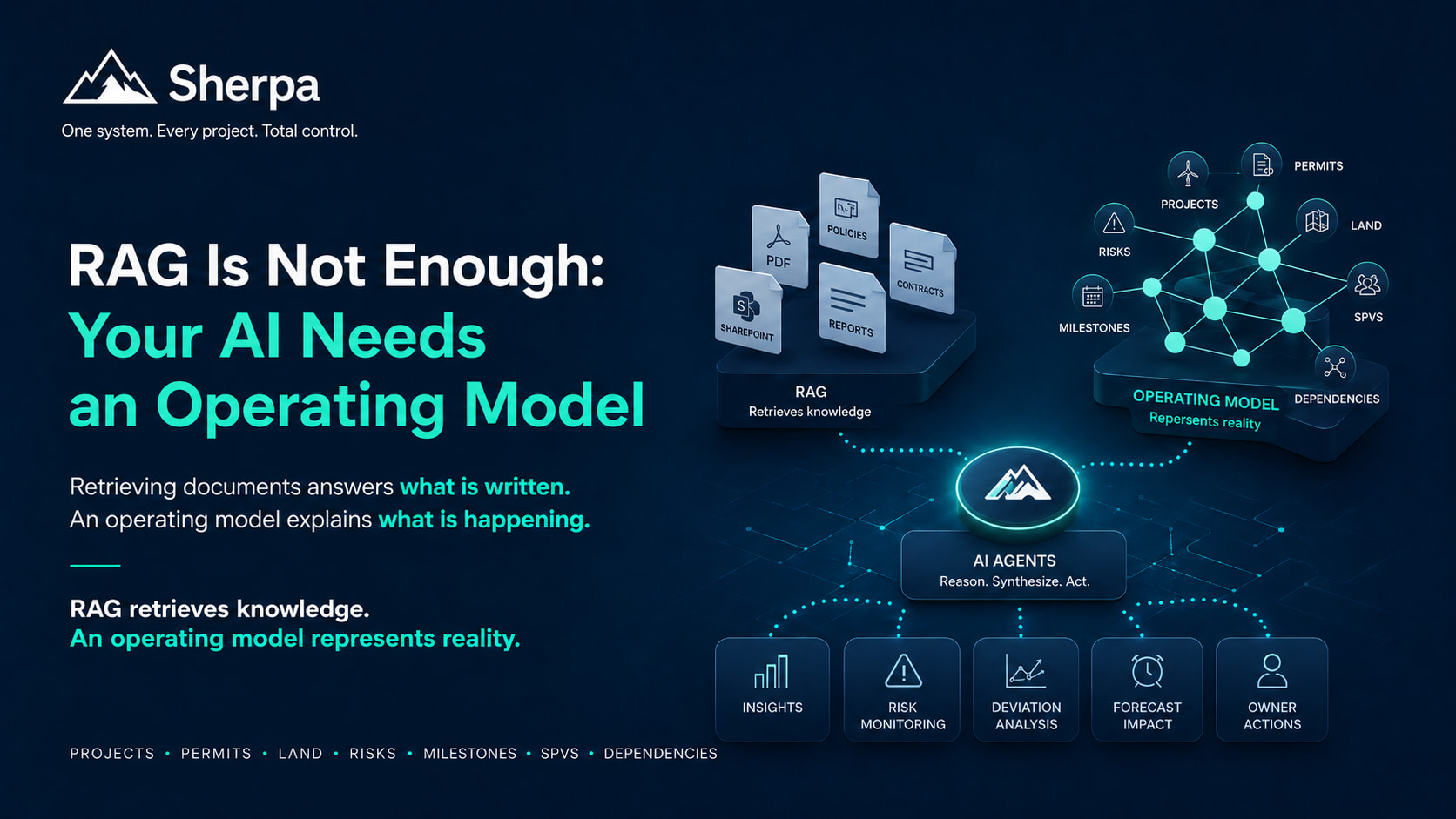
Why enterprise AI needs more than access to documents if it is expected to reason about how the business is actually operating. RAG can tell you what the permit says. It cannot tell you which RtB commitment depends on it, how far the forecast has drifted from baseline, or who owns the mitigation.

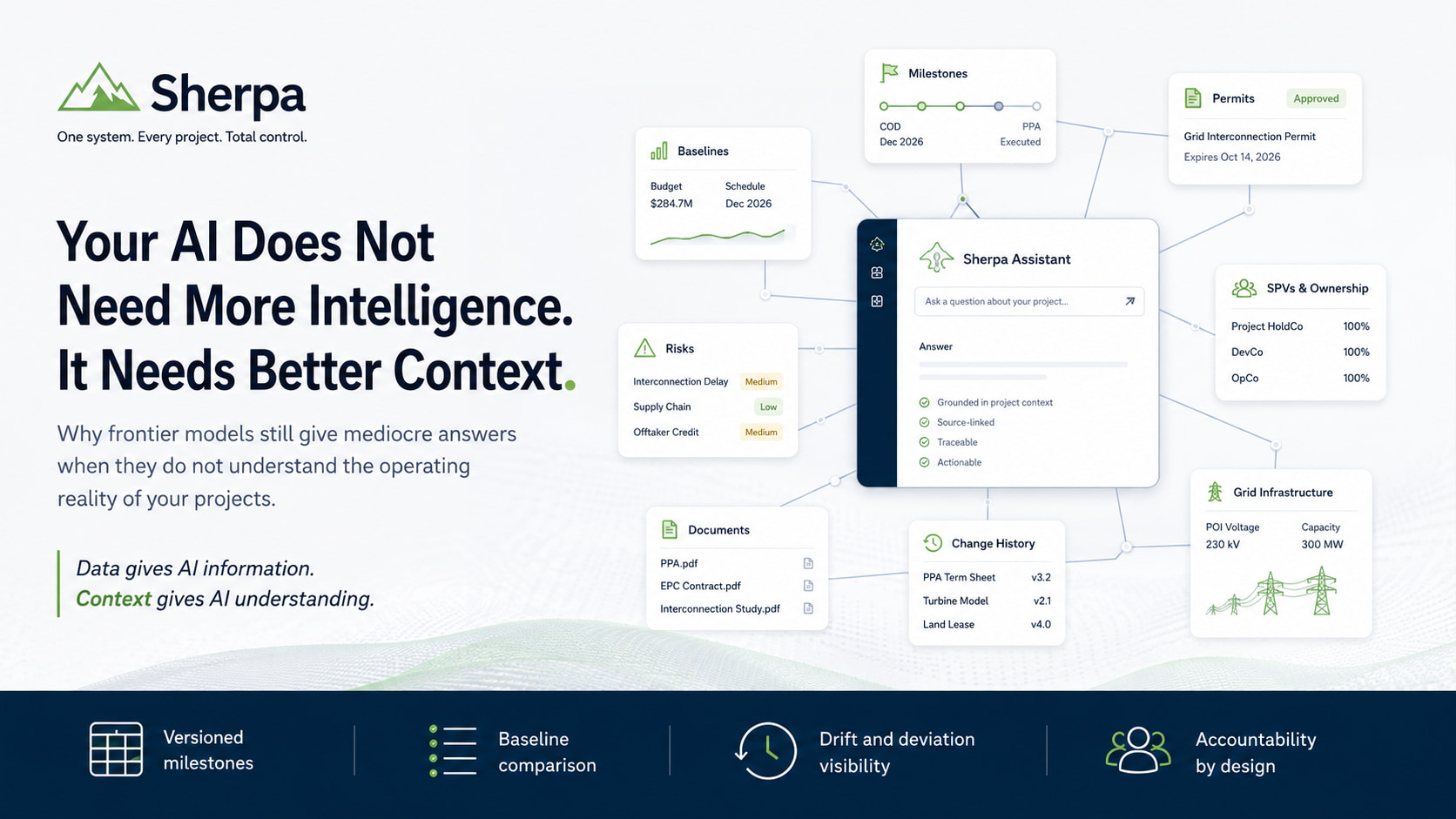
Why frontier models still give mediocre answers when they do not understand the operating reality of your projects. You can give an AI ten million rows of corporate data and it may still not know which RtB date is the current commitment, which permit threatens it, or who moved the forecast last week.

Renewable energy development is not a straight line from origination to COD. Eagles, century-old olive trees, inheritance disputes or a change at the local council can all become part of the critical path — and a risk register disconnected from milestones will not see any of them coming.

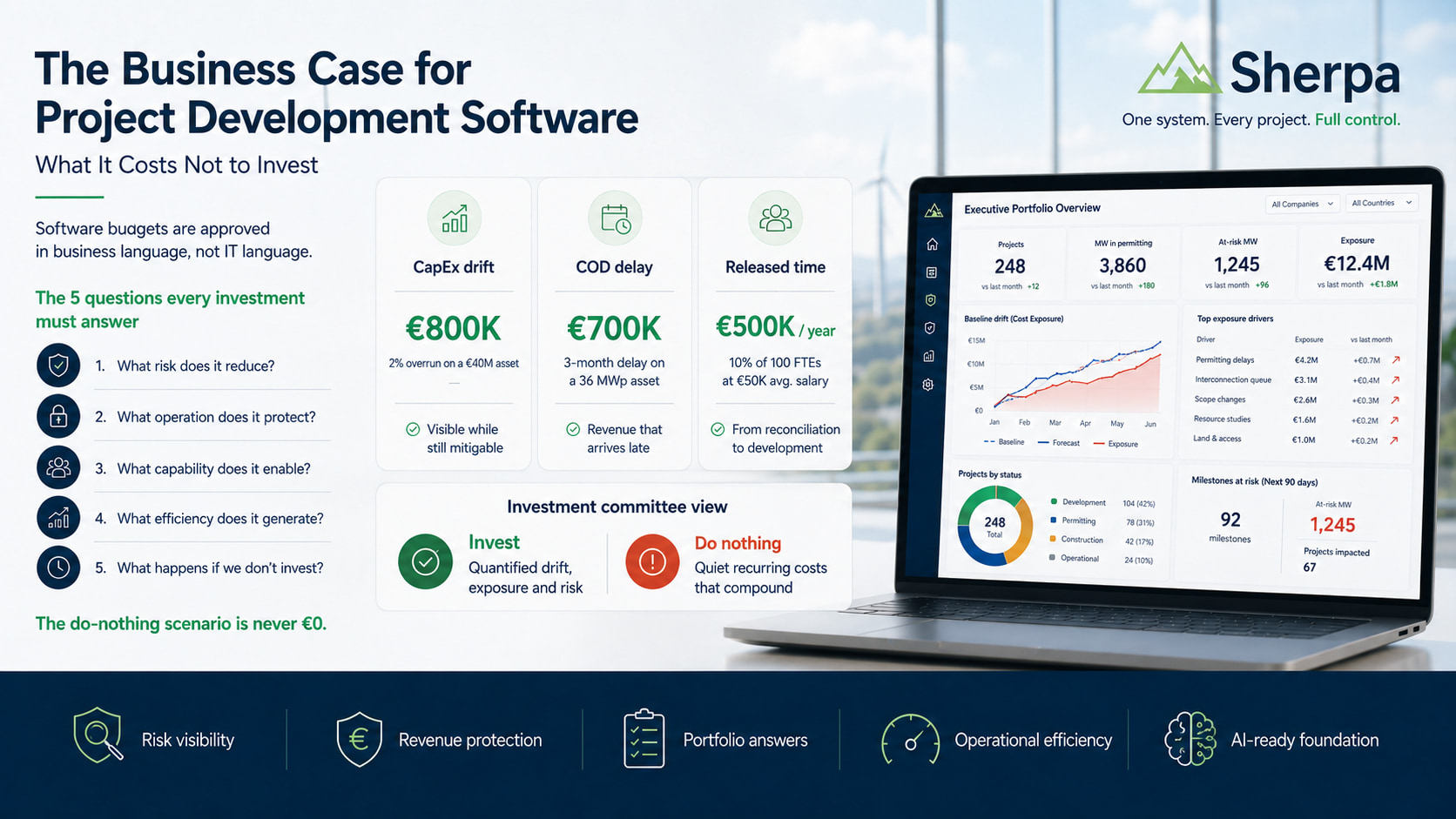
Software budgets are approved in business language, not IT language. The five questions every investment must answer — and a worked business case for project development software, with illustrative numbers a CFO can interrogate.
Ten platforms genuinely worth evaluating for renewable energy project development in 2026, organized by the buyer situation each is best for — with the vendor disclosure up front and no invented scores.
Fourteen tools actually worth shortlisting for permits and land in energy development — land systems, execution platforms, generic PPM with energy verticals, siting intelligence, and development platforms — with an honest account of what each is built for and where it stops.

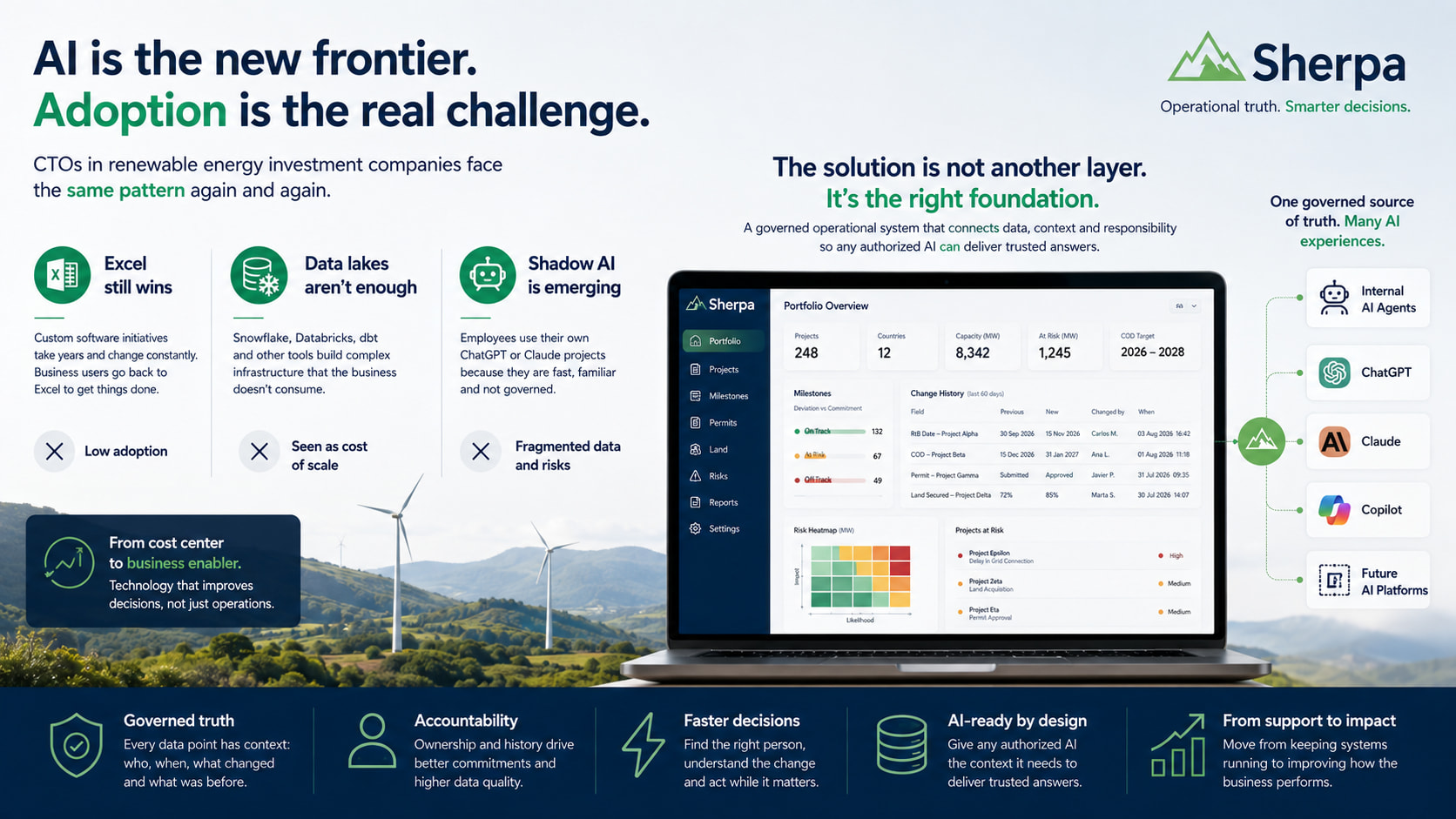
Technology leaders have spent a decade building infrastructure the business barely sees. AI is the chance to change that — or to repeat the same pattern at a higher level of sophistication. The missing layer was never infrastructure. It is governed operational context.

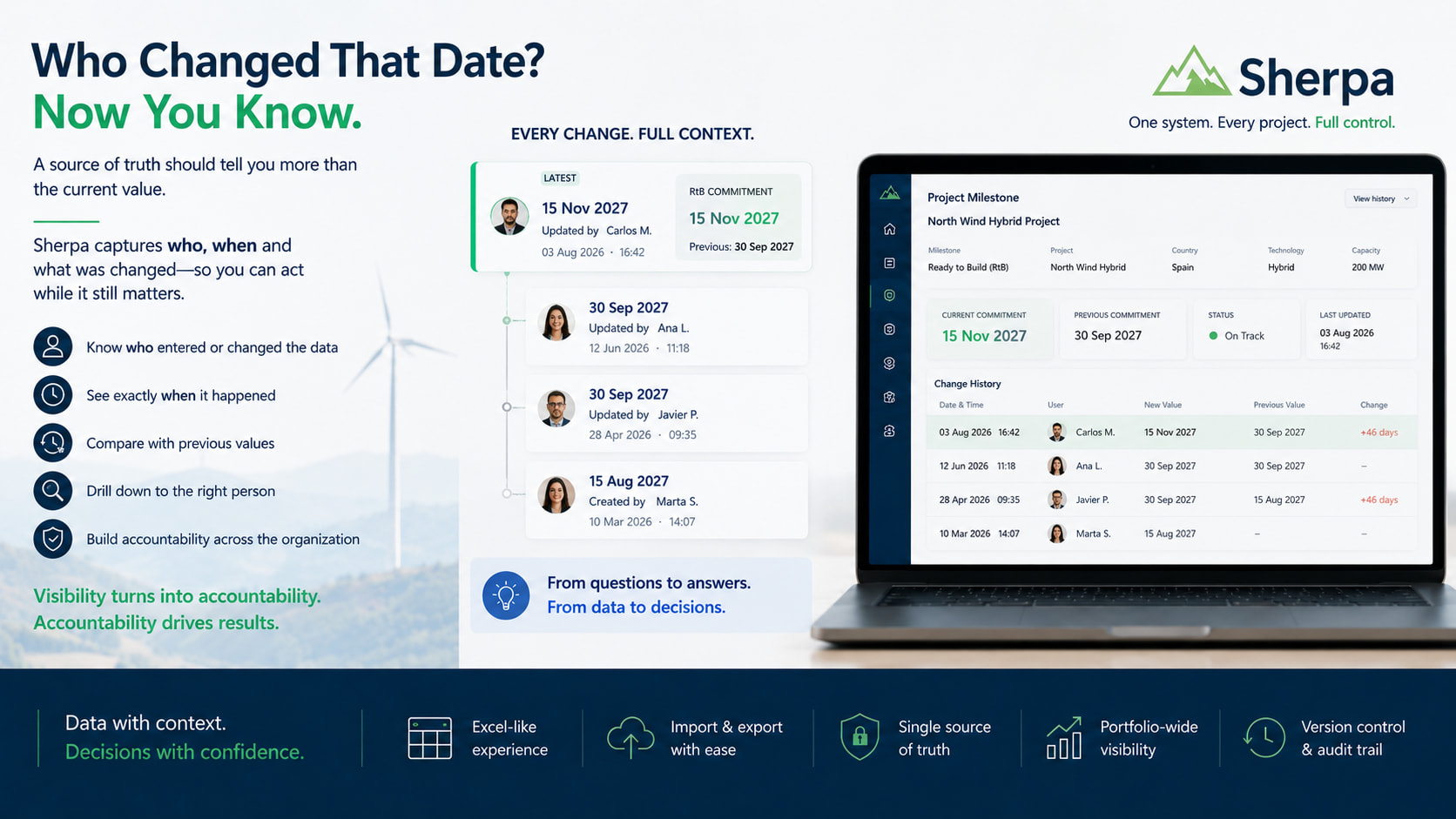
A source of truth tells you what the number is. A governed source of truth tells you who provided it, when it changed, and what it was before — and that difference changes behaviour, not just reporting.
What renewable energy project development software actually is, the six workflows it must support, and the ten questions that separate purpose-built platforms from rebranded project management tools.
Generic project management tools track tasks. Energy project development runs on plots, permits, baselines and SPVs. A dimension-by-dimension comparison of the two approaches.

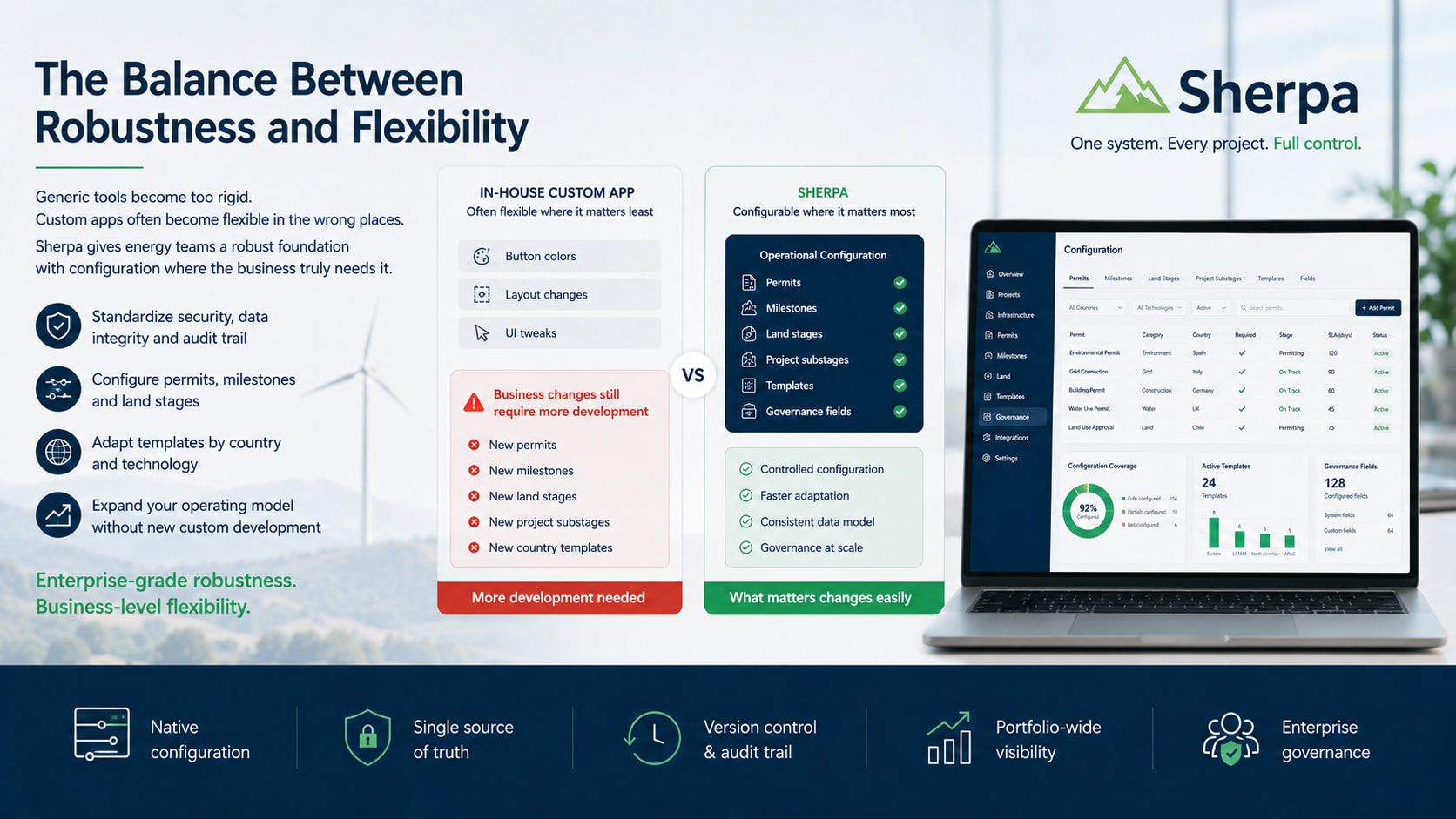
Portfolio governance has traditionally forced energy companies to choose between rigid off-the-shelf tools and endless custom development. Navorda offers a third path.

The hidden risk of AI agents is not that they do too little — it's that they all try to do the same thing. Why Navorda designs its seven Agents on the MECE principle: each agent with a clear job, together covering the full business journey.

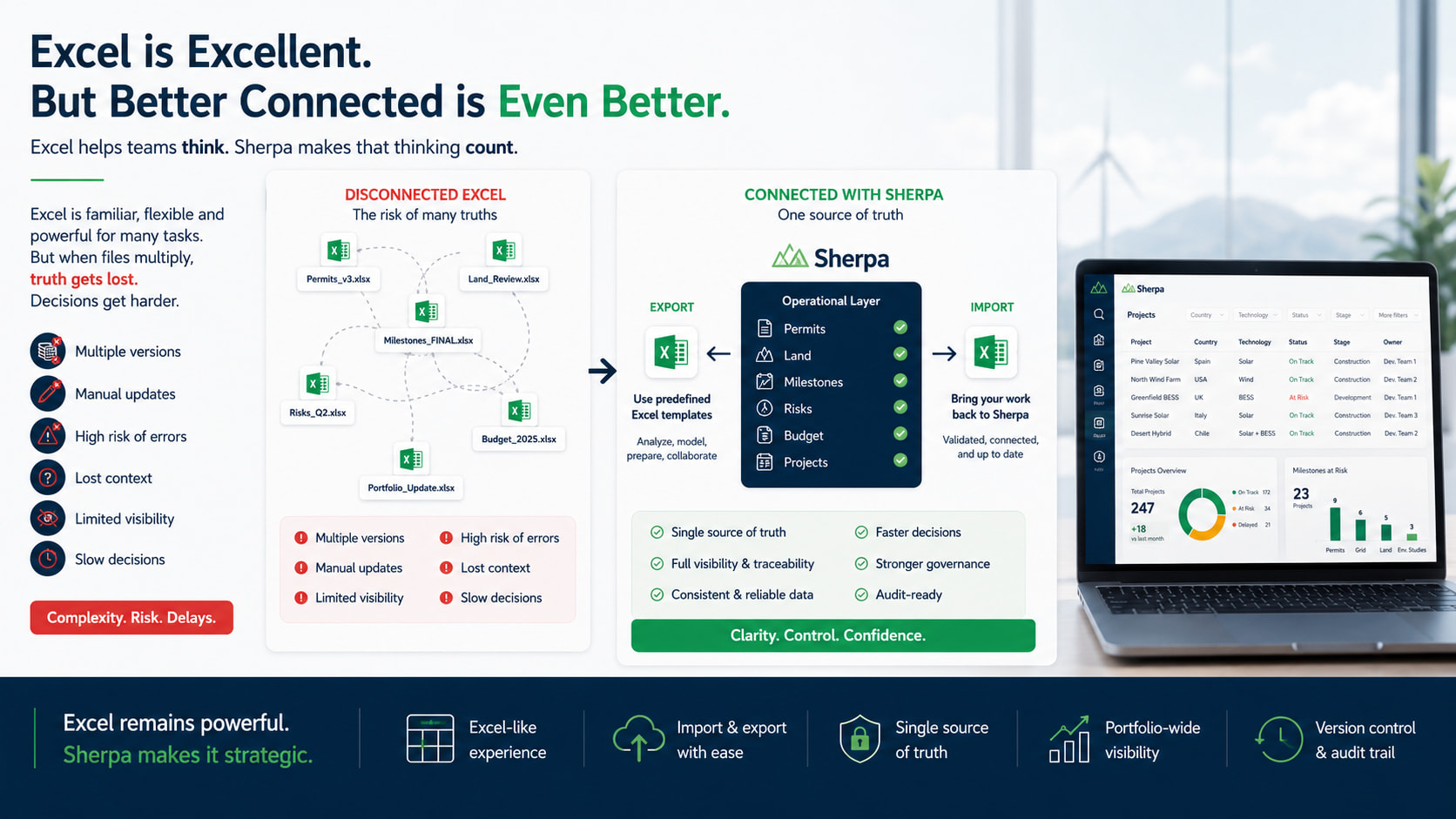
Excel isn't the enemy — it's where teams think. The problem starts when the spreadsheet stops being a workspace and becomes the system of record. Here's how Navorda gives Excel a proper place in the operating model instead of replacing it.

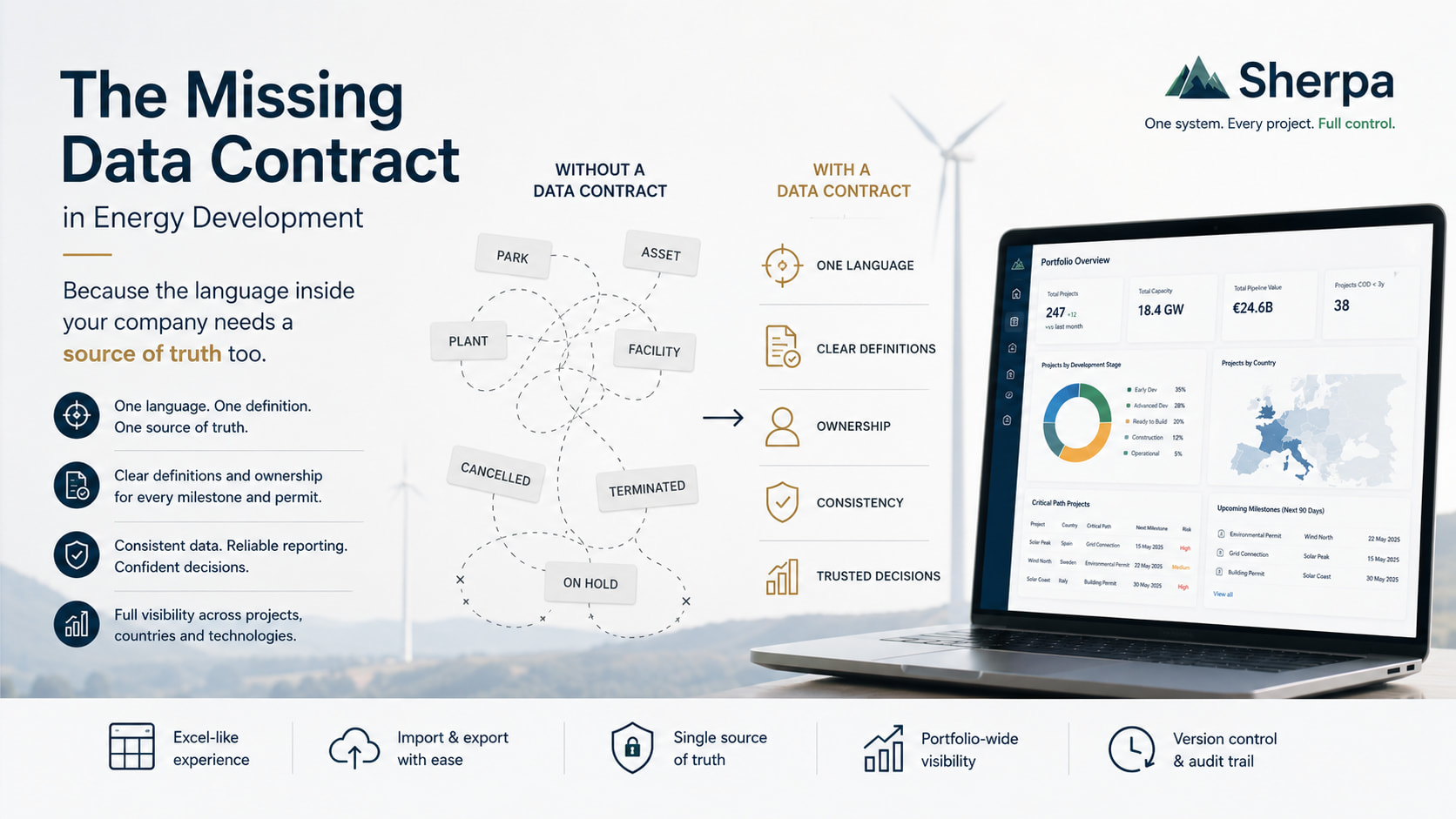
Because the language inside your company needs a source of truth too.

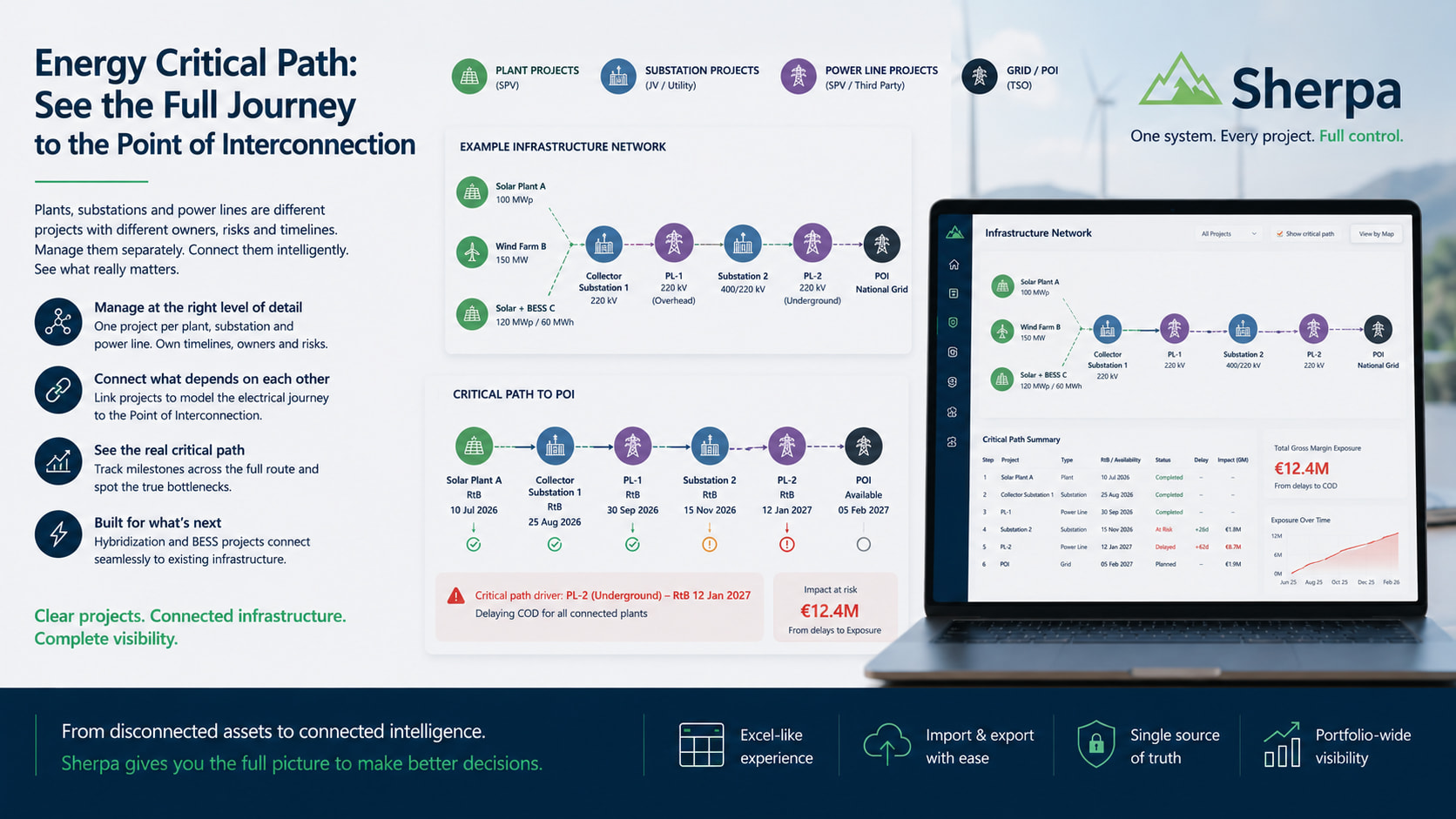
The infrastructure may be connected physically. That does not mean it should be managed operationally as one asset.

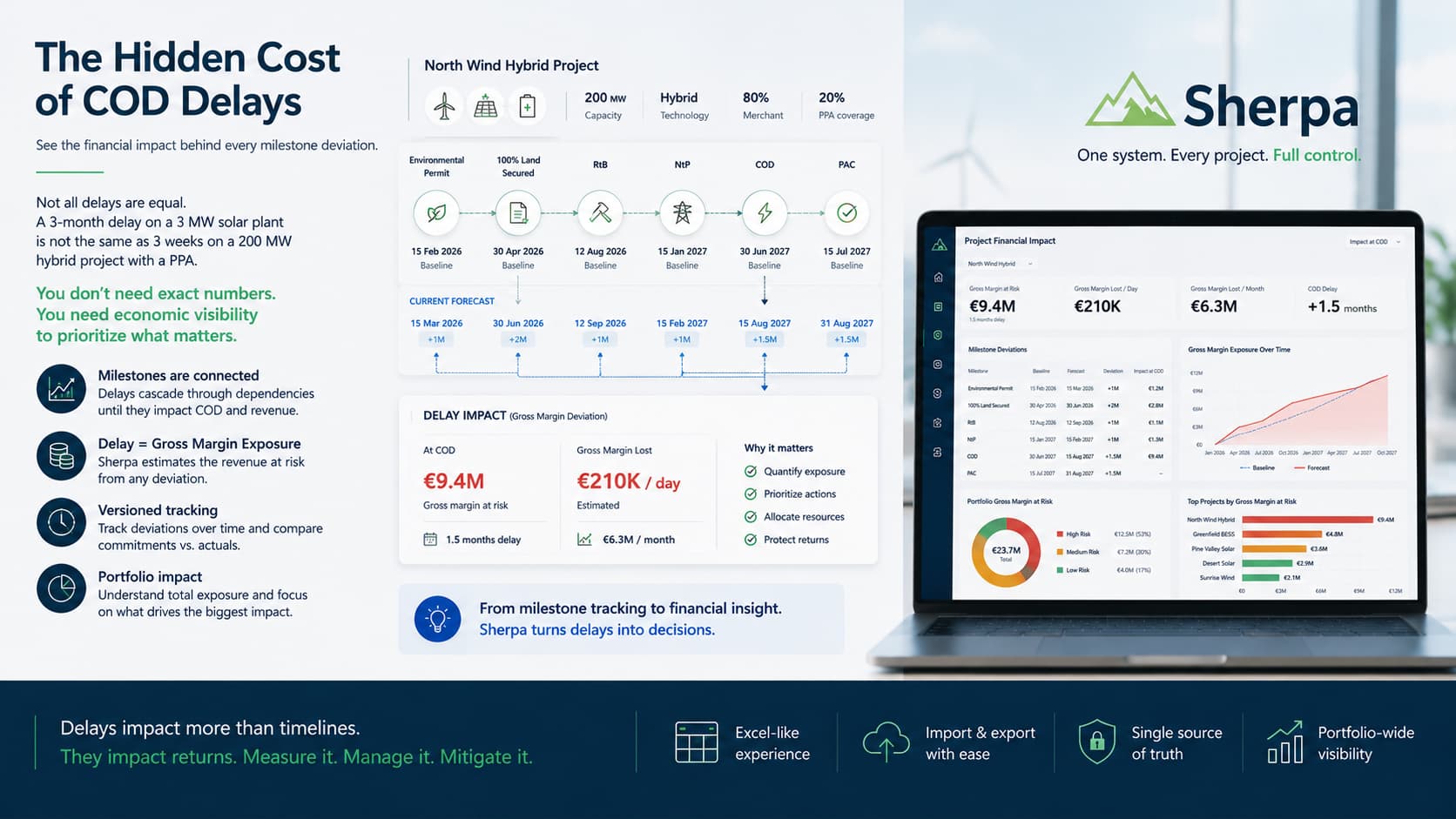
Most organizations can tell you if a project is delayed. Far fewer can tell you what that delay is economically worth — and that distinction reframes how portfolios should be governed.

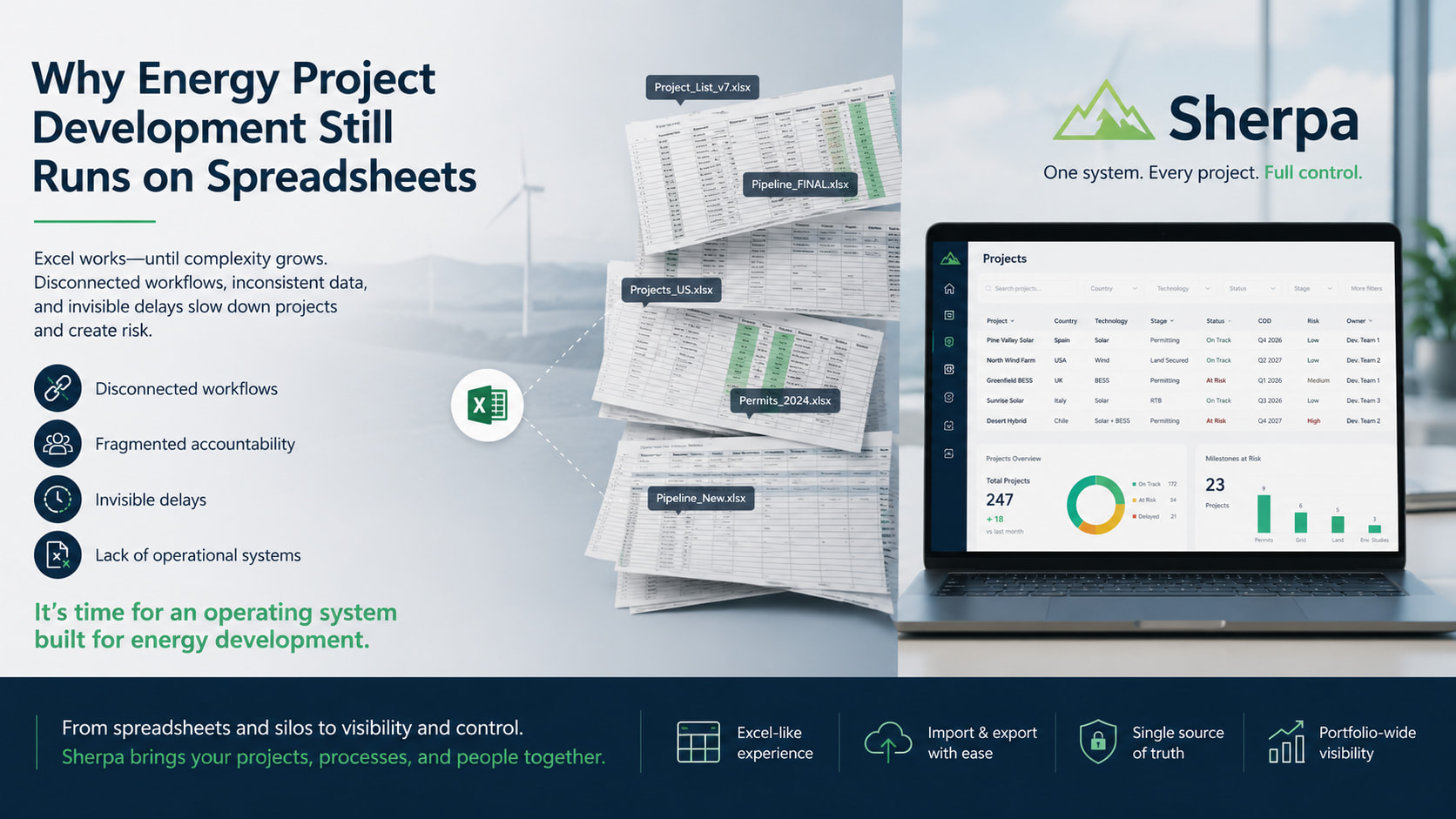
Excel solves a real operational need for project teams — until energy developers grow into multi-country, multi-team portfolios. The fix isn't to replace the spreadsheet experience, but to industrialize it.

A milestone only creates value when ownership, dependencies, baseline and consequences move with it.