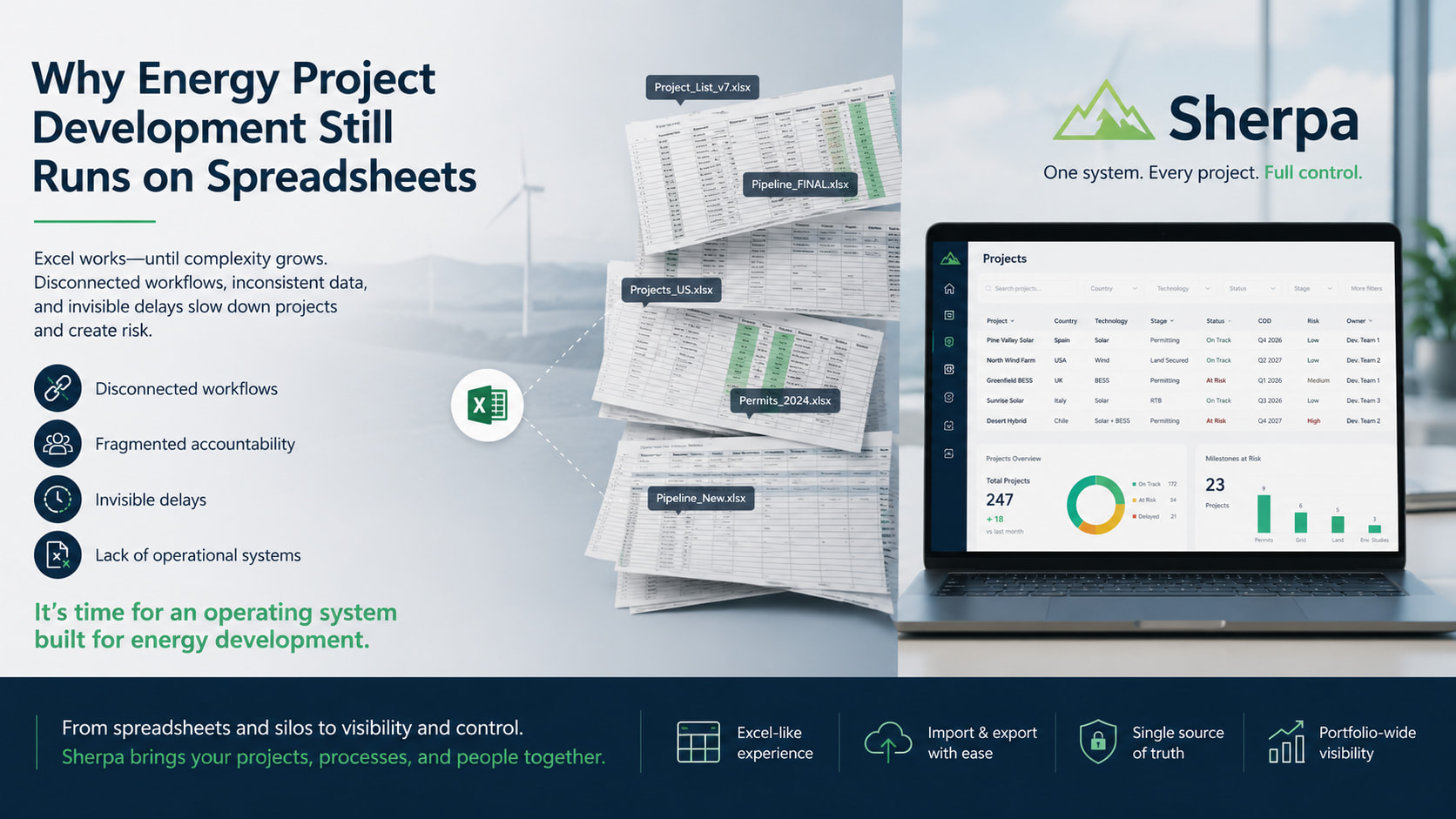
Why Energy Project Development Still Runs on Spreadsheets
Excel solves a real operational need for project teams — until energy developers grow into multi-country, multi-team portfolios. The fix isn't to replace the spreadsheet experience, but to industrialize it.
 Luis Cabello6 min read
The global energy transition is accelerating at unprecedented speed.
Across Europe, the Americas, and Asia, developers are managing pipelines of solar parks, wind farms, BESS facilities, substations, hydrogen hubs, and data center energy infrastructure worth billions of euros.
And yet, behind many of these projects, the operational backbone still looks surprisingly familiar:
- Excel spreadsheets.
- Shared drives.
- Email chains.
- Disconnected GIS files.
- Version after version of "Final_Project_List_v12_REAL.xlsx".
At first glance, this may seem irrational. Why would an industry managing infrastructure at this scale still depend so heavily on spreadsheets?
The answer is simple: because Excel solves a very real operational need exceptionally well.
Excel Is Not the Enemy
Excel gives project developers exactly what they need in the early stages of development:
- A simple grid where projects can be listed
- Flexible columns for relevant information
- Fast filtering and sorting
- Easy copy-paste workflows
- Minimal training requirements
- Immediate adaptability to changing business needs
In practice, Excel became the natural language of project development teams.
Need a new column for permit status? Add it.
Need to sort projects by region? Filter it.
Need to prepare a management update quickly? Export it.
The problem is not that Excel is bad.
The problem is that energy project development eventually grows beyond what spreadsheets were designed to coordinate.
The Real Problem Starts When Organizations Scale
The moment multiple teams, countries, external advisors, engineering firms, and legal departments start collaborating, spreadsheets stop being operational tools and start becoming operational risks.
What usually happens next is predictable.
Different versions of the same spreadsheet begin to appear across the organization.
Each team adapts the structure slightly:
- Different columns
- Different naming conventions
- Different status definitions
- Different milestone criteria
Soon, the organization no longer has one project pipeline.
It has dozens of slightly incompatible interpretations of the same pipeline.
And the issue goes far beyond formatting.
In many organizations, even the rows themselves are no longer consistent.
- Some spreadsheets include only generation assets.
- Others include substations separately.
- Others merge substations into the main project.
- Some teams duplicate projects by phase.
- Others rename projects locally.
- Others track opportunities that no longer exist.
At that point, one of the most fundamental management questions becomes surprisingly difficult to answer:
How many projects do we actually have?
The challenge is no longer data entry.
The challenge becomes operational coordination.
Invisible Delays and Fragmented Accountability
As complexity grows, additional problems emerge:
- Permit dates diverge between departments
- Risks are tracked in isolated files
- Land acquisition progress becomes difficult to consolidate
- Reporting becomes increasingly manual
- Accountability becomes fragmented
- Delays become visible only when they are already critical
Teams spend more time reconciling information than managing execution.
And because spreadsheets are fundamentally passive tools, they cannot provide:
- structured workflows
- version-aware governance
- centralized accountability
- operational traceability
- portfolio-wide visibility
The result is an industry managing increasingly complex infrastructure using systems that were never designed for infrastructure-scale coordination.
Navorda Was Built Around the Reality of How Developers Actually Work
When we started building Navorda, we did not begin by asking:
How do we replace spreadsheets?
Instead, we asked:
Why do developers rely on spreadsheets so heavily in the first place?
That distinction matters.
Because forcing teams into rigid systems with unfamiliar workflows often creates more resistance than value.
Navorda was designed to preserve what developers already like about spreadsheets:
- tabular interfaces
- fast filtering
- flexible navigation
- quick editing
- easy exports
- familiar operational logic
The goal was not to eliminate the spreadsheet experience.
The goal was to industrialize it.
Today, Navorda provides:
- Excel-like navigation experiences
- advanced filtering and configurable views
- map-based operational visualization
- centralized project governance
- version-aware milestone tracking
- structured risk management
- portfolio-wide operational visibility
while still allowing teams to:
- import from Excel
- export to Excel
- work with familiar tabular workflows
This approach dramatically reduces adoption friction.
And in large organizations, reducing friction is often the single most important factor in successfully executing digital transformation.
The Energy Transition Needs Operational Systems
The energy industry is entering a phase where development portfolios are becoming larger, more international, and more operationally complex than ever before.
The next challenge is no longer simply finding projects.
It is coordinating them effectively at scale.
That requires moving from disconnected spreadsheets toward operational systems specifically designed for energy infrastructure development.
Not because spreadsheets failed.
But because the industry has outgrown them.