What’s in Navorda for Me? One Operating Model. Five Very Different Reasons to Care.
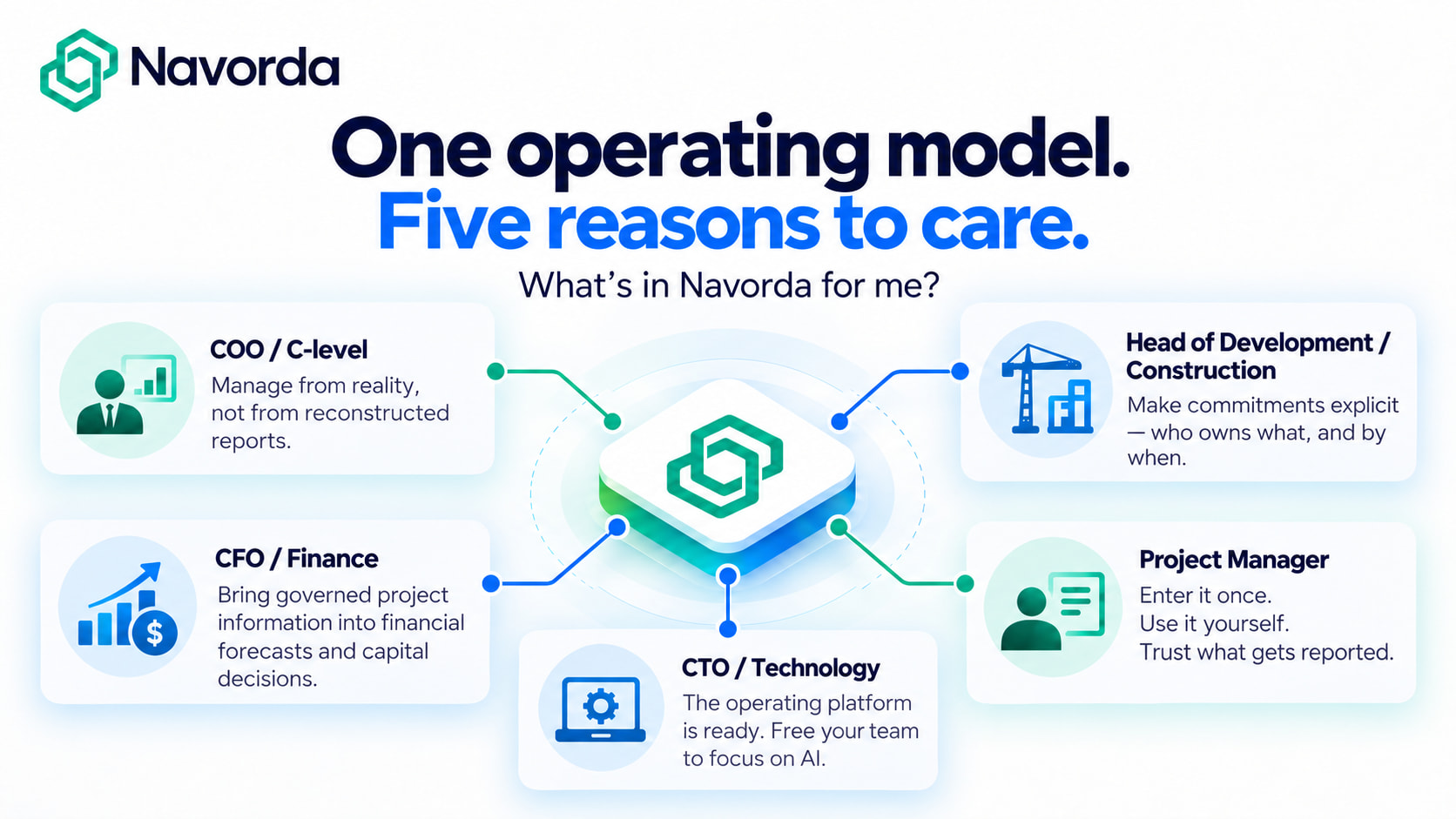
One governed operating model, five perspectives: less duplicated work for Project Managers, clearer commitments for Heads, better decisions for COOs, stronger financial visibility for CFOs and trusted operational context for CTOs.

Enterprise software is usually explained through features.
Milestones.
Dashboards.
Permissions.
Integrations.
AI.
Reporting.
But people do not adopt software because a feature list is impressive.
They adopt it because it makes their own job better.
And that creates an interesting challenge when explaining Navorda.
A Project Manager, a Head of Development, a COO, a CFO and a CTO may all use the same operating model.
But they should not care about it for the same reason.
So perhaps the simplest question is not:
What does Navorda do?
It is:
What’s in Navorda for me?
Project Manager
Enter it once. Use it yourself. Trust what gets reported.
Too many corporate systems ask Project Managers to maintain information primarily so somebody else can report on it.
That is a poor adoption model.
If you are the person closest to project reality, keeping information current should make your own job easier first.
Navorda can provide project structures based on country and technology.
Import from Excel.
Export to Excel.
Work through high-density, spreadsheet-like interfaces.
Make bulk updates.
Manage milestones, permits, risks, dependencies, responsibilities and commitments from the same project context.
The principle is simple:
Enter project reality once. Then use that same reality yourself.
But there is another benefit that matters just as much.
You should know what happens to your information after it leaves your screen.
It should not pass through several reporting layers and eventually reach management as a version of the project you no longer recognize.
Aggregation will change.
Views will change.
But the underlying governed facts should not.
Your project reality should not be reconstructed on its way to management.
Enter it once.
Use it yourself.
Trust what gets reported.
Head of Development / Construction
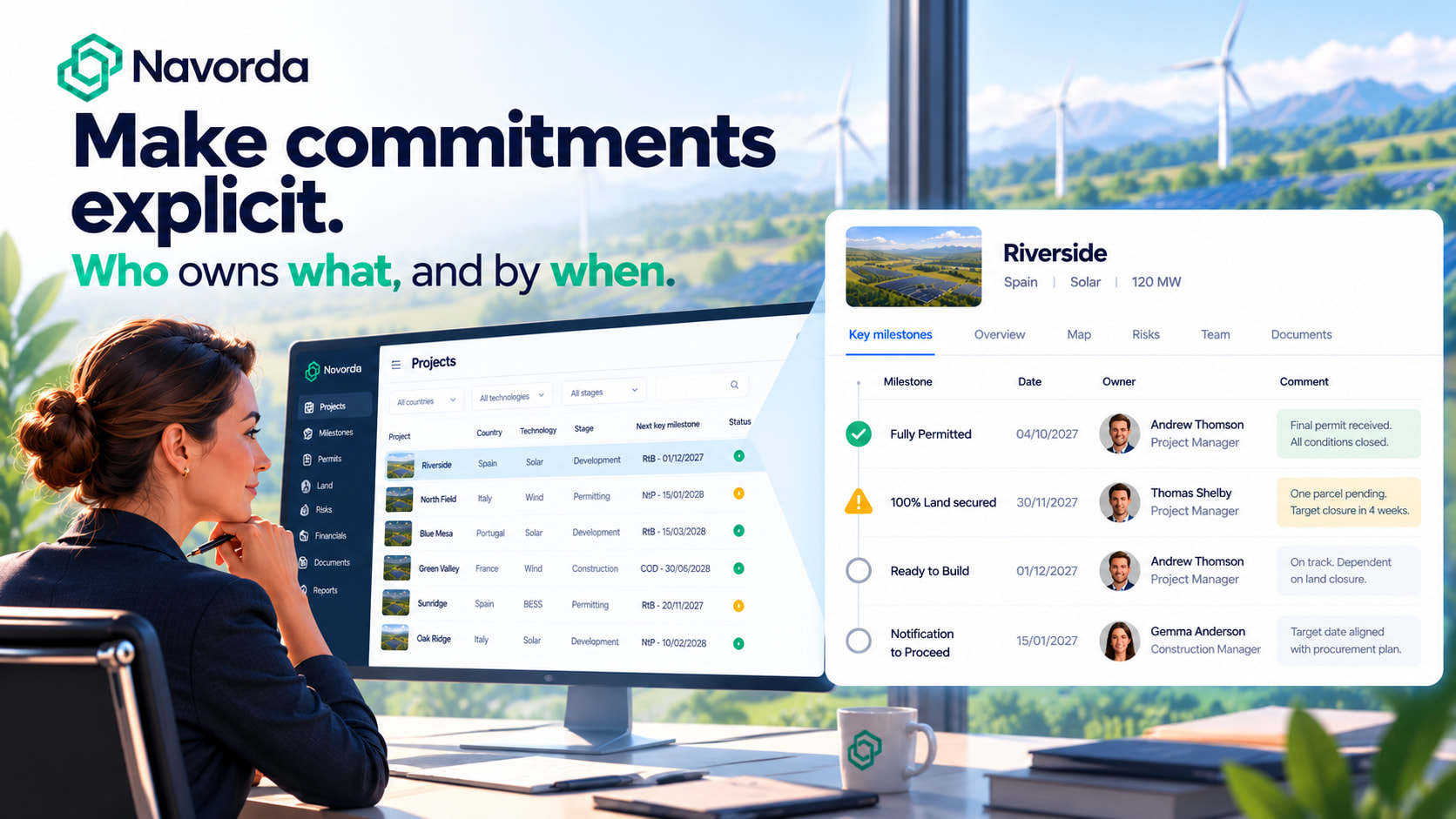
Make commitments explicit across your teams — who owns what, and by when.
A Head of Development or Construction faces a different problem.
The challenge is rarely knowing whether people are busy.
They are busy.
The challenge is keeping hundreds of commitments across projects and teams explicit.
Who owns this?
What exactly was agreed?
By when?
What depends on it?
What changed?
Where does management need to intervene?
At small scale, experienced managers can keep much of that context in their heads.
At portfolio scale, commitments start spreading across meetings, emails, trackers and individual memory.
Navorda makes that context explicit.
Ownership stays visible.
Deadlines remain connected.
Dependencies are governed.
Changes retain history.
Risks stay connected to what they threaten.
And management can see not only whether a project is green, amber or red.
It can understand how that outcome is being governed.
That gives the Head something stronger than:
“My team is working hard.”
It allows them to say:
This is what my team is governing. These are the commitments we are protecting. This is what changed. And this is where we need management support.
Who.
What.
When.
Always known.
COO / C-level
Manage from reality, not from reconstructed reports.
As companies scale, management naturally gets further away from execution.
That is not a management failure.
It is a consequence of growth.
More projects.
More countries.
More technologies.
More people.
More dependencies.
The COO increasingly experiences the organization through reports, meetings, presentations, escalations and summarized portfolio views.
But before those views exist, somebody often has to reconstruct reality.
Collect updates.
Reconcile figures.
Interpret changes.
Resolve discrepancies.
Prepare slides.
That introduces both effort and distance.
Navorda’s opportunity for C-level is therefore not simply:
another dashboard.
It is:
less reconstruction of reality before management can act.
A permit moves.
The affected milestone remains connected.
Dependencies remain visible.
Risks remain linked to what they threaten.
Commitments retain ownership.
The context behind a change travels upstream with the change itself.
Management can spend less time asking:
“Can someone prepare the latest view?”
and more time asking:
“Where do we need to act?”
The objective is simple:
Manage from reality, not from reconstructed reports.
CFO / Finance
Bring governed project information into financial forecasts and capital decisions.
A CFO looks at the same portfolio through a different lens.
The Project Manager sees a delayed permit.
The Head of Development sees a milestone at risk.
The COO sees a commitment that may not be delivered.
But the CFO sees something else.
A procurement payment that may move.
A capital call that may be required later than expected.
A debt drawdown that may need to be rescheduled.
A financial model whose assumptions may no longer reflect the project.
Because in energy development, operational milestones are also financial events.
And this creates a problem that many organizations know well.
Development manages dates.
Finance manages euros.
Both have sophisticated tools.
But the relationship between them is often maintained through meetings, spreadsheets, emails and reporting procedures.
Consider a project expecting NtP in January.
Its financial forecast includes equipment procurement, construction payments and funding requirements based on that assumption.
Now suppose NtP moves to April.
What happens to the forecast?
In many organizations, someone must notice the change, understand its financial implications, contact Finance, reconcile the assumptions and update the relevant models.
Until that happens, the development schedule and the financial forecast may describe two different realities.
The challenge is not necessarily a lack of financial software.
And the answer is not to replace the ERP or the complex Excel models Finance already trusts.
The opportunity is to connect those systems to a governed operational context.
What milestone does this financial commitment depend on?
Which project version produced this assumption?
Has the permit that gates procurement moved?
Which forecast figures may now need review?
Which risks threaten the expected cash flow?
Which project assumptions were used when the investment committee approved the business case?
Navorda Finance — forecasts, commitments and funding status on the project they belong to
This becomes especially relevant when financing growth.
Lenders and investors need credible information about the assets behind their capital.
Project progress.
Permits.
Land rights.
Contractual commitments.
Construction readiness.
Forecast assumptions.
Risks and deviations.
Much of that information originates outside Finance.
The more reliably it is governed, the easier it becomes to prepare financing discussions, support due diligence and explain how operational changes affect the investment case.
And there is another important distinction.
Complex financial models should often remain in Excel.
They are specialist calculation engines built around thousands of formulas, scenarios and sensitivities.
Replacing them with another application can create more cost than value.
But the assumptions entering those models and the critical outputs coming out of them should not remain disconnected from the business reality they represent.
Navorda’s role is to govern that connection.
The financial model calculates.
The ERP records accounting reality.
Navorda governs the project context behind financial commitments and assumptions.
External Models Governance — keep the model, govern what goes in and what matters coming out
Don’t Replace Your Excel Deep-Models. Govern Their Outputs.
The result is not the elimination of financial judgment.
It is better information for exercising that judgment.
For the CFO, the proposition becomes:
Bring governed project information into financial forecasts and capital decisions.
Because a financial forecast can only be as reliable as the operational assumptions behind it.
Navorda for CFOs & Finance Leaders — what’s in Navorda for Finance
CTO / Technology
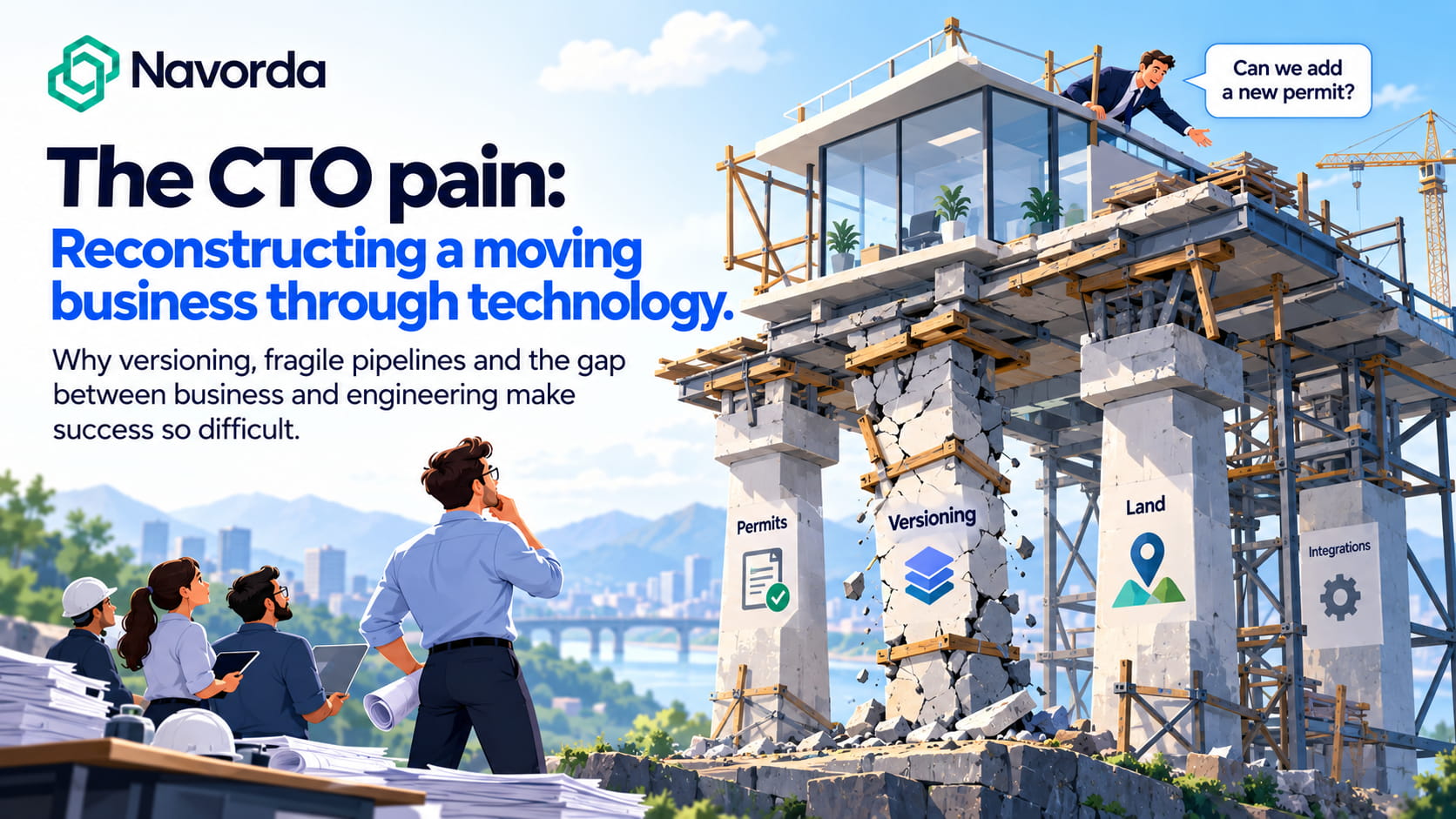
Stop rebuilding the business in software.
Technology leadership sees the same organizational complexity from a very different angle.
A new country introduces a different development process.
Development needs a permitting workflow.
Land needs another tool.
Finance needs project context.
Management needs portfolio reporting.
Then all of those things need to talk to one another.
Each request is reasonable.
But one reasonable request at a time, the technology team can end up maintaining an increasingly complex representation of how the business operates.
Custom applications.
Integrations.
Data pipelines.
Transformations.
Semantic models.
Reporting infrastructure.
And then the business changes again.
The issue is not that technologies such as enterprise data platforms, Power BI, integration tools or custom development are bad.
They solve real problems.
Those architecture decisions were often rational responses to fragmentation. Navorda changes the underlying conditions that made some of that complexity necessary.
The question is whether those technologies should also have to reconstruct the operating model of the business.
Your data platform shouldn’t have to reconstruct your business.
If projects, permits, milestones, dependencies, risks, ownership, commitments and financial context already exist as connected business objects, downstream technology can consume that context rather than continually rebuilding it.
That changes the CTO’s opportunity.
Instead of asking:
“What application does the business want us to build next?”
the conversation becomes:
“What operating foundation should the business have so it can keep evolving?”
Specialist systems can remain specialist systems.
ERP can remain ERP.
Treasury can remain treasury.
Power BI can remain an excellent consumption layer.
Enterprise data platforms can continue doing what they are good at.
Navorda provides the governed operational context connecting them.
One operational model. Many consumers.
And this becomes particularly important for AI
Enterprise AI does not become useful simply because it has access to more documents or another data lake.
It needs context it can trust.
Which project?
Which version?
Which owner?
Which milestone?
Which permit?
What changed?
What depends on it?
Which value is authoritative?
Who owns the next decision?
Navorda maintains those relationships as part of the operating model.
That governed context can then be consumed through Navorda Connect and the Navorda MCP Connector rather than independently reconstructed for every new AI use case.
So the CTO gains both: faster adaptation to business change, and AI built on context it can trust.
The goal is not less technology.
It is to use technology where it creates the most value.
Buy the operating model. Build the differentiation.
Five roles. One governed reality.
These benefits look very different.
But underneath them is the same mechanism.
The Project Manager maintains reality.
The Head governs commitments around it.
The COO makes decisions from it.
The CFO connects that reality to financial forecasts, capital requirements and investment decisions.
The CTO ensures systems and AI can consume it.
That is why Navorda is not simply another project-management application.
And it is not another reporting layer.
It is the governed operating context connecting execution and management as the organization scales.
| Role | What’s in Navorda for me? |
|---|---|
| Project Manager | Enter it once. Use it yourself. Trust what gets reported. |
| Head of Development / Construction | Make commitments explicit across your teams — who owns what, and by when. |
| COO / C-level | Manage from reality, not from reconstructed reports. |
| CFO / Finance | Bring governed project information into financial forecasts and capital decisions. |
| CTO / Technology | Stop rebuilding the business in software. |
Which one sounds most familiar?
The best way to understand whether Navorda fits your organization is probably not to start with a generic product demo.
Start with a 20-minute conversation about your priorities. No preparation or confidential project information needed.
Tell us how reality currently moves between project execution, functional leadership, management, finance and technology.
We can talk through what already works, what depends unnecessarily on manual reconstruction or custom infrastructure, and where a governed operating model could genuinely add value.
Navorda for Project Managers — enter it once, use it yourself, trust what gets reported
Navorda for Heads of Development / Construction — make commitments explicit across your teams
Navorda for COOs — manage from reality, not from reconstructed reports
Navorda for CTOs — stop rebuilding the business in software
Navorda Platform — the governed project reality all five roles work from
Enter it once. Use it yourself. Trust what gets reported. — the Project Manager chapter
The CTO pain: Reconstructing a moving business through technology — the CTO / Technology chapter
The Invisible Governance Heroes — the people currently holding your operating model together
Start from your priorities — not from a generic demo.