
Don’t Replace Your Excel Deep-Models. Govern Their Outputs.
Some Excel files contain years of expertise. Digital transformation should not destroy what already works.
 Luis Cabello4 min read
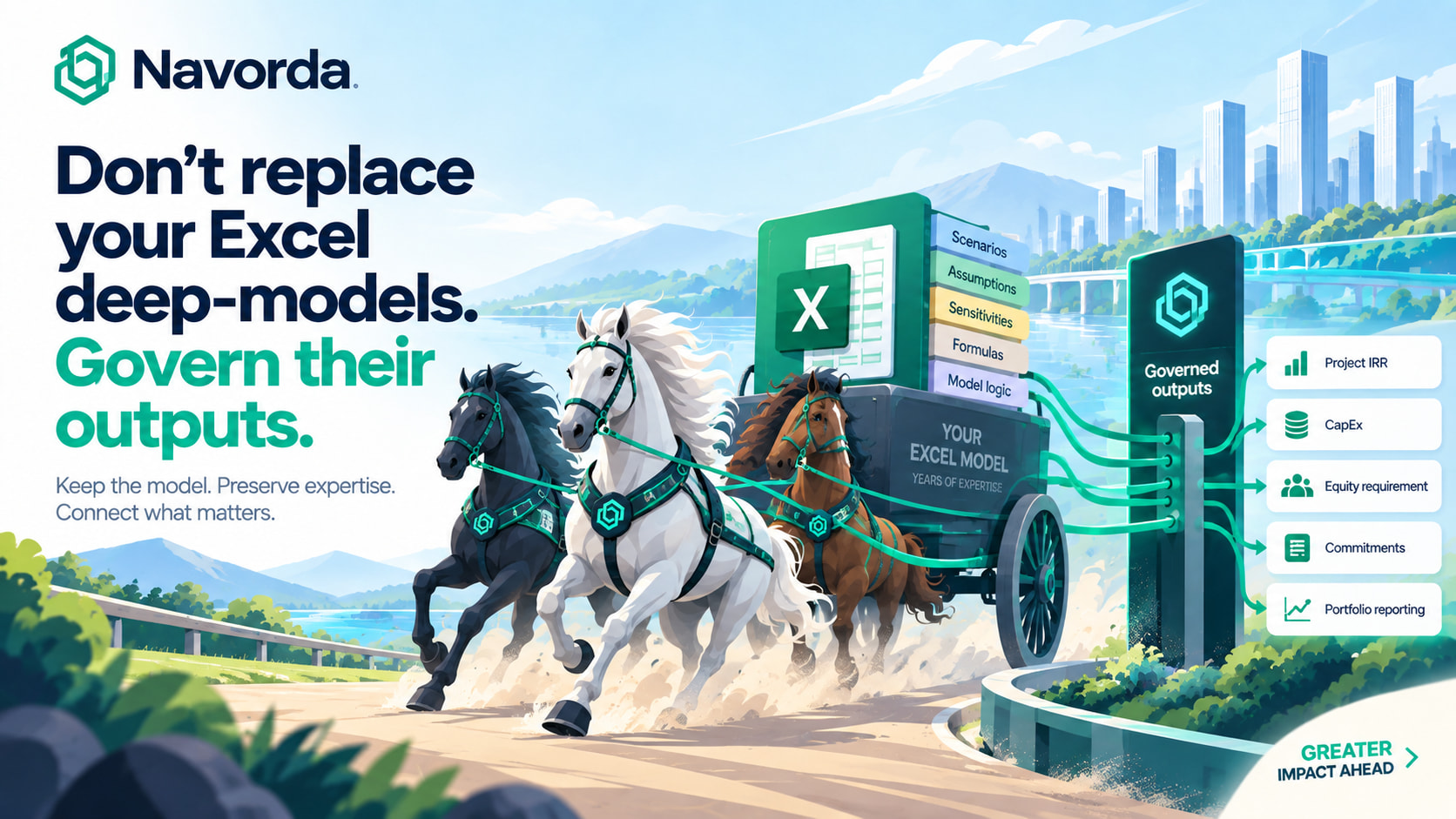
In the previous article, we argued that Excel is often not the problem.
Excel Isn’t the Problem. It’s the Symptom. — the previous article
Spreadsheets frequently appear because the operating model has gaps: missing ownership, disconnected information, unclear commitments or manual reconciliation.
But there is an important second part to that argument:
Some Excel files should not be replaced at all.
A sophisticated financial model is a good example.
It may contain thousands of formulas, assumptions, sensitivities and scenarios built over years.
It may accommodate different technologies, countries, financing structures and investment cases.
And, importantly, the people who own it understand exactly how it behaves.
Trying to rebuild all of that inside a corporate application can sound like digital transformation.
Sometimes it is simply rebuilding something that already works.
The financial model is often not the problem
Consider a project financial model.
Its job may be to transform hundreds of assumptions into a set of outputs such as:
- Project IRR.
- CapEx.
- Equity requirement.
- Financing needs.
- Expected cash flows.
- Valuation.
Excel can be exceptionally good at this kind of work.
The problem begins somewhere else.
A project changes.
NtP moves from March to June.
Installed capacity changes.
A new CapEx assumption is approved.
COD is revised.
But the financial model still contains the previous assumptions.
Nothing is technically broken.
Every formula works.
The workbook opens normally.
The calculations are perfectly correct.
They are simply calculating the wrong reality.
And that is a governance problem.
Then the output becomes a corporate commitment
Now look at the other side of the model.
The model calculates a Project IRR.
Or a €42 million CapEx.
Or an equity requirement.
That figure is copied into a presentation.
It reaches the Investment Committee.
It appears in the portfolio report.
Perhaps it is eventually communicated to an investor, lender or partner.
At some point, a cell inside an Excel workbook stops being just a calculation.
It becomes a corporate figure.
And then some very reasonable questions appear:
- Which workbook did this number come from?
- Which version?
- Which cell?
- What was the value at the time it was approved?
- Has the model changed since?
- Are the assumptions behind it still aligned with the project?
Those questions do not require rebuilding the financial model.
They require governing its relationship with the rest of the organization.
Govern both sides of the model
This is the approach behind External Models Governance in Navorda.
The specialist model remains the specialist model.
Navorda does not need to reproduce thousands of formulas to govern the information around them.
Instead, governance can happen on both sides.
What goes in
A model may assume:
NtP: 15 March
But the official project milestone in Navorda has moved to:
NtP: 30 June
Navorda can detect that the assumption used by the external model no longer reflects the governed project data.
The message is not:
Your formula is wrong.
It is:
The model is using an assumption that no longer reflects current project reality. Its outputs may be stale.
That is a very different problem.
What matters coming out
A critical output such as Project IRR or CapEx can be connected directly to the cell where it is calculated.
That creates traceability between:
Workbook → version → cell → calculated value → governed corporate figure.
The spreadsheet remains the calculation engine.
Navorda governs when its output becomes part of the company’s operating context.
Digitalization should not mean rebuilding everything
There is a temptation in enterprise software to assume that stronger governance requires moving every process into one application.
It does not.
In fact, that approach can create a new problem.
The corporate system gradually tries to replicate every exception, scenario and calculation that specialists already manage effectively elsewhere.
The system becomes more complex.
Changes become slower.
Specialists lose flexibility.
And eventually someone opens Excel again.
Not because users resist digitalization.
But because Excel may still be the better tool for that particular job.
Good architecture should recognize that.
The objective is not one tool
The objective is a governed operating model.
Sometimes that means replacing a spreadsheet because it is compensating for missing structure.
Sometimes it means integrating a specialist system.
And sometimes it means keeping an Excel model exactly where it is.
The important question is:
What needs to be governed?
For an external financial model, that may mean knowing:
- Which version is authoritative.
- Whether its assumptions still match corporate reality.
- Where a critical output came from.
- When that value changed.
- Which corporate commitments now depend on it.
None of that requires Navorda to become Excel.
Keep the model. Govern what matters.
Digital transformation should not become a competition to replace every tool people already use.
A more robust approach is to understand what each tool is good at — and govern the interfaces where information becomes important to the wider organization.
For complex external models, that means a simple principle:
Keep the model. Govern what goes in — and what matters coming out.
That is the idea behind External Models Governance in Navorda.
Excel Is Excellent — why spreadsheets win, and where they stop