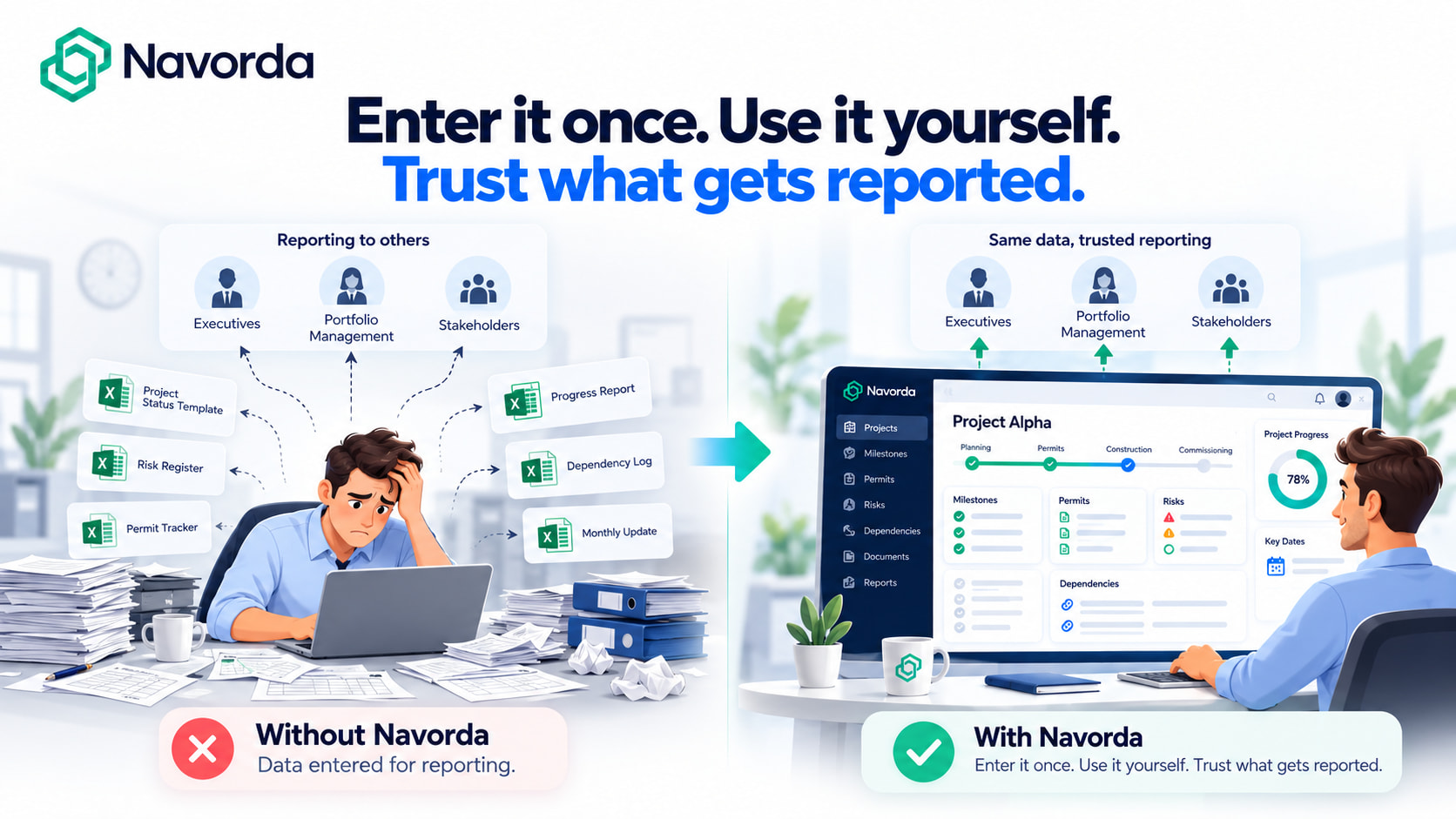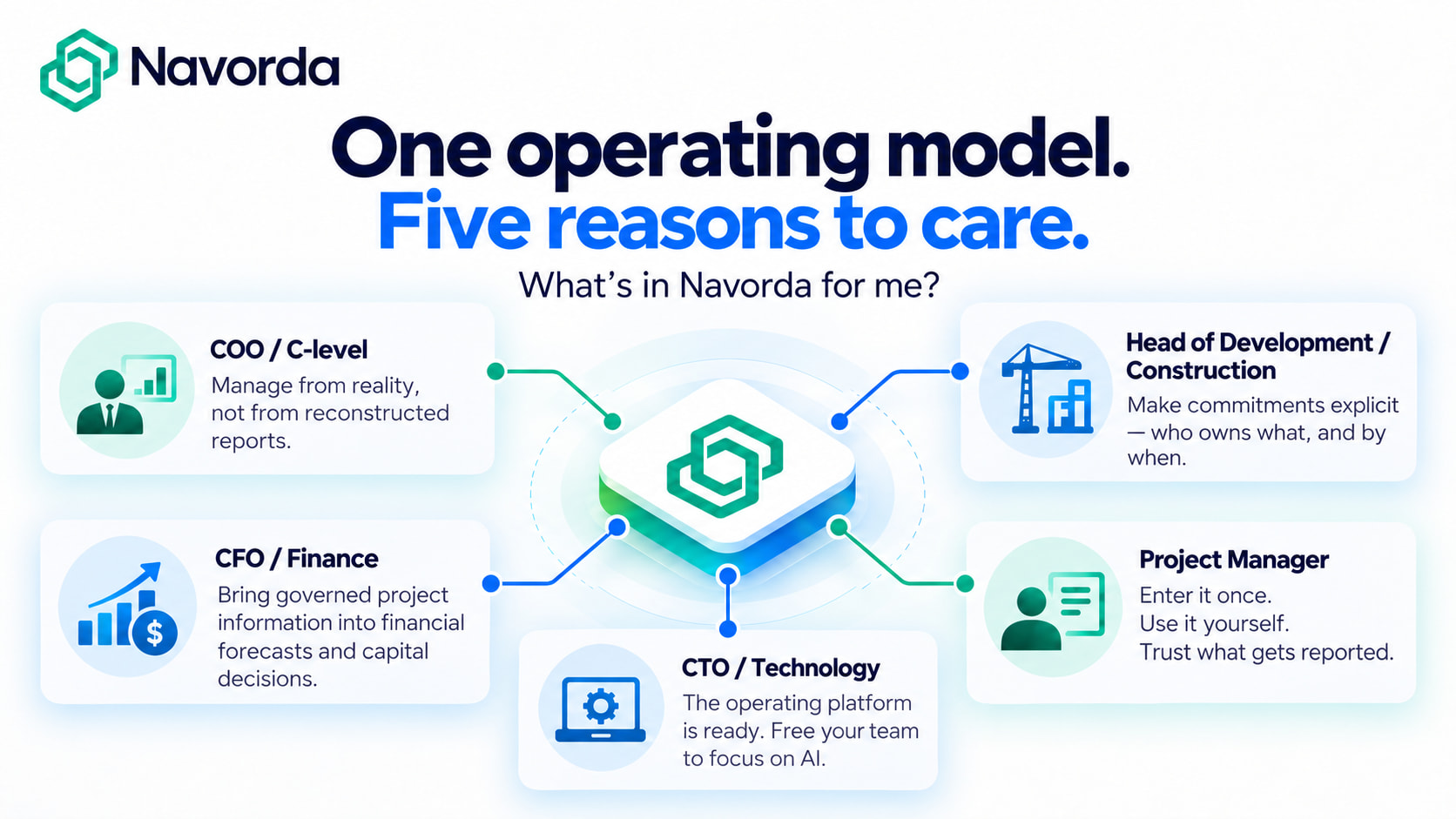
Excel Isn’t the Problem. It’s the Symptom.
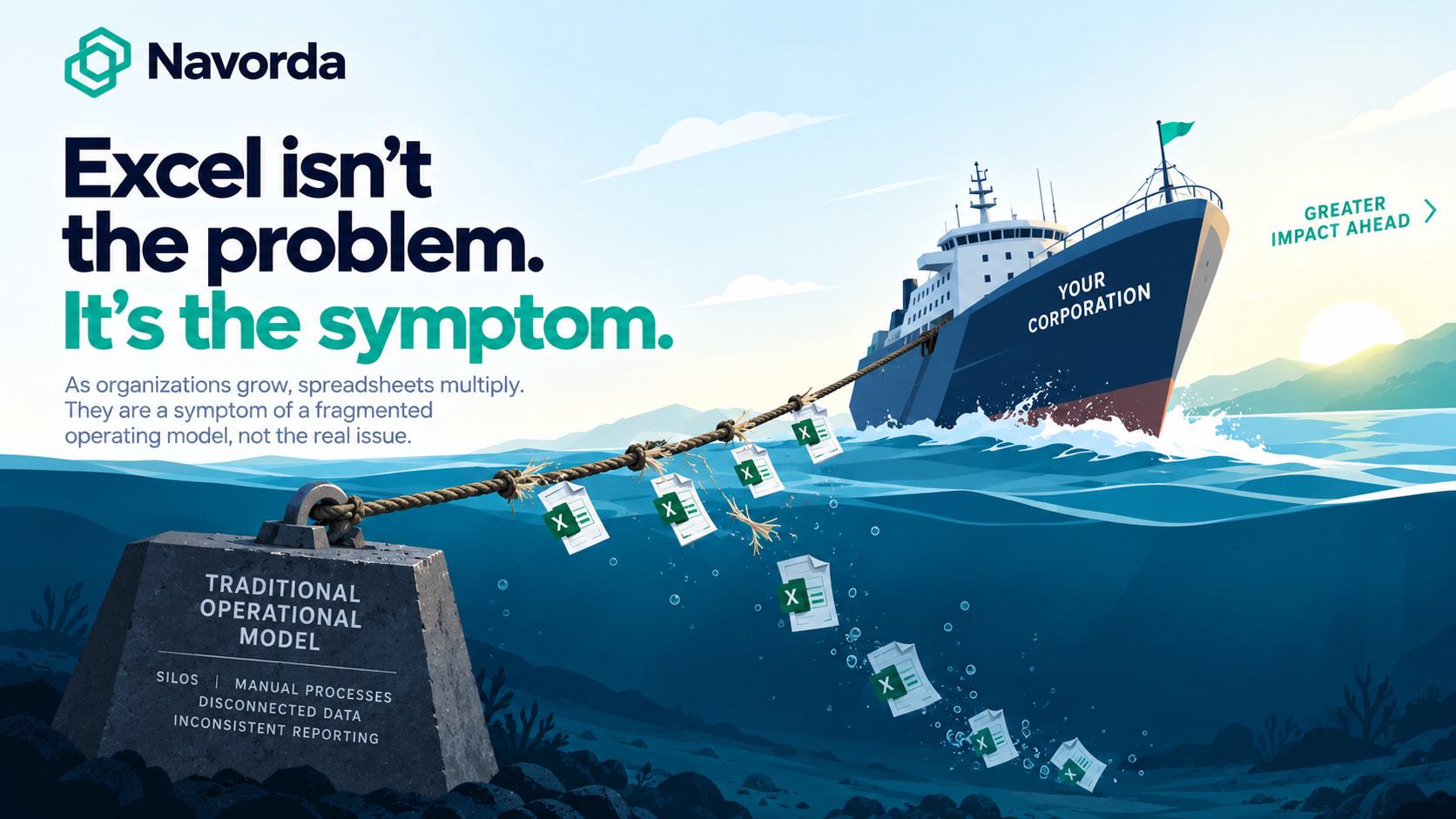
As energy developers scale, spreadsheets multiply. Excel is not the problem: it is the symptom of an operating model that fails to govern ownership and change.

As organizations grow, the distance between where reality changes and where decisions are made increases.
More projects. More people. More countries. More technologies.
Teams need ways to bridge that distance.
So another meeting appears.
Another report.
Another tracker.
And, very often, another Excel file.
That is why spreadsheets tend to multiply as organizations scale.
Excel isn’t necessarily the problem. It is often the symptom of something underneath.
Why Excel keeps coming back
Many organizations have tried to eliminate spreadsheets.
- A new database is built.
- A workflow is digitalized.
- A reporting platform is introduced.
For a while, there are fewer Excel files.
Then new ones appear.
This does not necessarily mean the digitalization failed.
It often means the organization still needs to compensate for something its operating model does not govern.
- Someone needs to connect information from several systems.
- Someone needs to keep track of dependencies.
- Someone needs to reconcile two versions of the same number.
- Someone needs to know who owns the next action.
And Excel is frequently the fastest way to bridge that gap.
The spreadsheet is visible.
The operating-model problem underneath it is not.
When a spreadsheet becomes part of the operating model
The warning sign is not simply that Excel exists.
It is what the organization depends on Excel to do.
Imagine a spreadsheet has become the only place where people can reliably understand:
- Who owns something.
- What depends on what.
- Which value is the current commitment.
- What has changed.
- Which risks are emerging.
- What requires attention next.
At that point, Excel is no longer just performing a calculation.
It has quietly become part of the operating model.
That can work surprisingly well while the organization is small.
But as the portfolio grows, so does the number of spreadsheets, versions, reconciliations and manual connections required to keep everything aligned.
Eventually, the system starts relying on people knowing which file to open, which column matters and who needs to be asked for the latest version.
But not every Excel file should disappear
There is an important distinction.
Not every spreadsheet is a symptom.
Some Excel files are genuinely excellent specialist tools.
A complex financial model, for example, may contain thousands of formulas, scenarios and assumptions developed through years of expertise.
Rebuilding that logic inside a corporate application does not automatically create better governance.
Sometimes it creates less flexibility, more maintenance and another system users eventually work around.
So the right question is not:
How do we eliminate Excel?
It is:
What job is this spreadsheet doing for the organization?
If Excel is compensating for missing ownership, traceability, dependencies or portfolio governance, the underlying operating model probably needs to change.
If Excel is doing something it is genuinely good at, perhaps the model should remain.
What may need governance instead are the assumptions going into it and the important outputs coming back.
Reporting does not solve the underlying problem
Organizations often respond to fragmentation by increasing reporting.
- More templates.
- More consolidation.
- More meetings.
- More PowerPoints.
But reporting usually reconstructs reality after the fact.
A stronger operating model keeps the important pieces of reality connected as they change.
- A milestone moves.
- A dependency becomes critical.
- A risk appears.
- A project assumption changes.
- A financial commitment moves with it.
Management should not need another spreadsheet to discover how those events relate.
AI does not remove the need for governance
AI can make fragmented information easier to search.
But faster access to conflicting information is not the same as knowing which information is authoritative.
AI still needs context:
- Which value is current?
- Why did it change?
- What depends on it?
- Who owns the next action?
Intelligence becomes much more useful when the underlying context is governed.
Look at the spreadsheet differently
The next time another tracker appears, instead of immediately asking:
How do we get rid of this Excel file?
Ask:
What is this spreadsheet compensating for?
Sometimes the answer will be that the process should be governed somewhere else.
Sometimes the spreadsheet itself should remain, while the assumptions, outputs or commitments around it need stronger governance.
That distinction matters.
Navorda is not being built to eliminate every tool people already use well.
It is being built to connect the critical facts, relationships and commitments through which energy development actually happens.
Excel isn’t the problem. It’s often the place where the underlying operating-model problem becomes visible.
Find out what your spreadsheets are compensating for — the five-minute Corporate Distance Assessment
What Got You Here Won’t Get You There — why distance grows with the portfolio
Excel Is Excellent — why spreadsheets win, and where they stop
Who Changed That Date? — what a governed source of truth adds