Who Changed That Date?
A source of truth tells you what the number is. A governed source of truth tells you who provided it, when it changed, and what it was before — and that difference changes behaviour, not just reporting.
 Luis Cabello6 min read
A source of truth should tell you more than what the latest value is. It should tell you who provided it, when it changed, and how it got there.
Imagine a portfolio review. A project expected to reach Ready-to-Build in September is now showing November.
Someone around the table asks: who provided that date?
It sounds simple. But in a large organization, the answer can trigger a surprisingly long journey. The portfolio team asks the Country Head. The Country Head asks the Development Manager. The Development Manager asks the project team. Someone checks an Excel file. Someone else searches an email thread. Another person remembers discussing it in a meeting.
Eventually, the answer arrives. But perhaps it arrives ten days later. By then the meeting is over, another reporting cycle has started, and the opportunity to act may already have disappeared.
The problem was never the date. The problem was the missing context around the date.
A Value Without Provenance Is Only Half the Truth
When we talk about a single source of truth, we normally focus on having one trusted value. One COD. One RtB date. One permit status. One land securization percentage.
That is important. But for every critical data point, the system should also know:
- who created it
- who last modified it
- when it was created
- when it changed
- what the previous value was
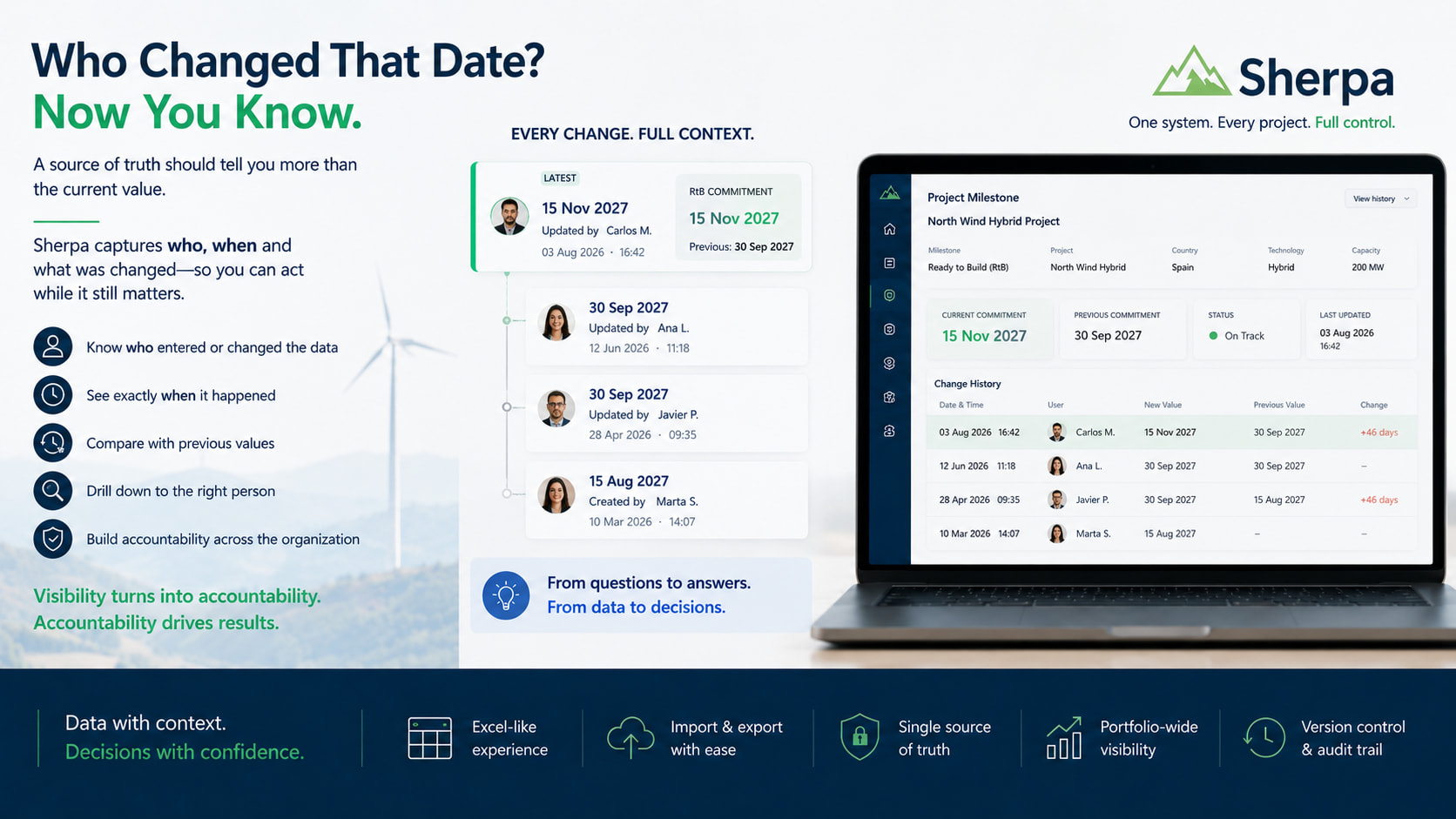
Knowing that the current RtB date is 15 November is useful. Knowing that it changed from 30 September to 15 November yesterday at 16:42, updated by the person responsible for the project, is something different. Now the information has context. And context makes action possible.
Every Question Becomes a Small Investigation
Large organizations can have sophisticated reporting processes but surprisingly inefficient mechanisms for answering basic questions. Why did this milestone move? Who changed this assumption? Where did this forecast come from? When was this information last reviewed?
Without traceability, each of those becomes a small investigation routed through three or four people, and the answer travels back through the same chain. The cost is not only time. It is the loss of the ability to react while the question still matters.
Drill Down Until You Reach the Person Who Knows
A governed system changes this dynamic. Instead of asking who knows where this number came from, you inspect the information directly.
Project. Milestone. Current commitment. Previous commitment. Last modification. Author.
Suddenly, the distance between a management-level question and the person closest to the underlying reality becomes much shorter. If clarification is required, you know exactly who to ask. No detective work. No forwarding chain. No reconstruction of how the information reached the portfolio report.
The system preserves that context. But something more important happens next.
Traceability Changes Behaviour
At first, authorship and timestamps look like a convenience — they help you identify the right person when clarification is needed. Over time, however, they change the organization. Everyone understands that an important commitment is no longer an anonymous number inside a spreadsheet. It has an owner.
If someone changes a milestone, that change is visible. If a permit forecast is updated, leadership can see when it happened. If an important assumption has remained untouched for six months, that is visible too.
This should not create a culture of surveillance. Good governance creates clarity of responsibility. People become more conscious of the commitments they enter because those commitments have organizational memory. And when responsibility becomes visible, data quality tends to improve.
From Reporting to Accountability
Consider two organizations. In the first, the portfolio report says:
RtB: 15 November 2027
Nobody immediately knows who provided it, when it changed, or what the previous commitment was.
In the second:
RtB: 15 November 2027 — previous commitment 30 September 2027, changed 3 August at 16:42, updated by the Project Development Manager.
The numerical value is identical. The governance value is not. The second organization can immediately move from seeing the deviation to understanding the deviation.
Historical Truth Matters Too
Timestamps and change history also protect something traditional reporting frequently destroys: history.
A forecast moves from September to November and September simply disappears. The spreadsheet now shows November. Technically, the data is current. Operationally, part of the truth has been lost.
Management does not only need to know what we believe today. It also needs to know what we believed before, when that belief changed, and who changed it. That is how organizations understand drift, forecasting quality and recurring patterns across the portfolio. Governance evolves from reporting the latest state to understanding how the state is changing.
Accountability Without Bureaucracy
Governance should not mean adding approval workflows to every change. That often produces bureaucracy rather than control. Good governance can be simpler. Let people work, but preserve:
- ownership
- timestamps
- history
- accountability
- traceability
You do not necessarily need to prevent someone from changing a date. You need to know that it changed, preserve what it was before, and know who changed it. That creates control without slowing the organization down.
The Invisible Infrastructure of Governance
Some of the most important capabilities in enterprise software are also the least spectacular. A timestamp will never attract as much attention as an AI agent. An audit trail is unlikely to be the feature that impresses most during the first five minutes of a demo. But these mechanisms determine whether an organization can trust the system when something important happens.
At Navorda, we consider this part of the operational foundation. Projects, permits, milestones, land information and risks should not exist as anonymous values. They should carry context. Who. When. What changed. What existed before.
Because once this information exists consistently across the portfolio, the system does not just connect data. It connects responsibility.
See how Navorda Platform keeps baselines, deviations and change history on every milestone →
A source of truth tells you what the number is. A governed source of truth tells you where it came from, who stands behind it, and how it changed.
That is where visibility becomes accountability. And where software starts becoming governance.