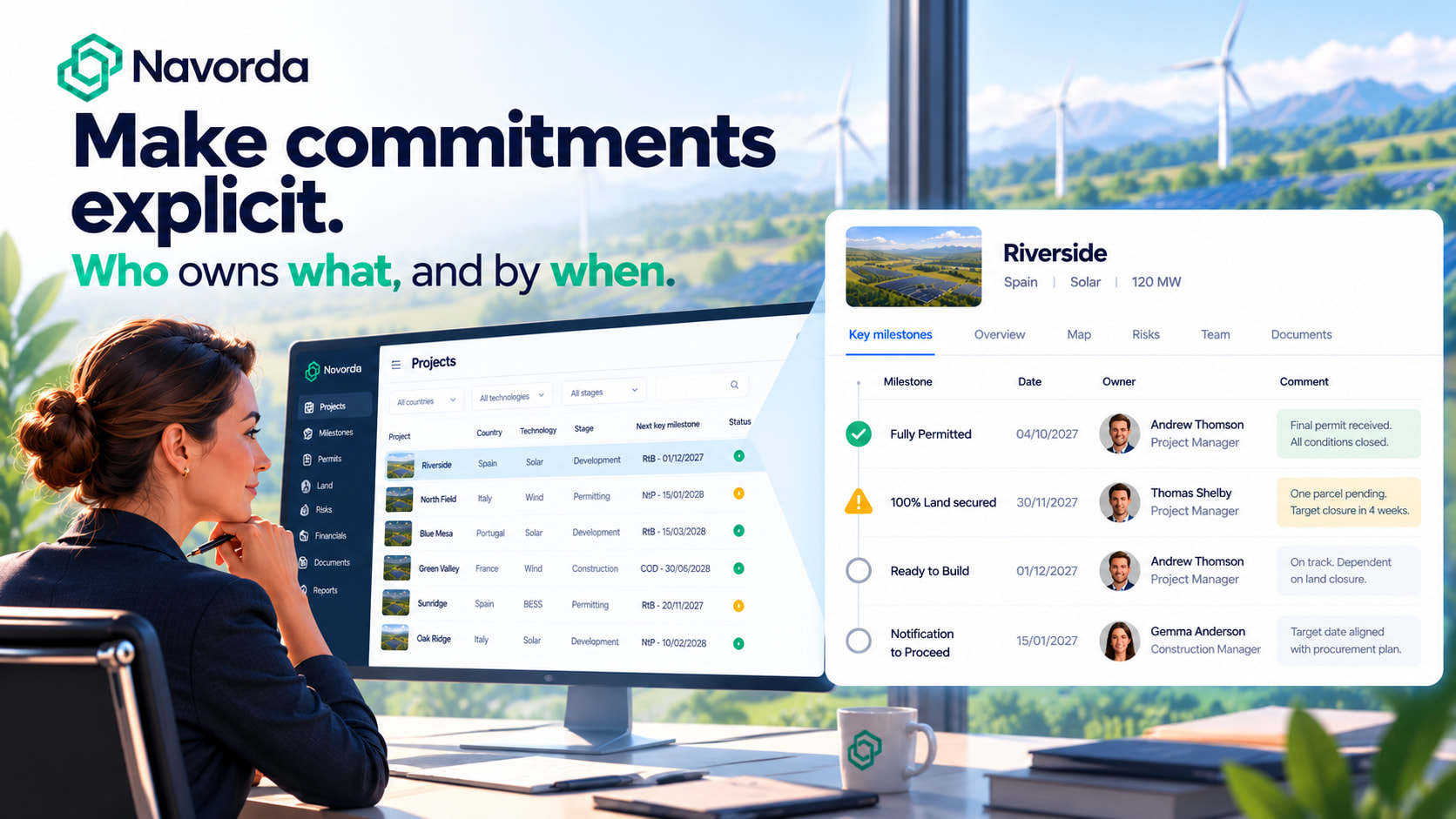
Make commitments explicit — who owns what, and by when.
Good governance starts when commitments stop living in people’s heads. As the portfolio grows, the problem is not lack of work but ambiguity around commitments — who owns what, and by when.
 Luis Cabello5 min read
Good governance starts when commitments stop living in people’s heads.
If you lead Development or Construction, your problem is probably not knowing whether your team is busy.
You already know they are.
The harder question is:
Do you know exactly what the organization is committed to — who owns it, and by when?
At small scale, this is surprisingly manageable.
You know the projects.
You know the people.
You remember that a permit is waiting for one final document, that Engineering promised a revision next week, and that a land issue needs to be escalated before the next committee.
Much of the operating model lives naturally in the team.
Then the portfolio grows.
More projects. More countries. More specialist teams. More external stakeholders.
And suddenly the problem is not lack of work.
It is ambiguity around commitments.
A milestone alone is not enough
Imagine a project showing:
RtB — 30 September
That tells you very little about whether the organization is actually in control.
What matters is what sits behind that date.
Is the critical permit on track?
Who owns the unresolved land issue?
What happens if the grid dependency moves?
A good Head of Development already asks these questions instinctively.
The problem is that the answers often live across different places: a meeting, somebody’s Excel file, an email thread, a risk register, or simply the memory of the person closest to the issue.
That works.
Until it doesn’t.
The goal should not be to add more reporting.
It should be to make the commitments already governing the business explicit.
Who. What. When.
A commitment becomes much easier to govern when three things are always clear:
Who owns it. What exactly has been committed. When it is expected.
Everything else becomes easier from there.
A dependency can be challenged.
A delay can be escalated.
A mitigation can be followed.
A change can retain its history.
And, importantly, management can understand the difference between a project that happens to be green and a project that is being actively governed to stay green.
That distinction matters.
Good management is often invisible
One of the frustrations of leading a strong team is that much of the best work disappears precisely because it succeeds.
A risk is spotted early.
A dependency is escalated before it becomes critical.
A supplier is pushed.
A permit problem is resolved.
A commitment is renegotiated before the portfolio milestone is affected.
Management often sees only the final result:
Green. On track.
But behind that green status may be weeks of good judgment and active governance.
A better operating model should make that work visible.
Not by measuring every action.
Not by turning specialists into data-entry operators.
But by preserving the context that matters: what changed, who owns the response, and what commitment is now being protected.
That allows a Head of Development or Construction to move from:
My team is working hard.
to:
This is what my team is governing, these are the commitments we are protecting, and this is where we need management support.
That is a much stronger management conversation.
Accountability is not micromanagement
There is an important difference between making commitments explicit and telling specialists how to do their jobs.
A permitting expert does not need management dictating every activity required to secure an authorization.
An engineer does not need every technical decision turned into a corporate workflow.
A Project Manager does not need another person sitting virtually over their shoulder.
But the organization does need clarity around the outcomes it depends on.
That is where governance should live.
Standardize the commitment. Leave room for expertise in the execution.
This is one of the principles behind Navorda.
The operating model should give enough structure for the organization to remain connected without removing the flexibility specialists need to do good work.
Less chasing. More governing.
There is another practical consequence.
As portfolios grow, senior people can spend an extraordinary amount of time simply reconnecting information.
“Who owns this?”
“Did we agree a date?”
“Has anyone followed up?”
“Does this affect RtB?”
“Can someone confirm before the meeting?”
None of these questions is difficult.
But hundreds of them create a management burden.
And every time the answer depends on finding the right person, reopening an email, checking another tracker or organizing another meeting, corporate distance grows.
The objective is not to eliminate communication.
It is to make communication happen on top of shared context, rather than using communication to rebuild that context every time.
This is where Navorda fits
Navorda connects project reality with the commitments around it.
Ownership stays explicit.
Dependencies remain connected.
Changes retain their history.
The Head can see not only what the current status is, but also what is being governed behind it.
And when something moves, the organization has a better chance of understanding the consequence before it becomes tomorrow’s surprise.
The principle is simple:
Who. What. When. Always known.
Because as the portfolio grows, leadership should not depend on remembering everything.
It should depend on an operating model that makes the important commitments impossible to lose.
Bring one project
If you want to see whether this fits your way of working, bring one representative project to a Navorda Fit Review.
We can look together at where commitments currently live, how ownership and dependencies are governed, and where information still depends too heavily on meetings, trackers or individual memory.
Bring one project. Start from your reality.
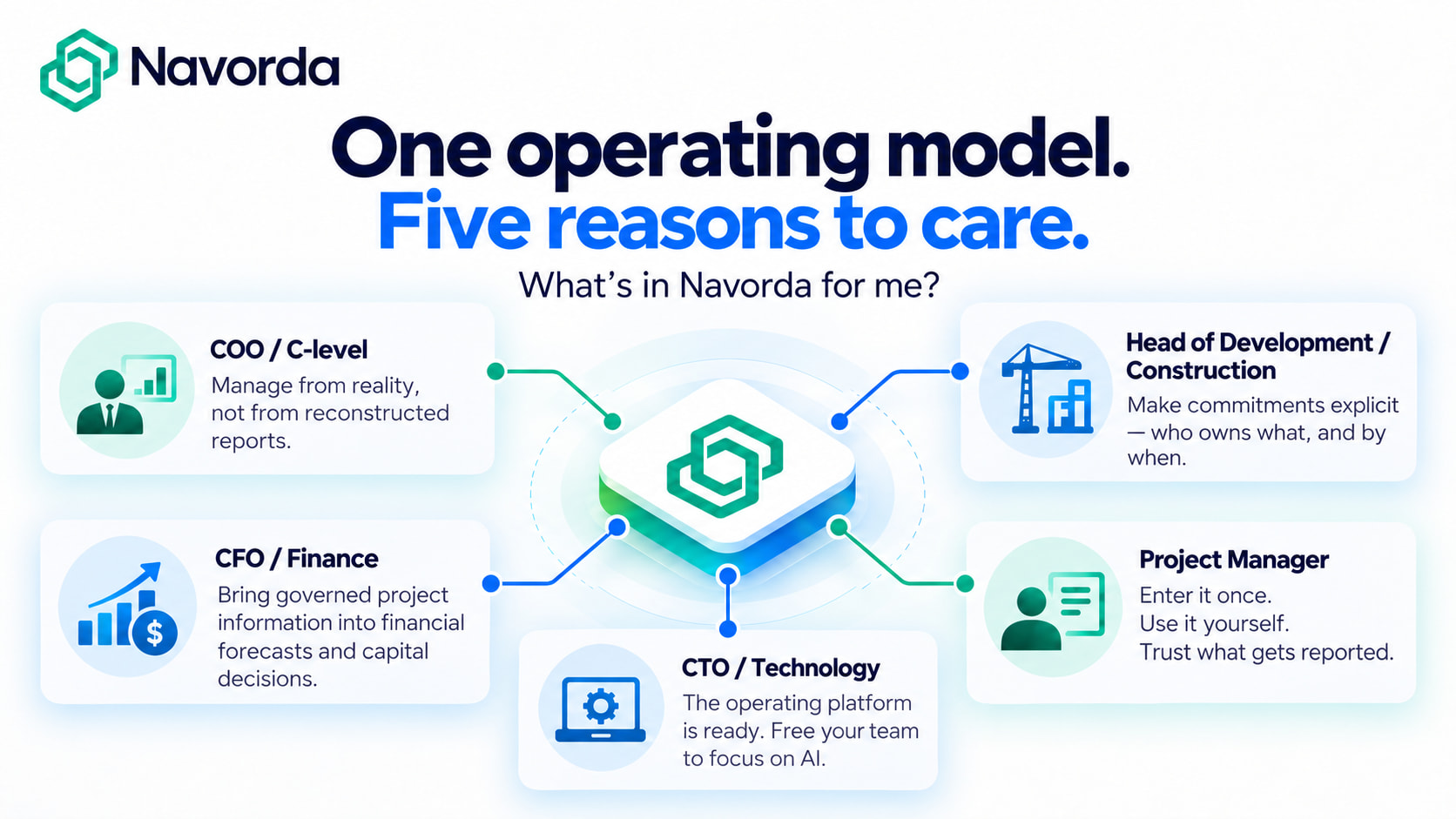
Navorda for Heads of Development / Construction — the role page behind this article
Navorda Decisions — who decided what, on whose behalf, and what follows
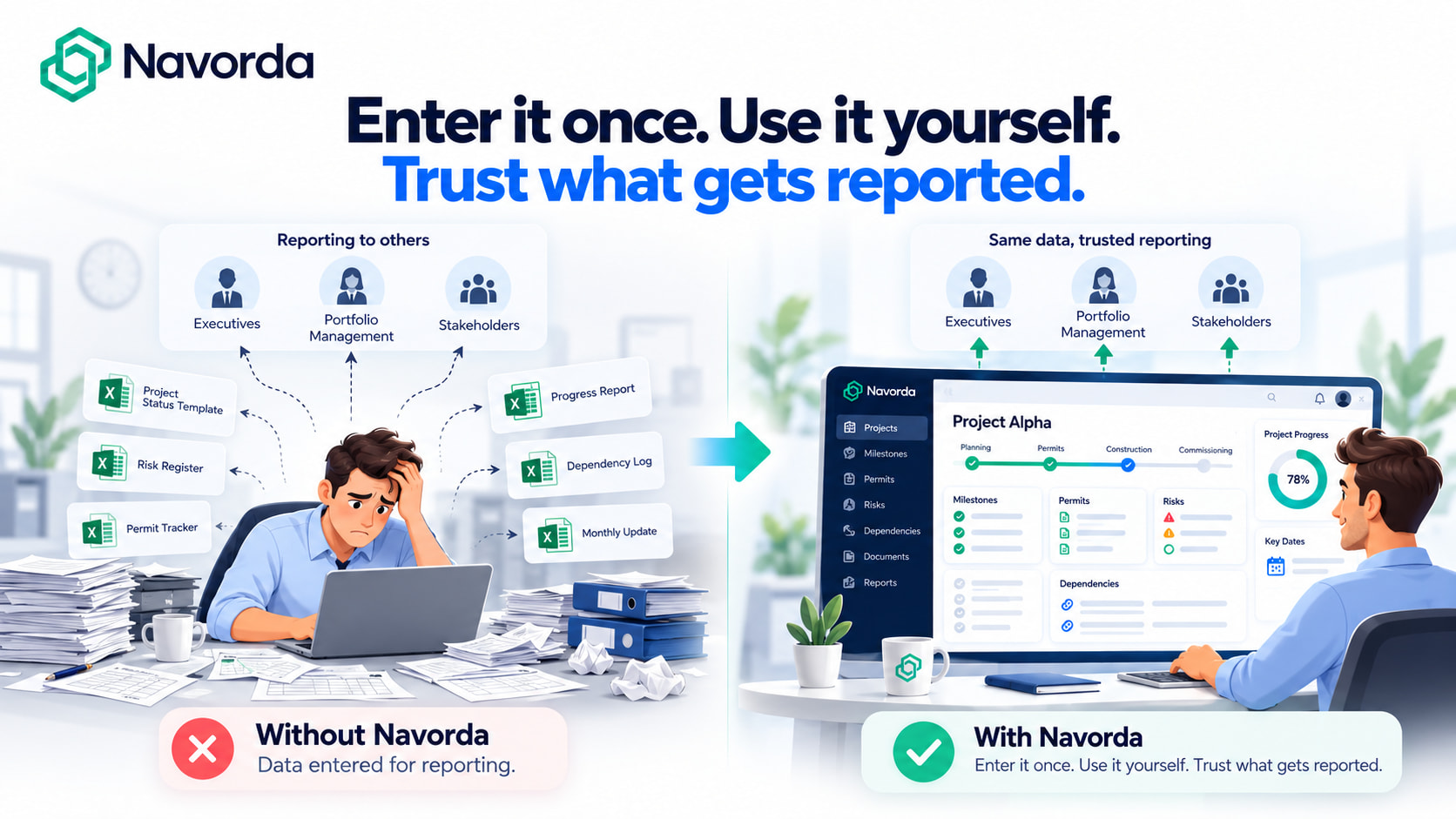
Enter it once. Use it yourself. Trust what gets reported. — the Project Manager chapter
The Invisible Governance Heroes — the people quietly holding your operating model together