The Invisible Governance Heroes
Every growing organization has people who quietly reconcile project reality, connect dependencies and make reporting work. They are invisible governance heroes — and better governance should amplify their expertise, not replace it. Keep the heroes. Remove the unnecessary heroics.

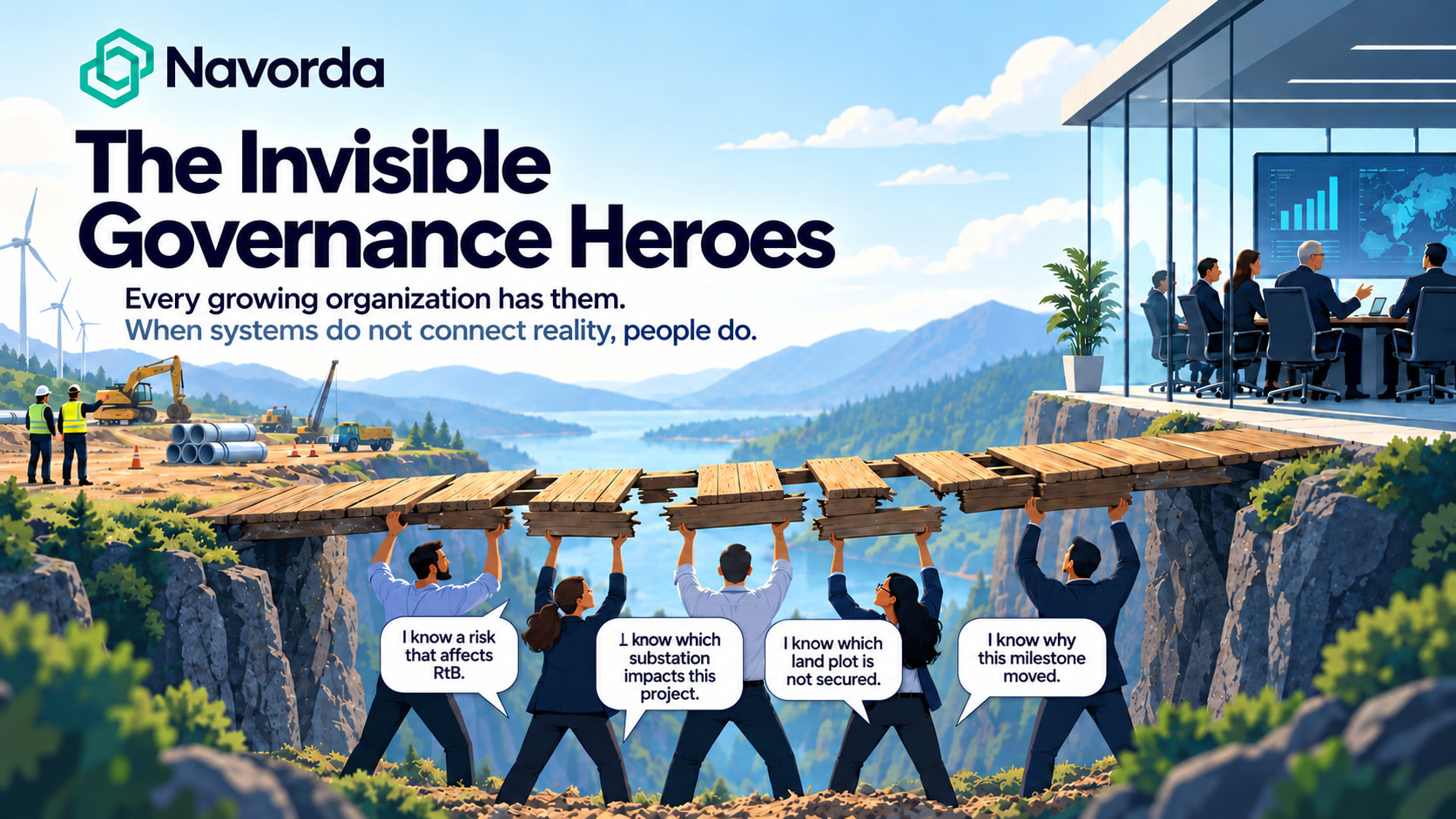
The people quietly holding your operating model together — and why better governance should amplify their expertise, not replace it.
While you are reading this, your organization may be quietly relying on a handful of people to keep its operating model together.
You probably know who they are.
The person who knows which project list is actually current.
Who remembers why that milestone moved.
Who knows which risk deserves more attention than its traffic light suggests.
Who can explain why two reports contain different figures.
Who remembers the dependency nobody formally documented.
When systems do not connect reality, people do.
We call them Invisible Governance Heroes.
And the better they are at doing this, the less visible the underlying problem becomes.
When systems stop connecting reality, people do it instead
Most energy developers already have plenty of tools.
ERP.
GIS.
Excel.
Power BI.
Document repositories.
Project-management software.
Financial models.
Email and Teams.
Each tool may work perfectly well for its own purpose.
The problem appears in the space between them.
A permit moves.
Someone understands the effect on a milestone.
Someone else realizes that milestone affects procurement.
Finance needs to revise a forecast.
A financial model may still contain the previous assumption.
Management eventually needs to know whether COD is now at risk.
The organization needs those facts to become one coherent reality.
And very often, software does not create that connection. People do.
Meet the invisible governance heroes
They are the people who:
- reconcile two project lists before a meeting,
- know which spreadsheet contains the latest number,
- remember the dependency nobody formally documented,
- translate technical issues into management consequences,
- chase owners before reporting deadlines,
- correct PowerPoint slides because the underlying reality changed yesterday,
- explain why a number is technically correct but no longer relevant,
- connect decisions made in one meeting with actions required somewhere else.
They add enormous value.
The organization works because particular people remember:
who, what, when, why and what depends on it.
That is incredibly valuable human expertise.
It is also a fragile way to scale.
The invisible work behind reliable governance
A few minutes reconciling project lists.
Half an hour checking which figure is current.
Another meeting to reconnect decisions with execution.
Two days preparing a portfolio review.
None of these activities seems dramatic in isolation.
Together, they consume a significant amount of highly valuable expertise.
The problem is not that these people are doing something unimportant.
The problem is that some of your best people are spending their expertise manually rebuilding context the operating model should help preserve.
Reporting can hide the effort underneath
Imagine management receives a clean portfolio report every month.
Projects.
MW.
Stages.
Risks.
Milestones.
Traffic lights.
It looks structured.
But what happened before that report existed?
How many people were asked for updates?
How many Excel files were reconciled?
How many discrepancies were corrected?
How many assumptions were interpreted?
How many meetings were needed to decide which version was right?
A polished report can hide an enormous amount of organizational effort.
And this matters because:
Reconstructing reality is not the same as governing it.
The better your heroes are, the easier the problem is to miss
Reports still arrive.
Meetings still work.
Management still gets an answer.
Risks are caught before they escalate.
The organization appears well connected.
But sometimes that connection exists because talented people are continuously repairing the gaps between systems, processes and teams.
Their competence can hide weaknesses in the operating model.
Until:
- the portfolio doubles,
- another country is added,
- a key person leaves,
- a new technology introduces different dependencies,
- or the reporting cycle simply becomes too complex to reconstruct manually.
Then the organization discovers how much of its operating model lived inside people.
The hero is not the risk
The hero is not the risk. The organization’s dependence on undocumented context is the risk.
The problem is not having highly experienced people.
You want those people.
The problem is when important corporate context exists only because those people personally remember it.
The goal is not to make these heroes less necessary
This distinction matters.
Better governance should not make the people who understand the business less valuable.
Quite the opposite.
A great Project Manager is valuable because they understand the project, anticipate problems and make good decisions — not because they know which spreadsheet contains the latest milestone.
A great Head of Development is valuable because they can prioritize, challenge assumptions and coordinate teams — not because only they remember who committed to what.
A great portfolio specialist is valuable because they understand relationships and consequences — not because they spend two days reconstructing them before every management meeting.
The objective is to preserve their knowledge, make their contribution visible and let them use more of their time where human judgment actually matters.
Make their knowledge part of the operating model
A scalable operating model should make explicit what today often lives inside people’s heads.
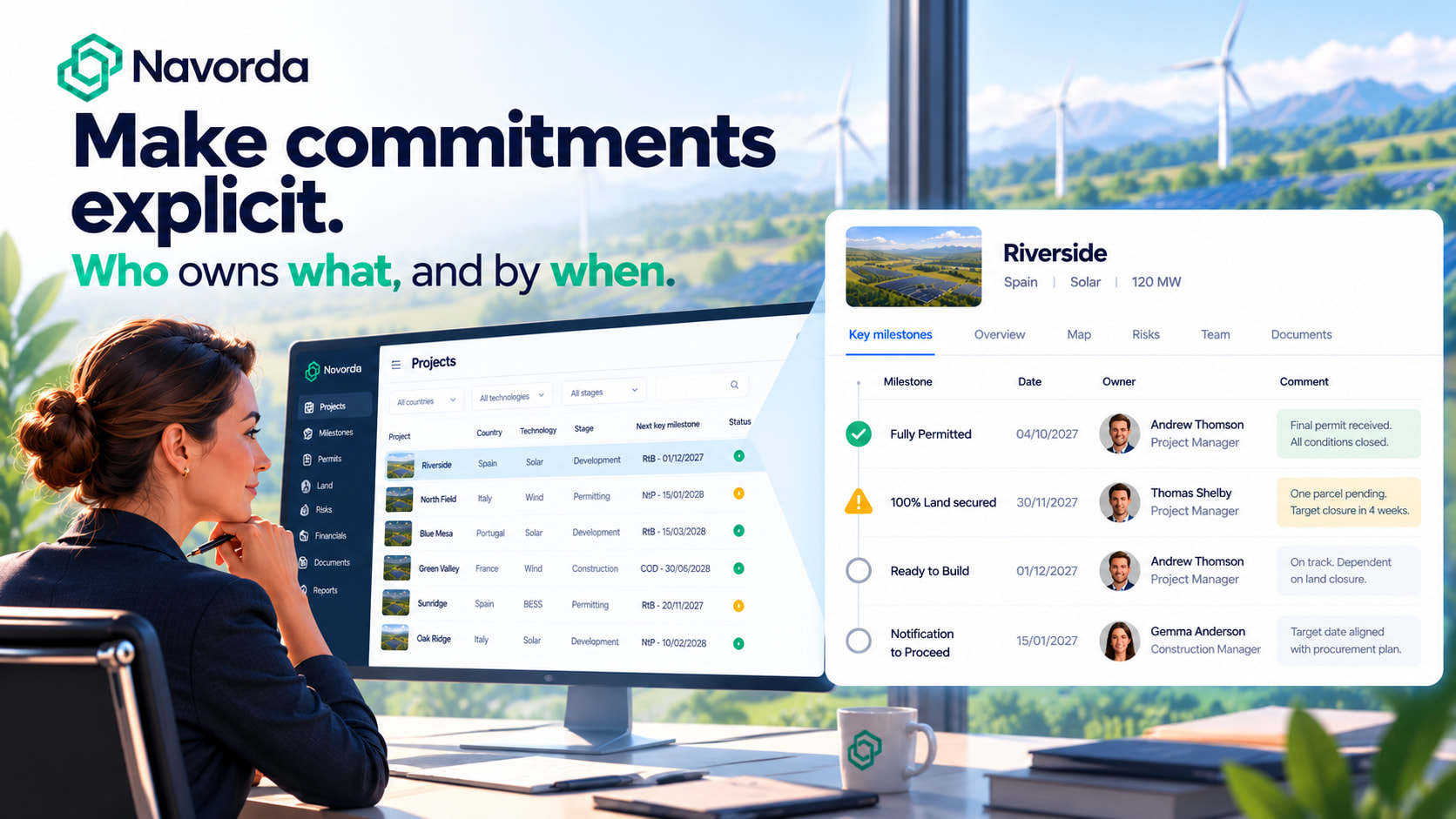
Which project does this commitment belong to? Who owns it? By when? What depends on it? What changed? Why? Which value is authoritative? What decision is now required?
That does not eliminate human judgment.
It makes human judgment more valuable.
People can spend less time moving information and more time interpreting it.
Less time reconstructing reality.
More time acting on it.
This is the governance layer
The governance layer is not another reporting system.
It is the context connecting project execution with management decisions.
Projects remain connected to milestones.
Milestones to dependencies.
Dependencies to risks.
Risks to owners and mitigation.
Projects to ownership structures.
Financial commitments to the events driving them.
External models to the assumptions and outputs that matter.
Reality does not need to be reconstructed from scratch every time somebody asks a question.
It remains connected as it changes.
Making the invisible visible
Making governance explicit does something else that matters:
It makes good management visible.
A risk identified early.
A dependency escalated before it became critical.
A commitment protected.
A problem prevented before management ever saw it.
Today, much of that work disappears precisely because it succeeds.
A governed operating model can preserve that context.
Management can see not only the final status, but how the organization is actively governing the outcome.
Make their expertise scalable
Navorda is designed to make the relationships these people already understand explicit and governable.
Ownership becomes visible.
Changes retain history.
Dependencies become part of project reality.
Commitments stay connected to execution.
Information can move through the organization without losing the context people worked so hard to create.
The objective is not to replace the people holding the organization together.
It is to make what they know less fragile, make what they do more visible, and give them better infrastructure around their expertise.
Keep the heroes. Remove the unnecessary heroics.
Your best people should remain critical to the organization.
But for the right reasons.
Not because only they know which file is current.
Not because reporting collapses when they go on holiday.
Not because every important dependency lives inside their memory.
They should be valuable because they understand the business.
Because they anticipate.
Because they challenge.
Because they prioritize.
Because they make good decisions.
Better governance does not reduce their importance. It gives their expertise more leverage.
Make their knowledge visible.
Make their contribution visible.
Make the context around them durable.
And let your governance heroes spend more time doing the things only great people can do.
How much of your operating model still depends on invisible heroics?
If the right people were not in the room tomorrow, how much context would the organization lose?
The Navorda Corporate Distance Assessment helps identify where information, ownership and decisions still depend on people manually connecting the dots.
What’s in Navorda for Me? One operating model, five very different reasons to care
Navorda for Heads of Development / Construction — make commitments explicit across your teams
Navorda for Project Managers — enter it once, use it yourself, trust what gets reported