The Invisible Governance Layer
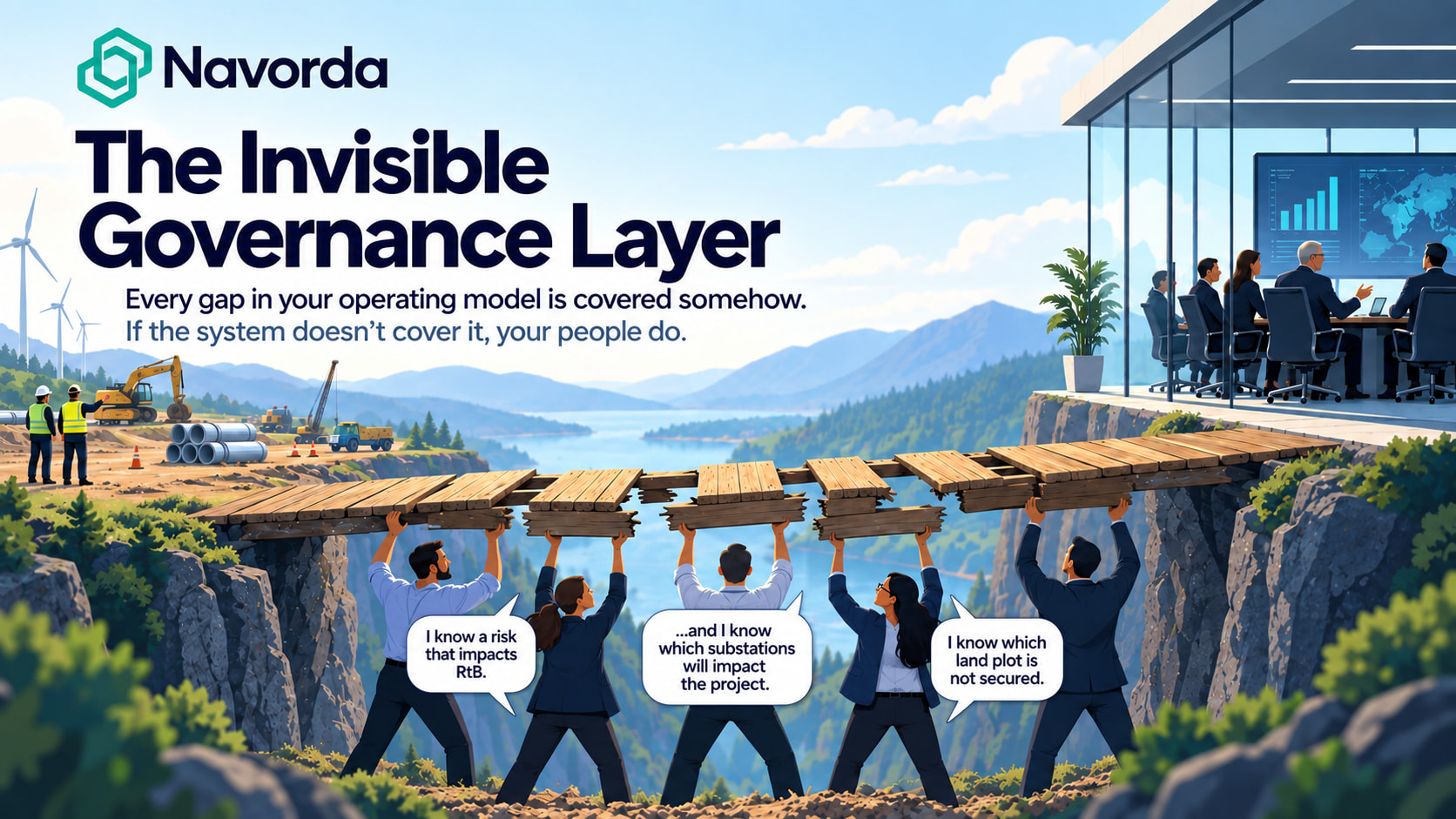
Every gap in your operating model is covered somehow. If the system doesn’t cover it, your people do. That accumulated effort creates an invisible governance layer around the organization — and growth turns hidden effort into structural risk.
 Luis Cabello7 min read
Every operating model has gaps.
Information that does not flow automatically. Relationships that exist only in someone’s head. Commitments that need to be followed manually. Numbers that have to be reconciled before they can be trusted. Decisions that live in meeting minutes rather than in the systems expected to execute them.
Those gaps do not remain empty.
If the system does not cover them, your people do.
Someone creates another Excel file.
Someone organizes another meeting.
Someone prepares another PowerPoint.
Someone checks whether Development and Finance are using the same COD assumption.
Someone reconciles two project lists before the portfolio report goes out.
Someone remembers that five projects depend on the same substation.
Someone calls a colleague because the information available in the system cannot quite be trusted.
Someone manually checks the figures before they reach the Investment Committee.
The company continues operating.
And because it continues operating, the underlying problem can remain almost invisible.
But all that accumulated human effort is doing something very specific.
It is creating an invisible governance layer around the organization.
The operating model always gets completed somehow
Consider a typical energy-development portfolio.
Projects may live in one application.
Permits somewhere else.
Land securization in spreadsheets or GIS tools.
Risks in a register.
Financial consequences in a model.
SPVs and ownership structures in another system.
Offtake agreements in a document repository.
Commitments in emails and meeting minutes.
Management reporting in PowerPoint.
None of those tools are necessarily wrong.
The problem appears in the spaces between them.
Who knows that a three-month delay in one permit affects a milestone?
Who connects that milestone to a forecasted payment?
Who knows which SPV owns the project?
Who remembers that several projects share the same grid infrastructure?
Who can identify which number in the financial model became the figure approved by an Investment Committee?
Who knows why a date changed six months ago?
There is always an answer.
But very often, the answer is a person.
The organization works because experienced people continuously reconstruct the relationships that its systems do not explicitly govern.
That work becomes part of the operating model, even if nobody ever designed it that way.
The invisible governance tax
This layer consumes resources silently.
There is rarely a budget line called “manual governance created by gaps in the operating model”.
Instead, the cost appears everywhere and nowhere.
A few minutes searching for the latest file.
Half an hour reconciling two reports.
Another meeting because two departments have different interpretations of the same milestone.
Two days preparing the monthly portfolio review.
A spreadsheet maintained because the corporate system does not quite answer the question.
A senior manager spending time rebuilding context before making a decision.
Individually, none of these activities looks particularly dramatic.
Collectively, they can represent a significant invisible governance tax.
And because much of this work is performed by capable people as part of their normal jobs, the organization can easily underestimate how much resource is actually being consumed.
The strongest people often become the most important pieces of this invisible layer.
They know where the information lives.
They know which number can be trusted.
They know who to call.
They know what the process says — and what actually happens.
They become the glue between systems, departments and projects.
That can keep an organization working remarkably well.
Until the organization grows.
Growth turns hidden effort into structural risk
When a developer is small, communication itself can operate as part of the governance model.
The development director knows the projects personally.
Finance knows which spreadsheet contains the current assumptions.
The CEO knows which infrastructure is shared.
The project manager remembers why a milestone moved.
The organization can compensate for imperfect systems because the distance between the people executing the business and the people managing it is still relatively small.
Then ten projects become fifty.
One country becomes six.
Solar becomes solar, wind and BESS.
More departments appear. More specialists. More SPVs. More investors. More lenders. More counterparties. More dependencies. More commitments.
And the invisible governance layer has to scale with all of them.
But human context does not scale in the same way.
The organization compensates again with more meetings, more reporting procedures, more PowerPoints, more Excel files, more checks and more people translating one version of reality into another.
At that point, the problem is no longer only about efficiency.
It starts becoming a corporate risk.
The organization increasingly depends on the right person remembering the right relationship, noticing the right discrepancy or forwarding the right information at the right moment.
And every additional project, country, technology and organizational layer increases the number of relationships that need to be governed.
The dangerous part is that it still seems to work
An invisible governance layer rarely fails all at once.
That is what makes it difficult to detect.
Most problems are corrected before they become visible.
Someone catches the wrong figure before the presentation.
Someone notices that the project list is outdated.
Someone remembers a dependency that was never formally recorded.
Someone calls Finance before the forecast is circulated.
Someone explains why the milestone changed.
The organization works because people continually absorb the imperfections of the operating model.
Until one day, one gap is not covered.
Management discovers a risk after it has already affected the schedule.
A commitment is interpreted differently by two departments.
A milestone moves without the financial forecast moving with it.
Two portfolio reports contain different versions of the project list.
A figure presented externally cannot later be traced back to the assumptions that generated it.
A dependency becomes visible only after another project has already been affected.
The problem was not created on that particular day.
The organization had been relying on invisible governance for years.
Growth simply made the weakness harder to absorb.
Governance is not the same as centralizing data
The natural response is often to centralize everything.
More databases. More integrations. More reporting systems.
Those may all be useful.
But storing information centrally does not automatically create governance.
Governance is about understanding relationships.
What does this information belong to? Who owns it? What changed? When did it change? Which version is authoritative? What depends on it? What was committed? What are the consequences if it changes? Who needs to act?
Even terminology becomes part of the problem.
Development may call something a plant.
Engineering may call it an asset.
Finance may call it a facility.
A dashboard does not resolve that ambiguity.
It simply visualizes it.
A scalable operating model has to make definitions, ownership, relationships, dependencies and commitments part of the infrastructure of the company itself.
Not everything should be replaced
This does not mean that every specialist tool should disappear.
Quite the opposite.
A sophisticated financial model may legitimately remain in Excel.
Contracts may remain in a document-management system.
ERP transactions may continue to live in the ERP.
GIS specialists may continue using specialized geospatial tools.
The question is not:
How do we force everything into one application?
The better question is:
How do we maintain one governed corporate understanding of how everything relates?
That is a very different problem.
An energy-development portfolio naturally connects projects, land, permits, milestones, risks, infrastructure, dependencies, SPVs, shareholders, transactions, offtake agreements, financial impacts, responsibilities and commitments.
Those things do not necessarily need the same tool.
But the corporation needs a coherent model of the relationships between them.
Reality has to travel upstream
When something changes close to execution, that change should eventually become part of corporate reality.
A parcel takes longer to secure.
An authority requests additional documentation.
An engineering dependency affects energization.
A risk becomes more likely.
A milestone moves.
Those events should not need to wait until someone reconstructs them during the next reporting cycle.
A governed operating model allows reality to travel upstream.
Decisions and accountability have to travel downstream
The opposite direction matters just as much.
Management approves a baseline.
An Investment Committee approves a financial assumption.
Someone becomes responsible for resolving a risk.
A milestone is expected by a particular date.
A financial commitment depends on that milestone.
Those decisions need to remain connected to the projects, objects and people responsible for executing them.
Otherwise, decisions gradually dissolve into emails, presentations, meeting minutes and human memory.
A scalable governance layer therefore has to work in both directions:
Reality travels upstream. Decisions and accountability travel downstream.
Making the invisible visible
Navorda was created from years of observing this almost invisible layer inside energy organizations.
Not because those organizations were badly managed.
Often, quite the opposite.
They worked because experienced people were compensating extraordinarily well for the gaps between systems, departments and processes.
But that effort came with a cost.
And as organizations grew, it increasingly came with risk.
Navorda is designed to turn that invisible layer into explicit corporate infrastructure.
Relationships become visible.
Ownership becomes explicit.
Changes become traceable.
Dependencies become part of the model.
Commitments remain connected to execution.
Information can move through the organization without requiring someone to reconstruct the context every time.
The objective is not to add another layer of administration.
It is to stop your people from having to provide that layer themselves.
Release the resources currently holding the organization together
There is an important consequence when this happens.
The organization does not simply gain more control.
It can start releasing part of the human effort currently spent keeping everything connected.
The people who were reconciling information can spend more time acting on it.
The managers rebuilding context can spend more time making decisions.
The specialists maintaining parallel reporting structures can spend more time improving the projects themselves.
The same expertise that was silently compensating for gaps in the operating model can become power for the next stage of growth.
That is why the invisible governance layer should not only be seen as a problem.
Once made visible and governed deliberately, it can become a competitive advantage.
Make it visible. Govern it deliberately. Release the people holding it together.
And use that released capacity to move the corporation to the next level.
Measure the layer your people are holding up — the five-minute Corporate Distance Assessment
What Got You Here Won’t Get You There