Enter it once. Use it yourself. Trust what gets reported.
Project Managers should not maintain data only so somebody else can report on it. Enter project reality once, use it to run the project, and trust that management sees the same governed information.
 Luis Cabello5 min read
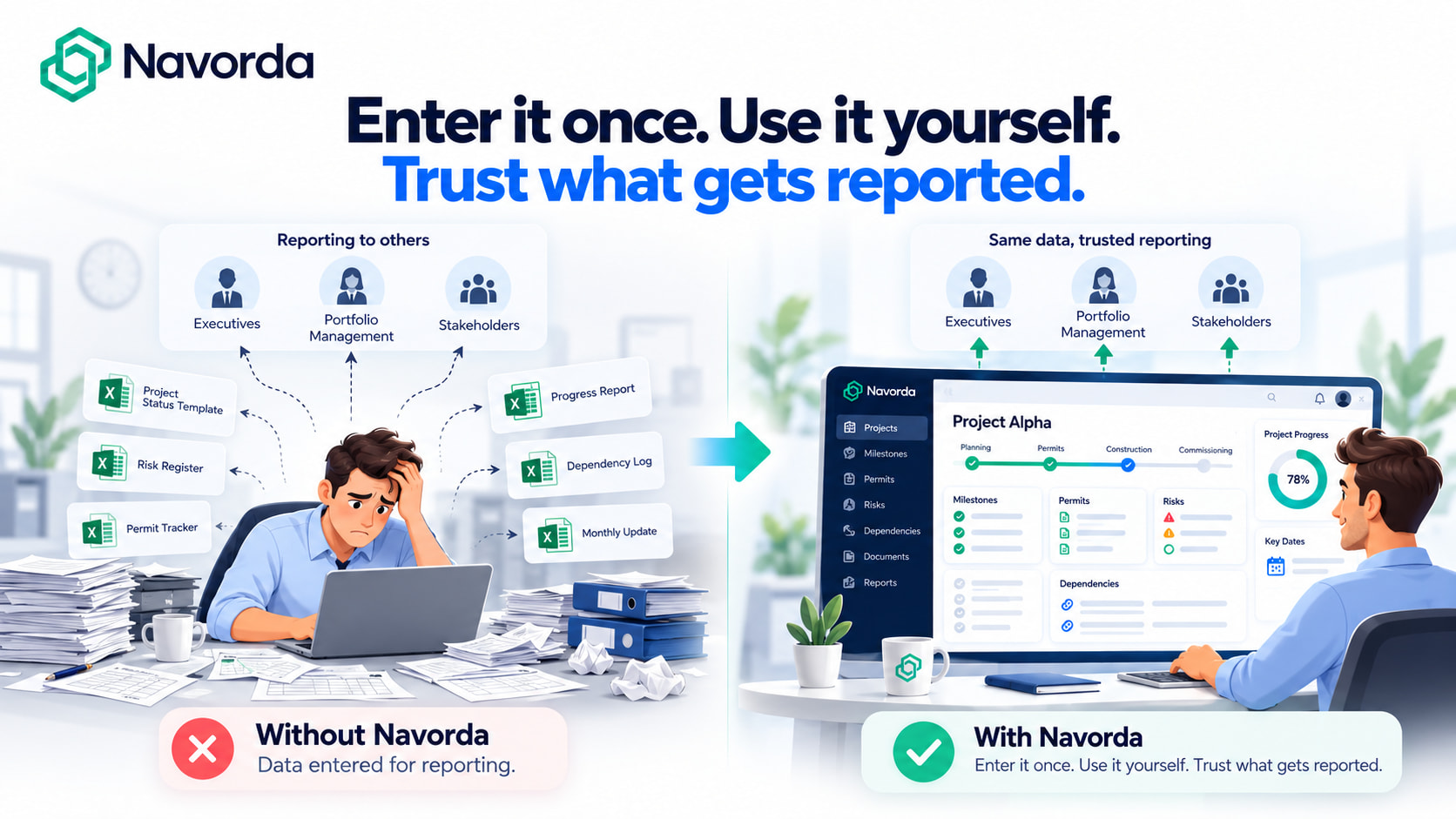
Project data should make the Project Manager’s job easier first — not exist only to feed somebody else’s report.
There is a familiar problem with many corporate systems.
The person closest to project reality is asked to maintain information so that someone further up the organization can use it.
Update the milestone.
Complete the risk register.
Refresh the permit status.
Fill in the monthly template.
Send the Excel file.
Explain the changes.
Then, somewhere between the project and management, that information is exported, consolidated, reformatted, interpreted and summarized.
By the time it reaches leadership, the Project Manager may barely recognize what they originally entered.
That is a poor operating model.
And it is also a poor adoption model.
Because if a Project Manager is responsible for keeping project information accurate, the system should create value for them first.
Enter it once
Project Managers should not spend their time recreating information the organization already knows.
A solar project in Spain has a different structure from a BESS project in Finland.
The expected permits are different.
The milestones are different.
The risks are different.
The development lifecycle may be different.
That does not mean every new project should start from an empty screen.
Navorda can use country- and technology-specific templates to provide the expected structure from the beginning.
Then teams adapt the project to reality rather than rebuilding the corporate model every time.
And because Excel remains one of the most effective tools for working with large amounts of structured information, we do not believe users should be forced to choose between Navorda and Excel.
Import from Excel.
Export to Excel.
Work through high-density, spreadsheet-like grids.
Update information in bulk.
Use familiar working patterns where they make sense.
The principle is simple:
Industrialize what people value about Excel instead of fighting it.
Use it yourself
This is probably the most important part.
The information maintained in Navorda should not exist primarily for reporting.
A Project Manager should be able to use the same project reality to actually run the project.
Milestones.
Permits.
Risks.
Dependencies.
Responsibilities.
Comments.
Commitments.
Ownership.
Versions.
Changes.
The system becomes useful because the Project Manager can answer their own questions:
What is late?
What depends on it?
Who owns the next action?
What changed since last week?
Which risk threatens RtB?
Which commitment needs attention?
What did we originally baseline?
Keeping Navorda current therefore becomes part of managing the project — not an administrative exercise added on top of it.
That distinction matters.
If maintaining the corporate source of truth only benefits someone else, adoption will always require pressure.
If it helps the person doing the work, keeping it true becomes useful in itself.
Your data should still be your data when it reaches management
Then comes the second half of the problem.
Imagine a Project Manager carefully maintains the current project reality.
But before that information reaches management:
- someone exports it,
- another team reconciles it,
- some fields are renamed,
- numbers are grouped,
- exceptions are interpreted,
- a PowerPoint is produced,
- and a management meeting discusses the resulting version.
Sometimes this is necessary.
Aggregation is necessary.
Different audiences need different views.
But the underlying facts should not need to be manually reconstructed.
The Project Manager should be able to say:
This is what I entered. This is where it came from. This is when it changed. And I know management is seeing the same governed reality.
That creates something surprisingly important:
trust.
Trust between execution and management.
Trust in the data.
And trust that the person closest to the project has not lost control of their own reality as it travels upstream.
Reporting should consume reality, not recreate it
There is a big difference between these two operating models.
Model A
- Project Manager maintains project information.
- Portfolio team asks for an update.
- Excel file is prepared.
- Information is reconciled.
- PowerPoint is created.
- Management receives a reconstructed version of reality.
Model B
- Project Manager maintains governed project reality.
- Portfolio and management views consume that same reality.
Different views.
Different levels of aggregation.
Same underlying facts.
That is what we mean when we say:
Reality travels upstream.
The Project Manager should not have to repeatedly push it there manually.
Ownership and history should travel with the information
Trust also requires context.
A value on its own is not enough.
Management may need to know:
Who changed it?
When?
What was the previous value?
Why did it change?
Who owns the resulting action?
What does it affect?
This is where structured governance becomes more useful than another monthly reporting template.
The context stays attached to the project reality.
It does not disappear when somebody copies a number into another file.
A source of truth only works if people want to keep it true
Companies often talk about creating a “single source of truth.”
But technically creating one is the easy part.
The harder question is:
Why would the people closest to reality keep it accurate every day?
If the answer is:
Because management needs the report
the operating model is already fragile.
We believe the better answer is:
Because it helps me manage my own project better.
And then, almost as a consequence, the rest of the organization benefits too.
The Project Manager gets a better working environment.
The Head gets explicit commitments, ownership and dependencies.
The COO gets closer to project reality.
The CTO gets governed operational context that systems and AI can trust.
One operating model.
Different reasons to care.
Enter it once. Use it yourself. Trust what gets reported.
For the Project Manager, that is the Navorda proposition.
Enter it once — without rebuilding known structure or duplicating information unnecessarily.
Use it yourself — because project information should help you manage the project, not merely feed a report.
Trust what gets reported — because the reality you maintain should remain the reality the organization sees.
That is how a corporate source of truth stops being another reporting obligation and becomes part of the way the project actually operates.
Does your reporting process still reconstruct project reality?
Request a Navorda Fit Review: a 20-minute conversation about your priorities. No preparation or confidential project information needed.
We can talk through how information currently moves from the Project Manager to functional leadership and management — where it is duplicated, interpreted or reconstructed, and where a governed operating model could reduce that effort.
Navorda for Project Managers — the role page behind this article
Milestones, baselines and lifecycle — what did we originally baseline, and what moved since
What’s in Navorda for Me? One operating model, five very different reasons to care