
Connect asset transactions to the projects and ownership structures they change.
Close deals without rebuilding the cap table.
Govern shareholder structures and track SPAs from screening through closing on the same projects Navorda Platform governs. When ownership changes, execution reality and corporate structure stay connected.
Same project reality. More specialist depth: keep the ownership tree and the deals that change it connected to the assets behind them.
Last updated
Sound familiar?
SPAs tracked in email threads
Screening, due diligence, signing, closing — each stage lives in a different inbox. Deal status is whatever the deal lead remembers, and the deal lead becomes the bottleneck.
The deal and the asset live apart
The transaction sits in a data room and a deal tracker; the SPV, the project and the shareholder structure it changes sit somewhere else. When it closes, someone has to remember to update everything downstream.
Ownership and execution disconnect
The deal team closes a transaction, but project records, portfolio dashboards and investor reports still show the old structure. A buyer's due diligence finds the contradictions before you do.
Ownership is operational data, not a diagram in a data room.
When SPAs live in inboxes and ownership lives in slides, every transaction opens a gap between legal reality and what your systems report. That gap compounds silently — until an audit, a financing round or a buyer's due diligence forces you to reconstruct the truth under deadline pressure, when it costs most.
Everything you need
Shareholder structures, above the project SPV
Holding companies, shareholders, equity shares, voting rights, entry and exit dates and the current ownership hierarchy — multi-level, with history. Navorda Platform links each project to its SPV; Navorda Transactions governs the tree above it.
Manage SPAs from screening through signing and closing
Every Sales and Purchase Agreement tracked through screening, due diligence, signing, conditions and closing, so deal status is a system fact everyone can see — not something you ask the deal lead.
Buyer, seller and every counterparty on the record
Each transaction carries its buyer, seller and other counterparties, drawn from the same counterparty records your land contracts and offtake agreements use.
Transaction dates, conditions and earn-outs
Signing and closing dates, conditions where supported and earn-outs where supported are recorded as data, and transaction-linked milestones sit beside the project's own.
Ownership changes at closing
The moment a transaction closes, the stake it transfers is written into the shareholder structure the add-on governs. No cap-table rebuild, no lag between legal reality and system truth.
A dated transaction history
Every acquisition and disposal stays on the record with its dates and parties, so "who held this SPV in March 2024?" is a query, not an archaeology exercise.
What teams can now answer
- Which SPAs are in flight, and what stage is each one in?
- Which SPVs and projects does each transaction affect, and what stake changes hands?
- Who owns the project SPV today, and through which holding company?
- What did the ownership structure look like on any given date — and which transaction changed it?
- Could you hand a buyer's due diligence team a clean transaction history tomorrow?
How it works
Model the ownership tree
Start from the project-to-SPV links Navorda Platform already holds and add the holding companies, shareholders and percentages above them.
Register your transactions
Create SPAs for the deals in flight and track each one through screening, due diligence, signing and closing, with the buyer, seller, affected entities and stakes attached.
Let closing update ownership
When a deal closes, execute the transaction in Navorda. The shareholder structure updates, and the new ownership is immediately visible across the platform.
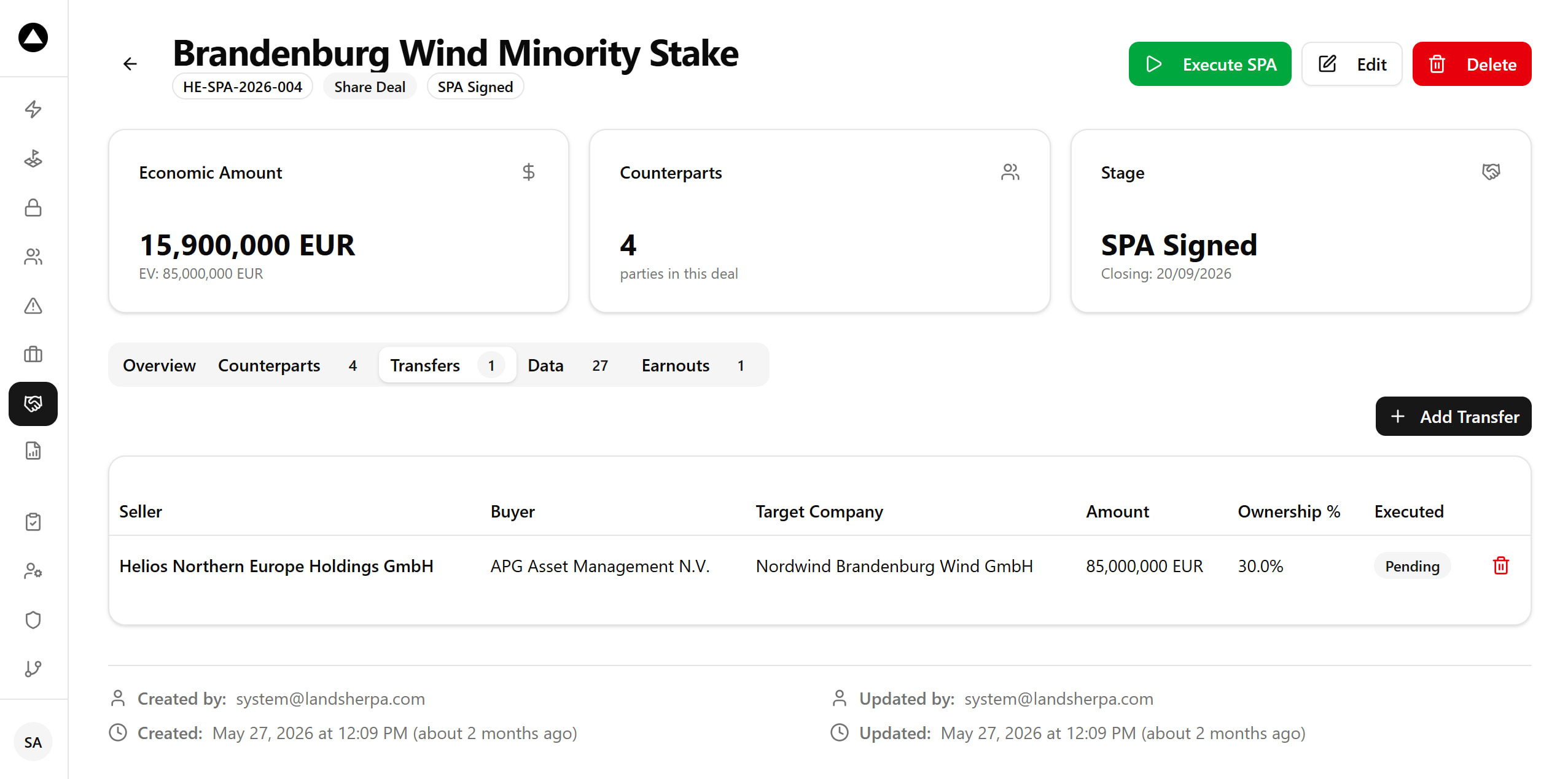
Transactions and the shareholder structures they change, in one place — ownership updates when a transaction executes.
Works seamlessly with the rest of Navorda
Navorda Transactions complements your legal counsel's data room and corporate registry filings. It keeps the operational record of ownership and transactions current between legal milestones — without replacing the documents your lawyers own.
Built on the same operating model
A closing is not a diagram update. It is an event on the same record that holds the project, its SPV and the shareholders above it — so the ownership Navorda reports is the ownership the deal produced.
Platform links each project to its SPV. Navorda Transactions governs the shareholder structure and the deals that change it.
Navorda Platform includes: Project, then Owning SPV. Navorda Transactions governs: Shareholder tree, then SPA, then Closing, then Ownership change. An SPA reaches closing → the stake it transfers is written into the shareholder tree the moment it executes → the previous holder stays in the history → the project's owning SPV in Navorda Platform is unchanged unless the deal moved it.
Platform links the project to its SPV. Transactions governs the rest of ownership.
Shareholder structures are portfolio facts; transactions are the events that change them. Both live in Navorda Transactions, on the project record Navorda Platform governs.
Navorda Transactions governs
- HoldCo relationships, shareholders, ownership percentages and the ownership hierarchy
- Equity shares, voting rights, entry and exit dates
- Acquisition and disposal processes
- Sales and Purchase Agreements
- The transaction pipeline: screening, due diligence, signing, conditions, closing
- Buyer, seller and transaction counterparties
- Affected SPVs, projects and stakes
- Transaction dates, and earn-outs where supported
- The ownership change at execution or closing, and the transaction history
Navorda Platform keeps
- The project record
- The SPV that owns each project
- The milestones, baselines and decisions a deal depends on
- Embedded reporting on all of it
Platform links each project to its SPV. Navorda Transactions governs the shareholder structure and the deals that change it.
Frequently asked questions
Ready to close deals without rebuilding the cap table?
Put shareholder structures and transactions in the same operating model as the projects they concern.