What Got You Here Won’t Get You There
The hidden governance problem inside growing energy developers: growth increases the distance between where reality happens and where decisions are made. Reality must flow upstream. Decisions and accountability must flow downstream.

Growth usually looks like a success story.
- More projects.
- More countries.
- More technologies.
- More people.
- More capital.
But growth creates another problem that is much less visible:
It increases the distance between where reality happens and where decisions are made.
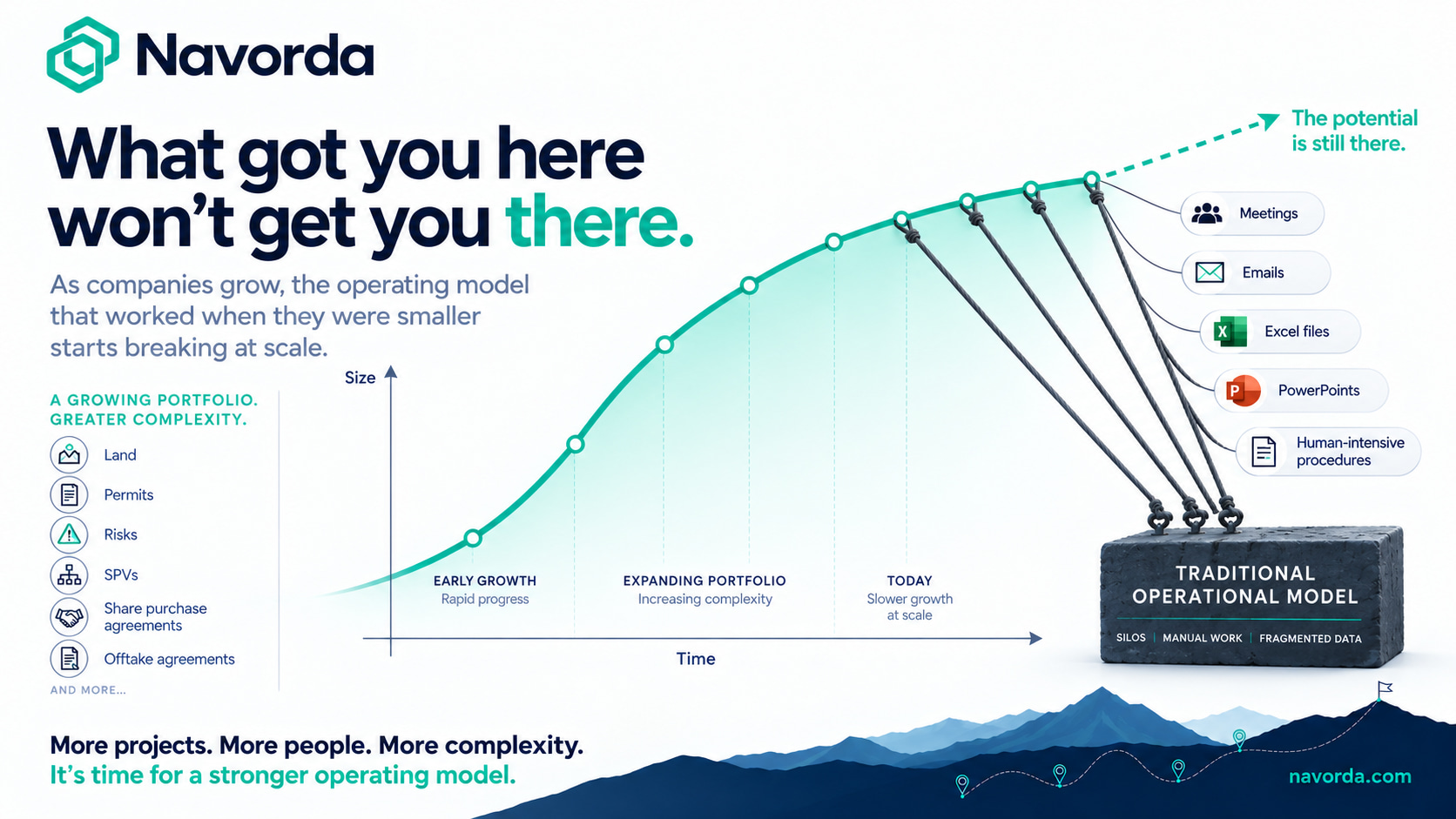
When an energy developer is small, communication itself can almost become the operating model.
The land specialist knows the permitting manager.
The project manager knows why a milestone moved.
The CEO probably knows which project is in trouble and why.
Then five projects become fifty.
One country becomes six.
Solar becomes solar, wind and BESS.
Projects accumulate grid dependencies, SPVs, financing commitments, offtake structures and transaction processes.
The information still exists.
But it has further to travel.
Someone knew. The organization did not.
A project manager knew a permit was slipping.
A land specialist knew a plot was still unsecured.
Engineering knew a substation dependency could affect several projects.
Finance knew that moving NtP would affect future cash requirements.
But management found out later.
Someone knew. The organization did not.
That is the governance gap.
And unless the operating model evolves, that gap tends to increase as the company grows.
More communication is not necessarily more governance
Companies usually compensate in predictable ways:
- More meetings.
- More emails.
- More spreadsheets.
- More PowerPoints.
- More reporting templates.
- More people consolidating information from other people.
These mechanisms can keep an organization working for a surprisingly long time.
The problem is not that these tools are bad.
A spreadsheet can calculate.
An email can communicate.
A presentation can summarize.
A meeting can align people.
The problem appears when they become the infrastructure holding the organization together.
Because moving information is not the same as governing the business.
Reporting is not the same as operating
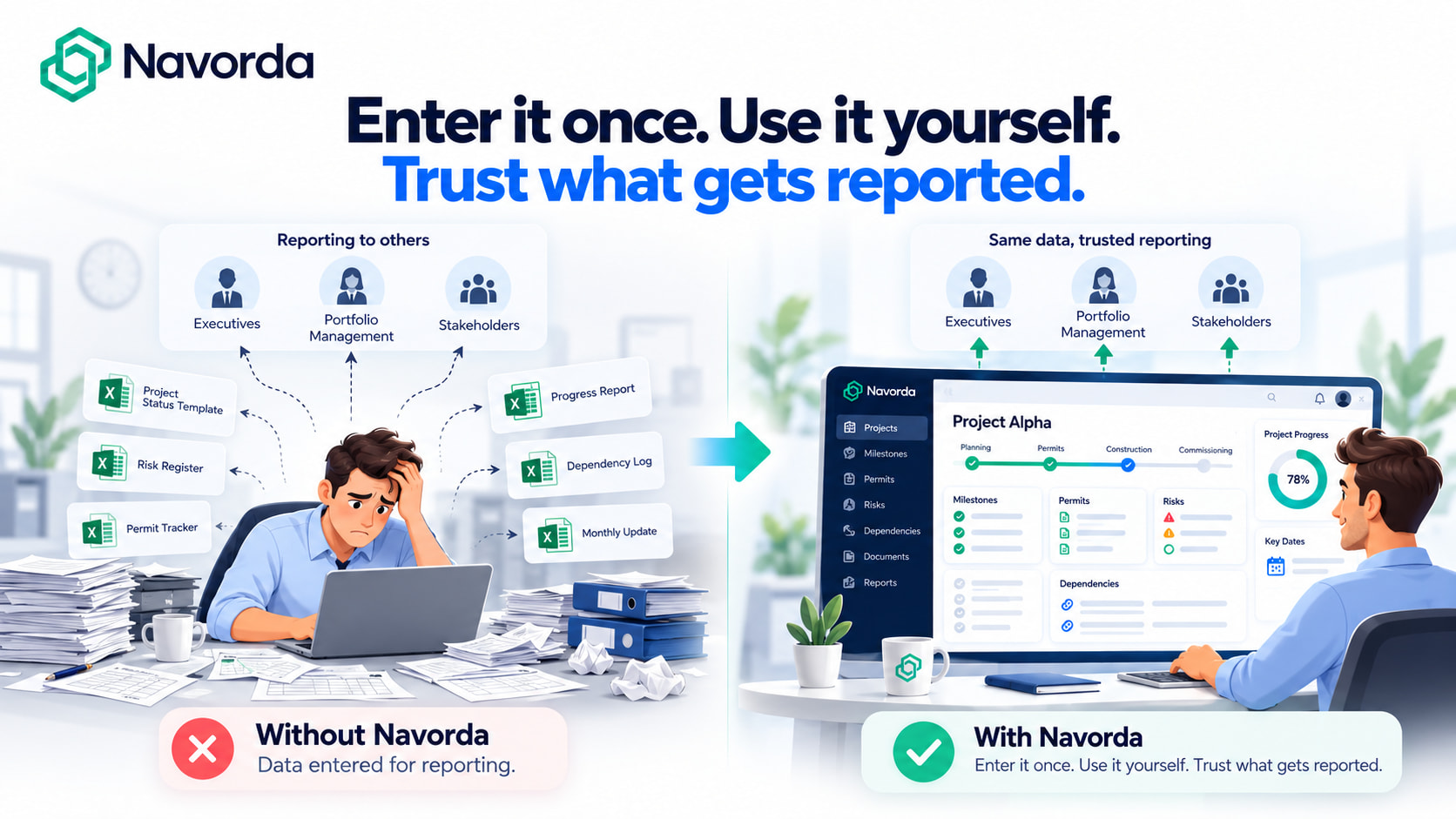
Traditional reporting periodically reconstructs reality.
Teams collect information, update files, reconcile numbers, prepare slides and eventually give management a representation of what is happening.
A governed operating model works differently.
It keeps the critical pieces of reality connected as they change.
- Projects connect to milestones.
- Milestones to dependencies.
- Dependencies to risks.
- Risks to owners.
- Projects to SPVs.
- Financial commitments to the events that drive them.
- External models to the assumptions and outputs that matter.
Then management can understand not only:
What is the latest number?
but also:
Where did it come from? Why did it change? What depends on it? Who owns the next action?
The objective is not to replace every tool
Digital transformation is sometimes interpreted as:
Find every spreadsheet and rebuild it inside a corporate application.
But replacing twenty spreadsheets with twenty screens does not necessarily solve the underlying problem.
Some tools may not need replacing at all.
A complex financial model, for example, may contain thousands of formulas and years of specialist knowledge.
The better question may be:
Which assumptions need to remain aligned with corporate reality, and which outputs become corporate commitments?
The model can remain the calculation engine.
The operating model governs what matters around it.
Replace what should be replaced. Integrate what already works. Govern what needs to remain flexible.
Information flows upstream. Accountability flows downstream.
As organizations scale, management cannot personally observe everything happening underneath it.
Operational reality therefore needs a reliable path upward: a delayed permit, an unsecured plot, a new risk, a changed assumption, a grid dependency.
These facts should not depend on whether the right person attends the right meeting.
Reality must flow upstream.
But governance works in both directions.
A management decision also needs to become execution: a changed priority, a mitigation action, a revised milestone, a commitment.
Someone needs to own what happens next.
Decisions and accountability must flow downstream.
That is how execution and management remain connected as the organization grows.
Robustness without rigidity
Scale does not only add volume.
It adds relationships.
More projects mean more permits, dependencies, risks, counterparties, SPVs, commitments and decisions.
And those relationships keep changing.
New countries introduce different permitting processes.
New technologies introduce different milestones.
New financing structures create different assumptions.
A scalable operating model therefore cannot simply be rigid.
It must provide structure without preventing adaptation.
Govern what must remain stable.
Allow what needs to change.
From fragmented information to governed context
Navorda is designed around this idea.
It connects the facts and commitments through which energy development actually happens: projects, land, permits, milestones, risks, dependencies, ownership, transactions, offtake, finance and the external models supporting critical decisions.
Not because every activity needs to happen inside Navorda.
But because the relationships that matter need to be governable.
The objective is to reduce the distance between:
What is happening, what management understands, and what the organization does next.
What got you here won’t get you there
The tools and habits that helped an organization grow will eventually show their limits at scale.
That does not mean throwing everything away.
It means recognizing that the operating model must evolve with the company.
As the business scales, governance has to scale with it.
That is the operating-model problem Navorda was built to solve.
Measure your own distance — the five-minute Corporate Distance Assessment
Excel Isn’t the Problem. It’s the Symptom.
AI Should Find the Next Delay Before the Dashboard Turns Red