Navorda vs Generic Project Management Tools for Energy Development
Generic project management tools track tasks. Energy project development runs on plots, permits, baselines and SPVs. A dimension-by-dimension comparison of the two approaches.

Every energy developer evaluating software eventually asks the same question: we already pay for a project management tool — can't we just use that?
It is a fair question. Generic project management platforms are mature, well-priced and familiar. For many industries they are exactly right. This post is an honest comparison of what happens when you run energy project development on one — dimension by dimension.
The Data Model
Generic tools model tasks, assignees, deadlines and budgets. Energy development runs on plots, permits, milestones, baselines, counterparts, SPVs and risks — entities with their own lifecycles, relationships and legal meaning.
You can emulate a permit as a task with custom fields. But the emulation breaks quickly: a permit has an administrative process behind it, statutory response windows, a responsible authority, and downstream dependencies on grid access and construction start. When the data model does not know what a permit is, every report becomes a manual reconstruction.
Land and Cadastral Reality
Land securization is where generic tools give up entirely. A solar project may sit on dozens of plots with different owners, agreement types and payment schedules. That data is spatial by nature — plot boundaries, cadastral references, overlaps with the project layout.
The usual workaround is a separate GIS tool plus a spreadsheet, joined by hope. Navorda treats the map as part of the operating system: plots, contracts and counterparts live in one place, and cadastral data imports natively.
Baselines vs Moving Deadlines
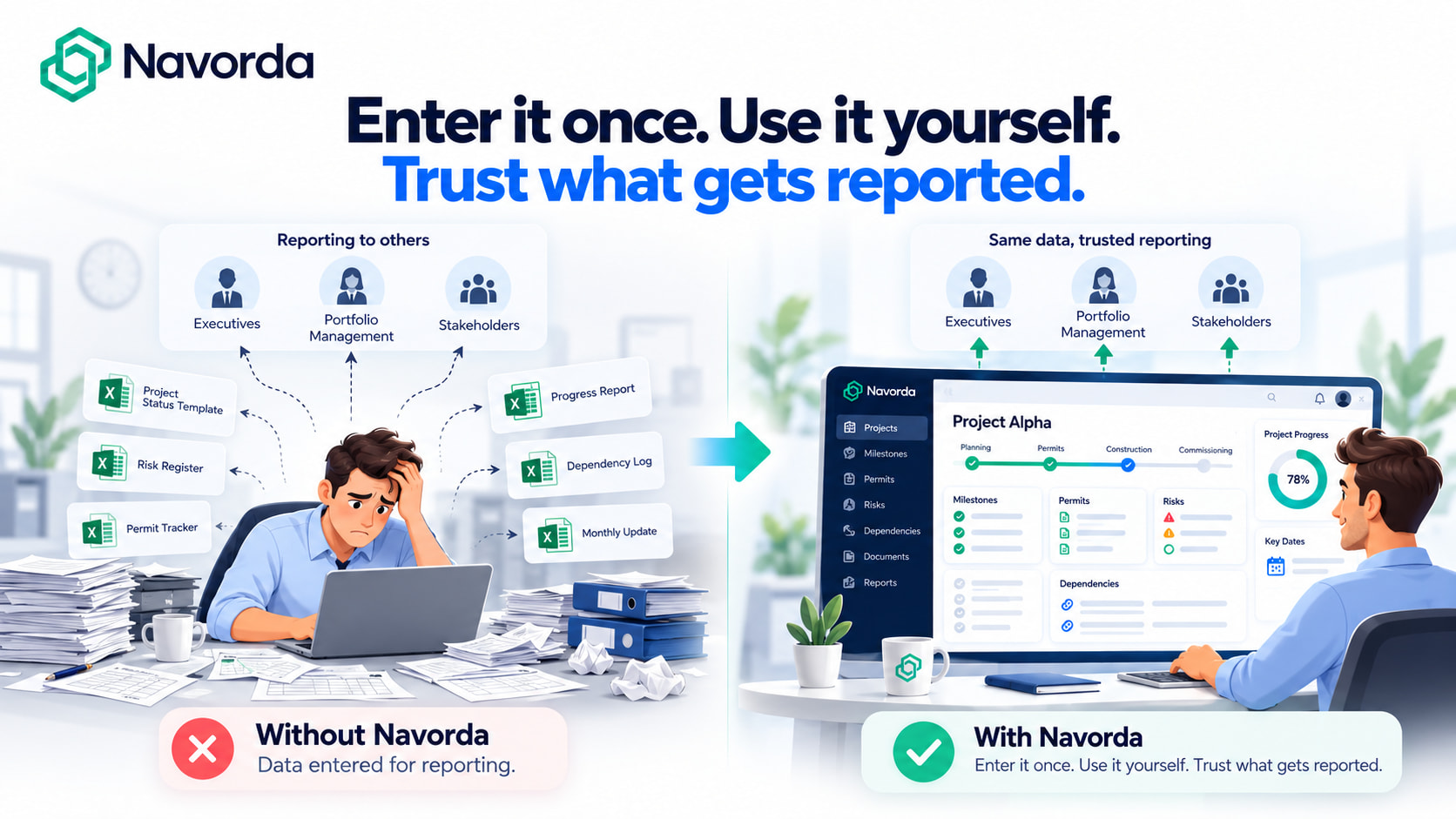
In a generic tool, when a date changes, the old date is gone. There is no approved baseline, so there is no deviation — just the current plan, which is always, trivially, on schedule.
Development teams need the opposite: a versioned baseline that management approved, and a live measurement of every deviation against it. That is the difference between knowing your RTB date moved and finding out at the quarterly review.
Risk in Days and Euros
Generic tools treat risk as a list with color-coded severity. Investment decisions need more: how many days does this risk put at stake, on which milestones, at what financial impact, and what does mitigation buy us? Purpose-built risk management quantifies exposure per project and aggregates it across the portfolio.
Ownership: SPVs and SPAs
Projects are companies. They get created, bought, and sold, in whole or in part, through Sales and Purchase Agreements with milestone-linked payments. No generic project tool models a multi-level shareholder structure, and reconstructing ownership in a spreadsheet after every transaction is exactly the kind of error-prone ritual software should have eliminated years ago.
Portfolio Rollup
When the data model fits the domain, portfolio reporting is a view, not a project. Capacity by stage, funnel conversion, exposure, upcoming milestones — live, per technology, per country, per vehicle. When it does not fit, reporting is a monthly export-and-assemble exercise that is stale before it is finished.
When a Generic Tool Is Enough
Honesty requires this section. If you develop a handful of projects, hold them to COD, and your land situation is simple, a well-run generic tool plus a disciplined spreadsheet may genuinely be enough. The overhead of a dedicated platform is justified by portfolio scale, transaction activity, or land and permitting complexity — not by fashion.
Construction task execution is also not the battleground: once a project is in build, EPC-side tools do that job well. The gap is everything before and around it — the development operating system.
The Bottom Line
Generic tools ask energy teams to translate their domain into tasks. Purpose-built platforms speak the domain natively.
Translation has a permanent cost: every report, every audit, every handover pays it again. A platform whose data model already knows what a plot, a permit, a baseline and an SPV are removes that tax — and everything else, from risk quantification to AI, becomes possible because the data is structured and governed.