The Missing Data Contract in Energy Development
Because the language inside your company needs a source of truth too.
 Luis Cabello6 min read
Ask anyone who has spent several years inside a renewable energy developer what the hardest operational problems are, and eventually the conversation stops being about megawatts.
It becomes about words.
What exactly is a project?
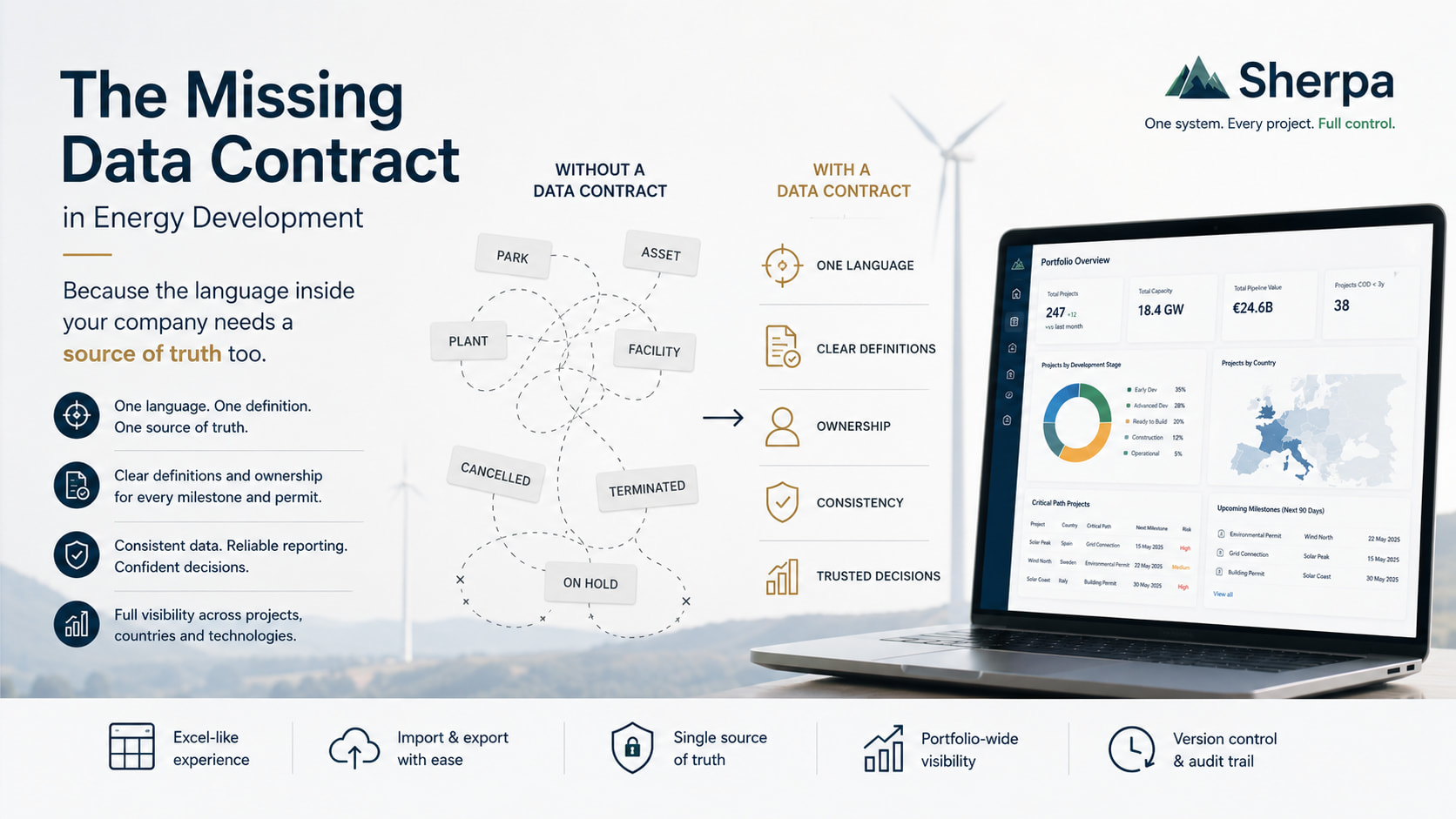
Inside the same company, the same infrastructure may be called:
- Park
- Asset
- Plant
- Facility
Development uses one term.
Engineering uses another.
Finance uses a third.
Four names for the same physical reality — repeated across spreadsheets, dashboards, investment memos, and portfolio reports every single day.
At first, this feels harmless.
Until the portfolio starts scaling.
The Real Problem Is Semantic Drift
Complexity in energy development rarely starts with infrastructure itself.
It starts when definitions slowly diverge across teams, countries, and systems.
The same fragmentation appears everywhere:
- project health
- permitting
- land securization
- risk management
- governance reporting
One team marks a project:
- Cancelled
Another:
- Terminated
Another:
- On Hold
Sometimes nobody fully agrees what each status actually means.
So portfolio review meetings slowly become:
- reconciliation exercises
instead of:
- decision-making exercises.
Nobody Is Doing Anything Wrong
Every team is simply using:
- the terminology they inherited
- the spreadsheets they received
- the systems available to them
The problem is structural:
most organizations never created a true operational data contract.
A single, enforceable agreement defining:
- what the organization tracks
- how it is named
- what it means
- who owns it
- and how consistency is preserved over time
Without that contract, every new system simply becomes:
another place where the same disagreement lives.
A dashboard does not solve ambiguity.
It visualizes ambiguity.
The Cost Is Paid Quietly
The symptoms become familiar very quickly inside large portfolios:
- The same milestone appears under different names across reports
- Teams calculate the same KPI differently
- Management spends time validating definitions instead of making decisions
- Due diligence processes slow down because nobody fully trusts the portfolio snapshot
- New hires spend months learning the company's unofficial vocabulary
These are not failures of software.
They are failures of semantics.
Why Traditional Governance Usually Fails
Most companies try to solve this through:
- workshops
- taxonomies
- PDFs
- data dictionaries
And six months later:
- spreadsheets diverge again
- definitions drift
- documentation becomes obsolete
Because documentation that lives outside the daily workflow always decays.
A true operational contract must become executable.
It must become part of the operational system itself.
Navorda Treats Operational Structure as a System Layer
This became one of the foundational principles behind Navorda.
Navorda's customization layer is not simply:
- a settings page
- a list of dropdowns
- a configuration menu
It behaves as an executable data contract owned by the organization itself.
The platform allows organizations to define:
- milestones
- permits
- substages
- technologies
- risk semantics
- metrics
- naming conventions
directly inside the system where teams actually work.
Not inside documentation.
Inside execution itself.
The Real Value Is Organizational Clarity
Over time:
- teams stop debating definitions
- reporting accelerates
- onboarding becomes easier
- governance becomes trustworthy
- leadership regains visibility
Eventually, something surprisingly rare happens:
everyone starts talking about the same reality.
Not because they memorized a governance document.
But because the operational system itself continuously reinforces shared semantics through daily execution.
The Future of Energy Development Requires Executable Governance
As energy portfolios become:
- larger
- more international
- more hybridized
organizations can no longer rely on loosely coordinated operational vocabulary.
The next generation of energy infrastructure platforms will not compete only on:
- dashboards
- automation
- AI
They will compete on their ability to create operational coherence across increasingly complex portfolios.
Because in large-scale energy development:
clarity is not created by visualizing more data.
It is created by ensuring the entire organization is finally talking about the same thing.