
Sometimes the Risk Has Wings: Why a Risk Register Must Connect to Milestones
Renewable energy development is not a straight line from origination to COD. Eagles, century-old olive trees, inheritance disputes or a change at the local council can all become part of the critical path — and a risk register disconnected from milestones will not see any of them coming.
 Luis Cabello6 min read
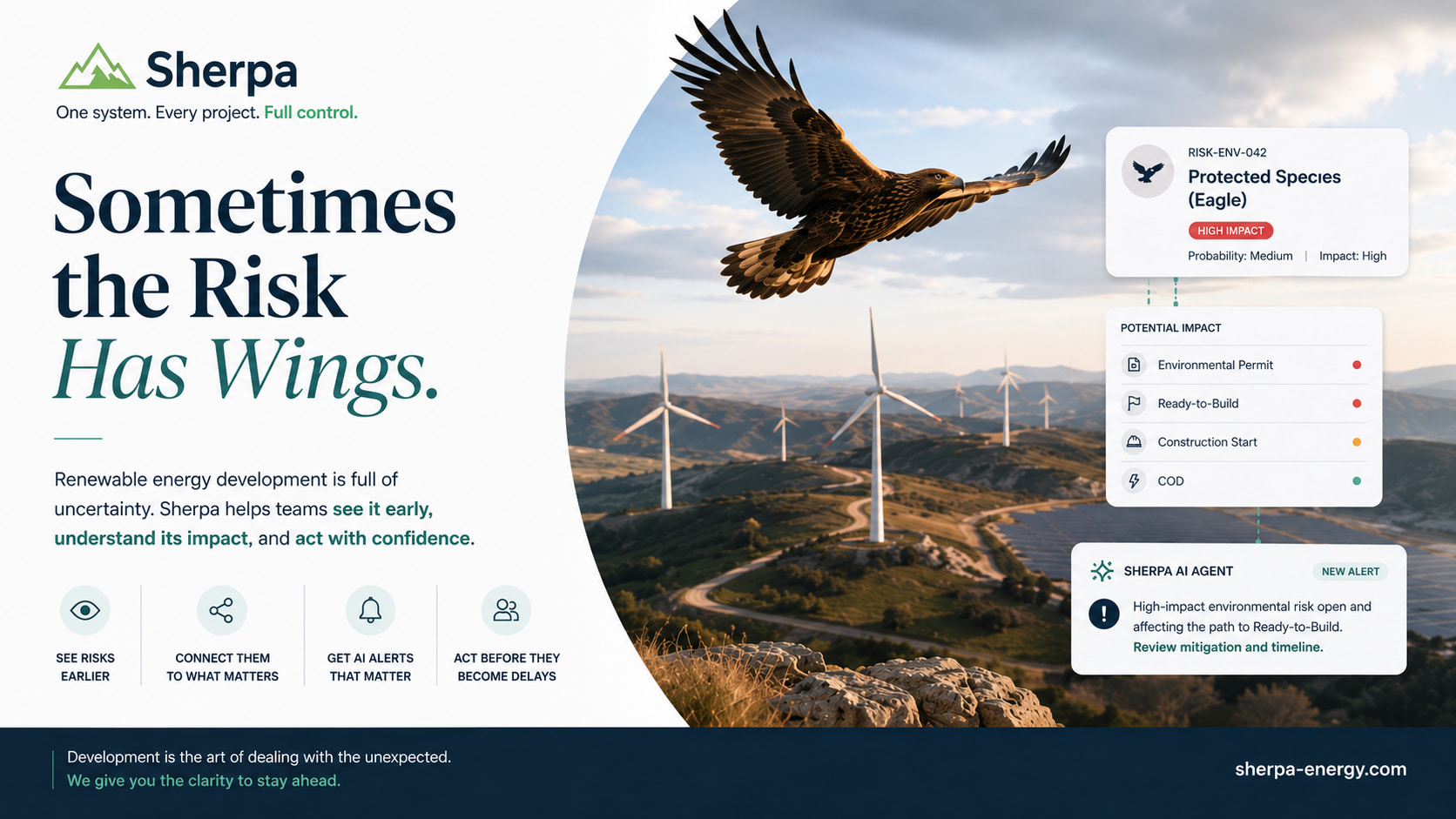
Sometimes the risk has wings.
A protected bird appears around the project area.
An environmental study identifies a constraint nobody expected when the opportunity was originated.
And suddenly, something invisible in the original plan becomes relevant to permitting, engineering, schedule — and potentially the economics of the project.
The specific risk may be unusual.
The situation is not.
Projects rarely evolve exactly as they were drawn in the first Gantt chart.
Sometimes It Is an Eagle
Other times, it is a group of century-old olive trees.
- A landowner dies, and an agreement becomes dependent on several heirs.
- The municipality changes its criteria.
- An election changes the people responsible for a local approval.
- A grid study introduces a requirement nobody anticipated twelve months earlier.
Renewable energy projects develop inside the real world.
And the real world does not follow the project plan.
Risks Should Not Live in Another Spreadsheet
Most organizations already manage risks.
The problem is usually where they live.
- The risk register lives in Excel.
- The project schedule lives somewhere else.
- Permitting has another tracker.
- Land has its own spreadsheet.
That fragmentation creates a blind spot.
A risk can be perfectly documented while remaining almost invisible to the person looking at the milestone it could jeopardize.
For example:
- Risk: environmental restriction affecting the evacuation route
- Probability: Medium
- Impact: High
- Mitigation: alternative routing under assessment
Useful. But incomplete.
The more important question is:
What does this risk threaten?
- The Environmental Permit?
- RtB?
- Construction start?
- Energization?
- COD?
A risk without connection to execution remains descriptive.
Governance starts when the organization understands its potential consequence.
Your milestones aren't dates. They're commitments. →
Risk Should Belong to the Project
At Navorda, risks belong to the project itself.
They carry structured information such as:
- Probability and impact, from which the system computes a severity score
- Owner, status and mitigation workflow
- Time-at-risk and time-after-mitigation, in days of potential delay
- Money-at-risk and money-after-mitigation, and the delta between them
- Affected infrastructure and related milestones
This allows management to distinguish between two very different situations:
- A project that is already delayed.
- A project carrying the risks that may create the next delay.
That second category is where risk management becomes truly valuable.
Most reporting is backward-looking.
Something happens.
A milestone moves.
The report turns red.
Then management asks why.
Risk governance should work one step earlier.
Not only: Why did COD move?
What could make COD move next?
How Navorda Risks quantifies risk exposure in days and euros →
What Is This Risk Worth in Days and Euros?
A risk that is only described can be discussed. A risk that is quantified can be funded.
That is the difference between a register that documents and a register that governs. Four measures do most of the work:
- Time-at-risk — the days of delay if the risk materializes unmitigated.
- Time-after-mitigation — the days that remain once the planned measures are in place.
- Money-at-risk — the financial exposure of the unmitigated case.
- Money-after-mitigation — the exposure that survives the mitigation.
The delta between the before and after pairs is the number that funds the mitigation. It answers the only question a budget holder actually asks: what does acting now buy us?
Put a number on it.
A 36 MWp asset producing 70 GWh per year loses roughly 17.5 GWh to a three-month delay. At €40/MWh, that is about €700,000 of revenue arriving later than the financial model assumed.
So an environmental risk carrying 90 days of time-at-risk on the path to RtB is not a "High" impact rating. It is roughly €700,000.
"Impact: High" is an opinion. "90 days and €700,000" is a decision.
Those figures are illustrative — a 36 MWp project at 70 GWh/year and €40/MWh. Substitute your own assumptions and the structure holds: the point is that the register produces a number at all.
The business case for project development software — what it costs not to invest →
This Is Where AI Becomes Useful
Navorda takes this one step further.
One of the Navorda AI agents, the Pathfinder, exists for exactly this job: connecting risks to the dates, dependencies and outcomes they can actually affect. Its question is a simple one — which risks threaten my milestones?
Not because AI magically solves an environmental constraint, a land dispute or a permitting issue.
It does not.
Its value is in connecting information that has traditionally been separated.
The risk register says one thing.
The permit tracker says another.
The milestone forecast says something else.
Traditionally, understanding the combined consequence depends on somebody noticing the relationship.
A governed system makes that relationship explicit. AI can then help surface it. For example:
High-impact environmental risk remains open. Environmental Permit is on the path to RtB. Current mitigation has no committed completion date. Potential RtB exposure should be reviewed.
The AI has not solved the risk.
But it has made it much harder to ignore.
No extra reporting layer. No chatbot to babysit. Risks matter when they touch the plan, and the job of the agent is to say so before the plan moves.
The seven Navorda AI agents — how governed data becomes guided action →
Software Does Not Solve the Eagle
Navorda will not move an eagle.
It will not resolve an inheritance.
It will not convince a municipality.
It will not negotiate a land agreement.
Those problems still require experienced people.
But experienced people make better decisions when they know:
- What the risk is
- Who owns it
- How serious it is
- What is being done about it
- And what happens if it materializes
Because an unknown risk cannot be managed.
A known but forgotten risk is barely better.
A visible, owned and monitored risk is something the organization can act on.
The Gantt Chart Is Not the Project
There is a temptation to describe development as a clean sequence:
- Land secured.
- Permit obtained.
- RtB.
- NtP.
- Construction.
- COD.
It looks great on a slide.
Reality is different.
Development is a network of assumptions, dependencies, authorities, landowners, environmental constraints and unexpected events.
The schedule describes the intended route. Risk management describes what may force you to change it.
Good development teams are not teams whose projects never encounter problems.
Those teams probably do not exist.
Good teams identify problems early, understand their implications, assign responsibility and adapt.
And good portfolio governance makes that capability scalable.
Sometimes the issue will be environmental. Sometimes legal. Sometimes technical. Sometimes political. Sometimes commercial.
And occasionally, yes, it may have wings.
Navorda does not remove development risk. It makes risk visible, connected and actionable before it becomes a delay.
Because uncertainty is not an exception to renewable energy development.
Dealing with it is the job.
Renewable energy project development software — the buyer's guide →