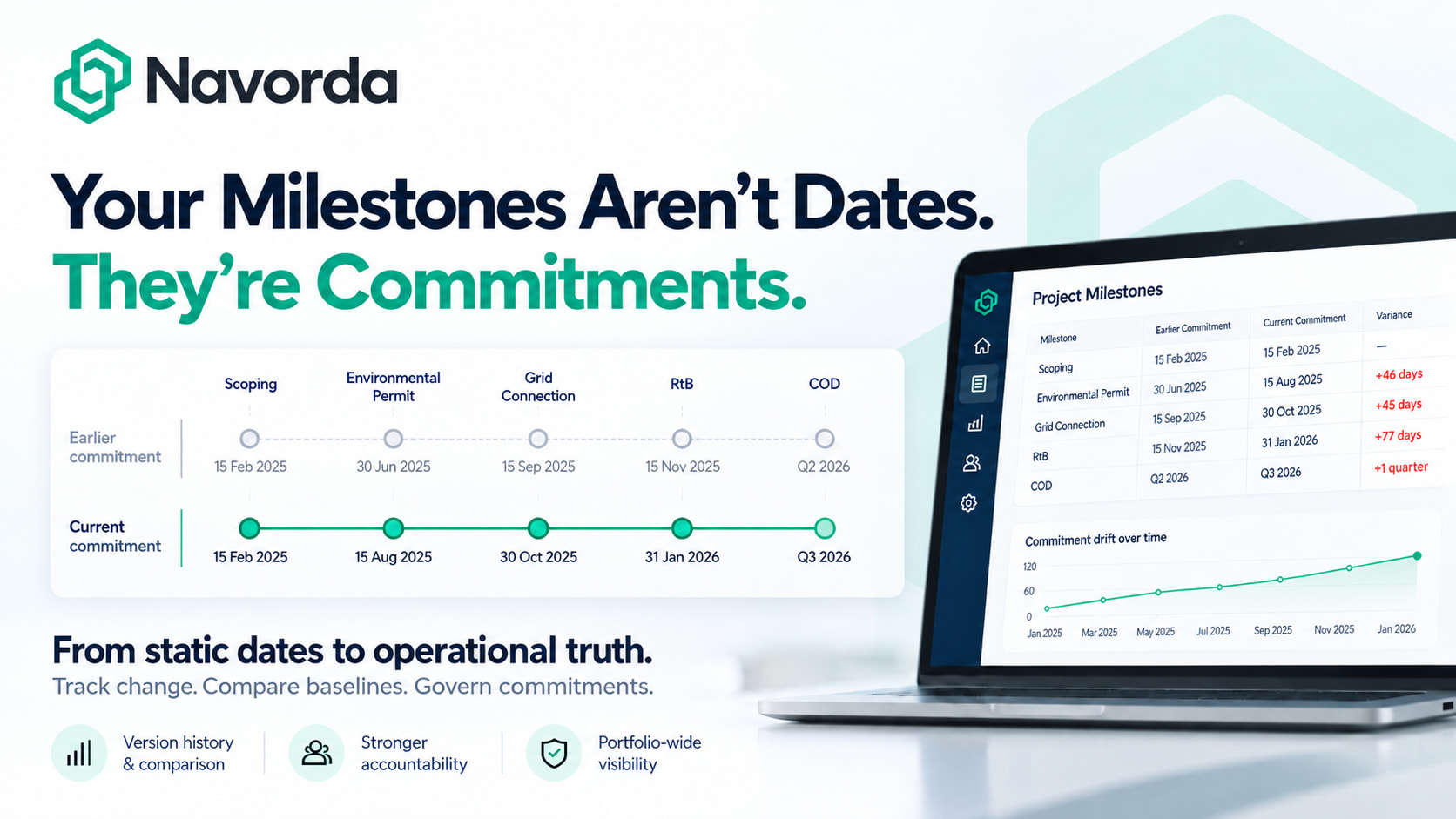
Your Milestones Aren’t Dates. They’re Commitments.
A milestone only creates value when ownership, dependencies, baseline and consequences move with it.

In most energy development organizations, milestone tracking appears deceptively simple.
A project has:
- an Environmental Permit date
- a Grid Connection milestone
- an RtB target
- a COD forecast
Each milestone is usually represented by a single date inside an Excel file, a project management tool, or a dashboard.
At first glance, this seems reasonable.
But in practice, this approach hides one of the biggest operational blind spots in energy development:
organizations rarely track what they previously committed to.
Because a milestone is not a date. It is a commitment — and a commitment has an owner, depends on other things, was promised against a baseline, and carries consequences when it moves.
And that changes everything.
A Date Is Not a Commitment
Most systems store milestones as if they were static truths.
A permit is expected on:
- June 2026
- then August 2026
- then November 2026
The old value disappears.
The new value replaces it.
Eventually, the organization only sees the latest forecast.
But the most important operational question is no longer visible:
What did we believe three months ago?
Without that context, delays become normalized.
Teams continuously update dates during daily execution:
- permits move
- contracts slip
- mitigations shift
- COD forecasts evolve
And because previous commitments disappear, organizations lose the ability to measure:
- commitment drift
- execution reliability
- forecast accuracy
- operational accountability
At executive level, this creates a dangerous illusion of control.
Leadership may know where projects are today.
But they no longer know:
- where projects were expected to be
- when deviations actually started
- which teams consistently maintain realistic plans
- which portfolios systematically drift over time
The result is reactive management instead of operational governance.
Energy Development Is Not Static — It Is Evolutionary
A milestone is not a fixed state.
It is a continuously evolving operational process.
Every forecast is effectively a commitment:
- to investors
- to management
- to lenders
- to EPC contractors
- to counterparties
- to portfolio expectations
Yet most systems treat updates as replacements instead of historical states.
A milestone only creates value when four things move with it:
- Ownership — who is accountable for the commitment, not only who typed the date
- Dependencies — what waits on it, and what it waits on
- Baseline — what was promised, in which version, and to whom
- Consequences — what the move does to risk, schedule and money downstream
Strip those away and what is left is a cell in a spreadsheet.
This is the missing layer in modern energy development software.
Navorda Treats Milestones as Commitments
Navorda was designed around a different philosophy.
Instead of storing only the latest milestone date, Navorda stores the evolution of commitments over time.
By default, teams define expected acquisition dates for:
- permits
- land contracts
- risk mitigations
- RtB
- NtP
- COD
- SPA execution milestones
- and other critical development events
When those expectations change, Navorda does not simply overwrite the old value.
It versions it.
And it keeps the four things that make a milestone a commitment attached to it:
- Baseline — every reporting cycle locks a version: Budget, Forecast, a monthly snapshot or a custom baseline. Locked versions never change, so today's date is always read against what was committed.
- Dependencies — project-to-project, plant, line and substation relationships are part of the model, so an upstream slip shows its downstream impact.
- Consequences — risks attach to the milestones they threaten, quantified as time-at-risk and cost-at-risk. In Navorda Finance, a linked forecast date can follow the milestone when its owner chooses; nothing is recalculated behind anyone's back.
- Ownership — every change keeps who made it and when. What management decided about the slip, and the commitments that followed, become owned, dated Activities on the project record in Navorda Decisions.
The goal is not to punish teams for changing dates.
The goal is to create visibility into how projects evolve over time.
Benchmarking Reality Against Expectations
Once milestones become versioned states instead of static values, entirely new operational capabilities emerge.
Leadership can benchmark:
- current portfolio status
- previous monthly forecasts
- yearly commitments
- baseline schedules
- execution consistency across teams and regions
The conversation changes fundamentally.
Instead of asking:
Where are we today?
Organizations can finally ask:
Are we executing according to plan?
And even more importantly:
When did we stop being aligned with the plan?
This distinction matters enormously at scale.
Because in large development portfolios, delays rarely appear suddenly.
They emerge progressively through small deviations:
- a permit slipping by two weeks
- a grid milestone moving one month
- a land package progressing slower than expected
Individually, these changes seem manageable.
Collectively, they create major COD exposure.
Version-aware tracking makes those patterns visible early.
Operational Governance Requires Historical Truth
The energy industry has become extremely sophisticated in:
- financial modeling
- engineering
- project financing
- energy forecasting
But operational governance often still relies on systems that erase their own history.
Without historical visibility:
- accountability weakens
- planning quality deteriorates
- reporting becomes reactive
- portfolio governance becomes subjective
Versioning solves this by preserving operational truth over time.
Not only for dates.
But also for:
- amounts
- statuses
- project phases
- risks
- ownership structures
- financial expectations
The result is not simply better reporting.
It is a more governable organization.
The Next Generation of Energy Development Platforms
As development portfolios grow larger and more geographically distributed, organizations need more than project tracking tools.
They need systems capable of managing:
- operational commitments
- evolving forecasts
- historical accountability
- portfolio-wide execution governance
This requires moving beyond static milestones toward version-aware operational systems.
Because in energy development, the most important question is often not:
What is the current date?
But rather:
How far are we drifting from what we promised?
Your milestones aren't dates. They're commitments. Govern them as commitments — with their owner, their dependencies, their baseline and their consequences.
Related reading
Sometimes the Risk Has Wings: Why a Risk Register Must Connect to Milestones