
Energy Critical Path: Why Power Plants, Substations, and Power Lines Should Not Be Managed as a Single Project
The infrastructure may be connected physically. That does not mean it should be managed operationally as one asset.
 Luis Cabello6 min read
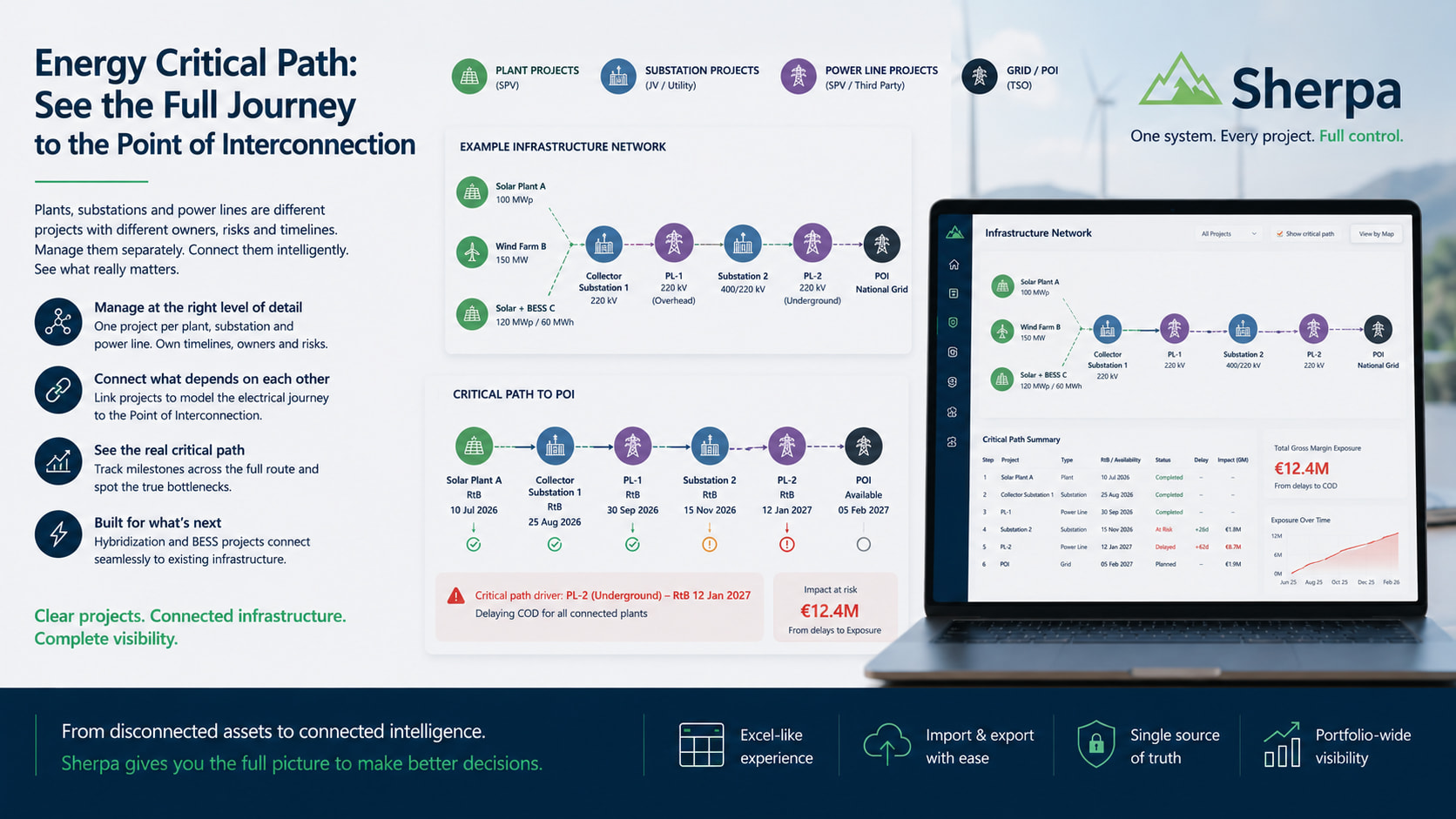
One of the most common structural problems in energy development portfolios starts surprisingly early:
everything gets grouped together.
The solar plant, the substation, the evacuation line, the grid connection infrastructure — all managed inside the same spreadsheet, the same project folder, or the same project record.
At first, this approach feels practical.
It reduces:
- the number of spreadsheets
- the amount of documentation
- the number of folders
- the perceived operational complexity
And historically, many organizations evolved this way because:
- financial models often treated the infrastructure as a single business case
- teams were smaller
- portfolios were simpler
- projects were developed sequentially instead of industrially
So the structure remained.
Even as portfolios scaled.
The Problem Appears When Infrastructure Starts Scaling
The issue is not visible when managing a handful of projects.
It becomes visible when organizations start operating:
- multiple plants
- shared substations
- complex evacuation networks
- hybrid infrastructures
- multi-SPV ownership structures
- regional portfolios
At that point, the operational reality becomes much more complex than the spreadsheet structure representing it.
Because in practice:
- plants may belong to individual SPVs
- substations may belong to joint ventures
- power lines may be shared across assets
- infrastructure may evolve independently
- different components may face different permitting paths
- delays may affect only parts of the electrical chain
And suddenly, a fundamental operational question becomes difficult to answer:
What is actually Ready-to-Build?
Is it:
- the plant?
- the substation?
- the evacuation infrastructure?
- the grid reinforcement?
- the final path to the Point of Interconnection?
Without structural separation between assets, organizations lose visibility into the real operational critical path.
Energy Infrastructure Is a Dependency Network
A power plant does not operate in isolation.
Its ability to generate revenue depends on an entire chain of interconnected infrastructure:
- internal collection systems
- evacuation lines
- substations
- transformer delivery
- grid infrastructure
- Point of Interconnection availability
Each element has:
- its own permits
- its own land requirements
- its own risks
- its own timelines
- its own stakeholders
- its own operational exposure
And critically:
- each element can delay the others.
A substation transformer delay may impact several plants simultaneously.
An environmental restriction may force an evacuation line to:
- change route
- move underground
- restart permitting
- redesign engineering
Yet in many traditional systems, all these realities remain flattened into a single project row.
That creates operational ambiguity precisely where organizations need clarity most.
Navorda Models the Electrical Journey, Not Just the Asset
Navorda was designed around a different principle:
infrastructure components should be operationally independent but logically connected.
Instead of grouping everything into a single project entity, Navorda allows organizations to manage:
- plants
- substations
- power lines
- grid infrastructures
- hybridization projects
- BESS expansions
as separate but related projects.
This creates a much more realistic representation of how energy infrastructure actually evolves.
Each infrastructure component can maintain:
- independent milestones
- separate permitting paths
- dedicated risks
- individual ownership structures
- technology-specific governance
- localized reporting
while remaining connected operationally to the broader energy system.
From Project Tracking to Critical Path Intelligence
Once projects become interconnected operational entities, a new reporting capability emerges:
Navorda can reconstruct the full electrical journey toward the Point of Interconnection.
This means organizations can understand not only:
- the RtB of the plant
But also:
- the latest RtB across all related infrastructure required for energization.
For example:
- the plant may already be RtB
- the internal substation may be progressing correctly
- but a 220 kV evacuation line between substations may still be delayed
Without connected infrastructure visibility, this bottleneck often remains hidden until late stages.
Navorda surfaces it directly.
The result is a much clearer operational understanding of:
- dependency chains
- portfolio exposure
- infrastructure bottlenecks
- true energization readiness
Hybridization Makes This Even More Critical
The industry is now entering a new phase of infrastructure complexity.
Hybridization is becoming standard:
- solar + wind
- solar + BESS
- wind + storage
- phased expansions
- shared evacuation assets
These infrastructures rarely behave like standalone projects anymore.
A BESS installation may reuse:
- existing evacuation lines
- substations
- permits
- grid infrastructure
A hybrid expansion may depend on assets already in operation.
Trying to manage this reality inside rigid, monolithic project structures quickly becomes unmanageable.
Navorda simplifies this by allowing organizations to:
- create infrastructure components independently
- connect them dynamically
- visualize relationships clearly
- maintain operational traceability across the full portfolio
The result is not only cleaner governance.
It is a much more accurate representation of how modern energy infrastructure actually works.
The Future of Energy Development Is Infrastructure Intelligence
As energy systems become larger, more interconnected, and more hybridized, operational management can no longer rely on flat project structures.
Organizations need systems capable of understanding:
- infrastructure dependencies
- shared operational exposure
- interconnected milestone logic
- portfolio-wide critical paths
Because in modern energy development:
the project is no longer just the plant.
The project is the entire journey to energization.