
The Cost of Delay: Why Energy Development Needs Economic Visibility, Not Just Project Tracking
Most organizations can tell you if a project is delayed. Far fewer can tell you what that delay is economically worth — and that distinction reframes how portfolios should be governed.
 Luis Cabello7 min read
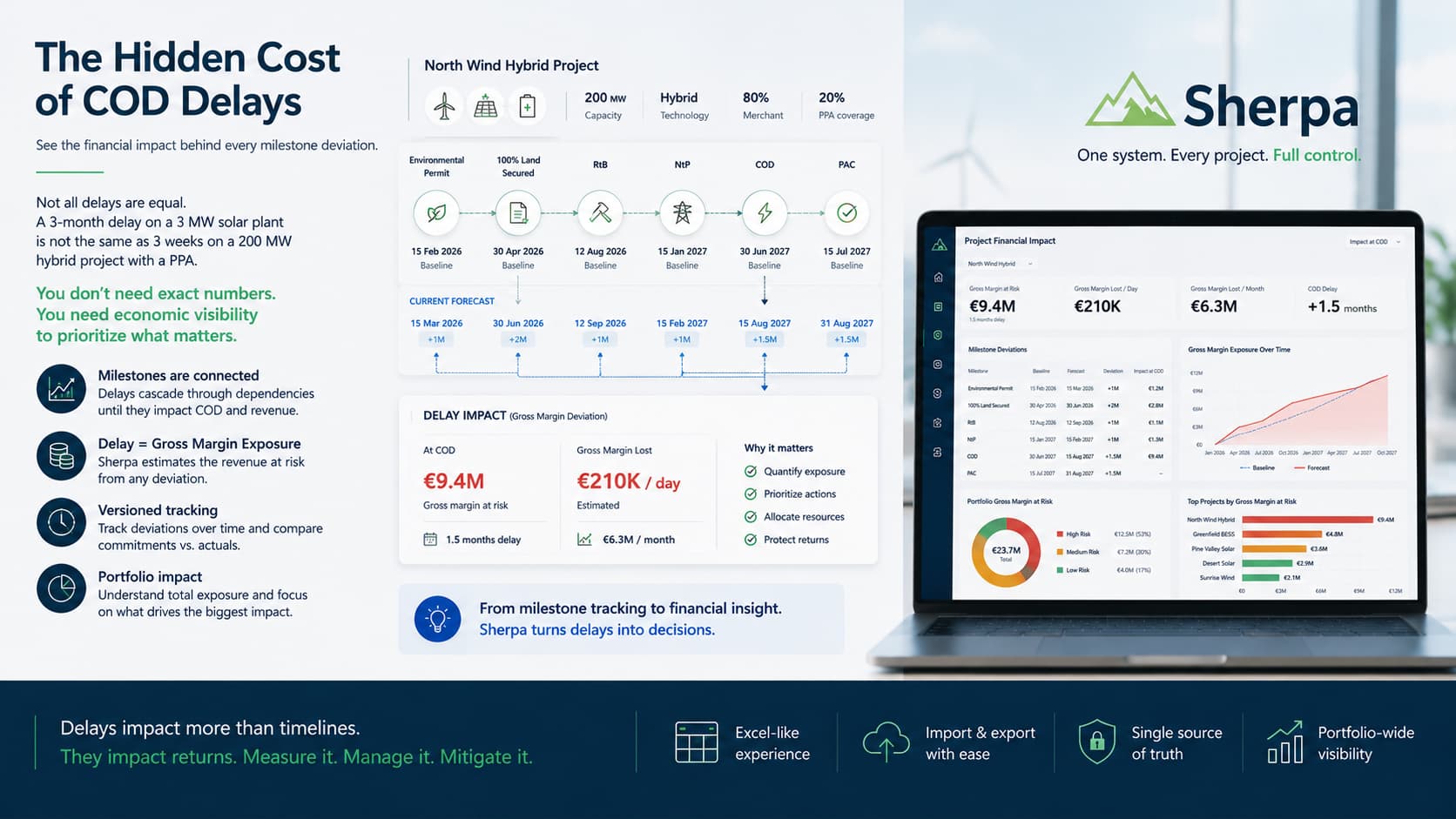
Most energy development organizations can tell you if a project is delayed.
Far fewer can tell you what that delay is economically worth.
And that distinction matters far more than most teams realize.
Because in modern energy portfolios, delays are not just operational deviations.
They are financial events.
Not All Delays Are Equal
In many organizations, milestone tracking still focuses primarily on dates:
- permit acquisition
- land securization
- RtB
- NtP
- COD
- PAC
Projects are usually categorized as:
- on track
- delayed
- at risk
But this creates a major operational blind spot.
A three-month delay on a small 3 MW solar project does not have the same economic impact as:
- a three-week delay on a 200 MW hybrid portfolio
- a delayed BESS facility supporting grid capacity
- a large wind project operating under favorable market conditions
- a project partially secured under long-term PPAs
Yet in many reporting environments, all delays appear operationally similar.
Because the systems tracking them rarely understand their financial significance.
The Industry's "Exact Figure" Problem
One of the most common reasons organizations avoid quantifying delay impact is surprisingly simple:
We cannot provide an exact number.
And technically, that is true.
The real economic impact of a delay depends on many variables:
- technology
- MWp vs MWn
- production yield
- merchant exposure
- PPA structures
- energy pricing
- curtailment assumptions
- operational efficiency
- location-specific performance
As a result, many organizations avoid translating delays into economics altogether.
But operational leadership rarely requires perfect precision to make decisions.
What leadership actually needs is something much more practical:
an estimation of relative economic importance.
Because prioritization does not require accounting-grade certainty.
It requires operational visibility.
The Real Question Is Not "Is It Delayed?"
The real question is:
How economically relevant is this delay compared to everything else happening in the portfolio?
That changes the management conversation completely.
Once delays become economically measurable:
- priorities become clearer
- mitigation actions become easier to justify
- escalation decisions become more objective
- portfolio governance becomes more rational
A project delay stops being just:
- "another red milestone"
And becomes:
- quantified operational exposure.
Navorda Connects Operational Deviations to Financial Impact
Navorda was designed around a simple operational principle:
development milestones are not isolated dates.
They are interconnected drivers of future revenue generation.
In many traditional systems, milestones such as:
- permit acquisition
- land securization
- RtB
- NtP
are tracked independently from COD and PAC.
But operationally, these milestones are deeply connected.
A delay in environmental permitting may impact:
- construction start
- energization
- COD
- revenue generation
Navorda's dependency framework models these relationships directly.
Milestones can be configured with "depends on" logic, enabling delays to propagate through the development timeline until their impact on COD becomes visible.
This creates a much more realistic operational model of project execution.
From Delay Tracking to Gross Margin Exposure
Once milestones are connected, Navorda can estimate the economic impact of delays through proxy metrics such as:
- expected revenue deviation
- gross margin deviation
- delay exposure per project
- portfolio-level impact
Importantly, the goal is not to predict the future with absolute precision.
The goal is to provide operationally meaningful approximations.
Because in executive decision-making:
- a directional estimate is often dramatically more useful than no estimate at all.
Navorda enables organizations to understand:
- which projects are drifting
- which deviations matter financially
- where mitigation efforts create the highest economic value
- how delays accumulate across the portfolio
This transforms milestone tracking into operational finance.
Versioning Unlocks Economic Benchmarking
This capability becomes even more powerful when combined with Navorda's version-aware tracking framework.
Because once historical commitments are preserved, organizations can benchmark:
- current expectations
- previous forecasts
- planned COD dates
- evolving financial exposure over time
Leadership can finally answer questions such as:
- How much gross margin exposure has increased this quarter?
- Which teams consistently maintain reliable forecasts?
- Which portfolios are systematically drifting economically?
- When did the deviation first become visible?
Without historical versioning, these questions are almost impossible to answer reliably.
The Next Evolution of Energy Portfolio Management
As energy portfolios grow larger and more capital-intensive, operational management can no longer stop at milestone visibility.
The next evolution is economic visibility.
Not only:
- what is delayed
But:
- what the delay actually means financially.
Because the future of energy development will not be driven only by:
- more projects
- more capital
- more infrastructure
It will be driven by organizations capable of:
- prioritizing intelligently
- understanding operational exposure
- translating execution into economics
- governing complexity at portfolio scale
And that requires systems designed not only to track projects —
but to understand the economic consequences of how those projects evolve over time.