The Best Renewable Energy Project Development Software in 2026
Ten platforms genuinely worth evaluating for renewable energy project development in 2026, organized by the buyer situation each is best for — with the vendor disclosure up front and no invented scores.
 Luis Cabello10 min read
"What is the best renewable energy project development software?" is a question with no honest one-word answer, because the tools that show up for it are built for different jobs. The honest version of the answer is a short list organized by buyer situation — which is what this article is. Ten platforms, each named as the best pick for the situation it was actually built for, and a clear account of where each one stops.
One disclosure before anything else: this article is written by CabSan Solutions, and we build Navorda, one of the tools listed below. We describe every vendor from their own public material, say plainly what each is best at, and try to be as hard on our own product as on the others. Treat this — like every vendor-written roundup, and most roundups in this category are vendor-written — as an informed but interested starting point, not a verdict.
What this category is (and is not)
Renewable energy project development software governs the pre-construction lifecycle of energy projects — land, permits, milestones, risks and ownership — for solar, wind, BESS, hydrogen and data center power portfolios. It is not generic project management with an energy template, and it is not asset management for operating plants: the entities that matter are plots, cadastral references, per-jurisdiction permitting processes, approved baselines, counterparts and SPVs, and a tool either models them natively or emulates them with custom fields. We keep a full definition, the six workflows the category must support, and an evaluation checklist in the buyer's guide.
Renewable energy project development software: what it is, and how to choose it
How we picked (and why there are no scores)
No weighted criteria, no stars, no leaderboard. Numeric rankings in vendor-written roundups are marketing dressed as analysis — including, in fairness, any we might invent here. Instead, each tool below is named best for a specific buyer situation, based on what the vendor's own material says the product is built for: the primary object of its data model, its stated geography, and where its depth genuinely lies. If your situation matches, that tool belongs on your shortlist ahead of the others — including ahead of ours.
The best options in 2026, by buyer situation
Navorda — best for European pre-construction depth (our product)
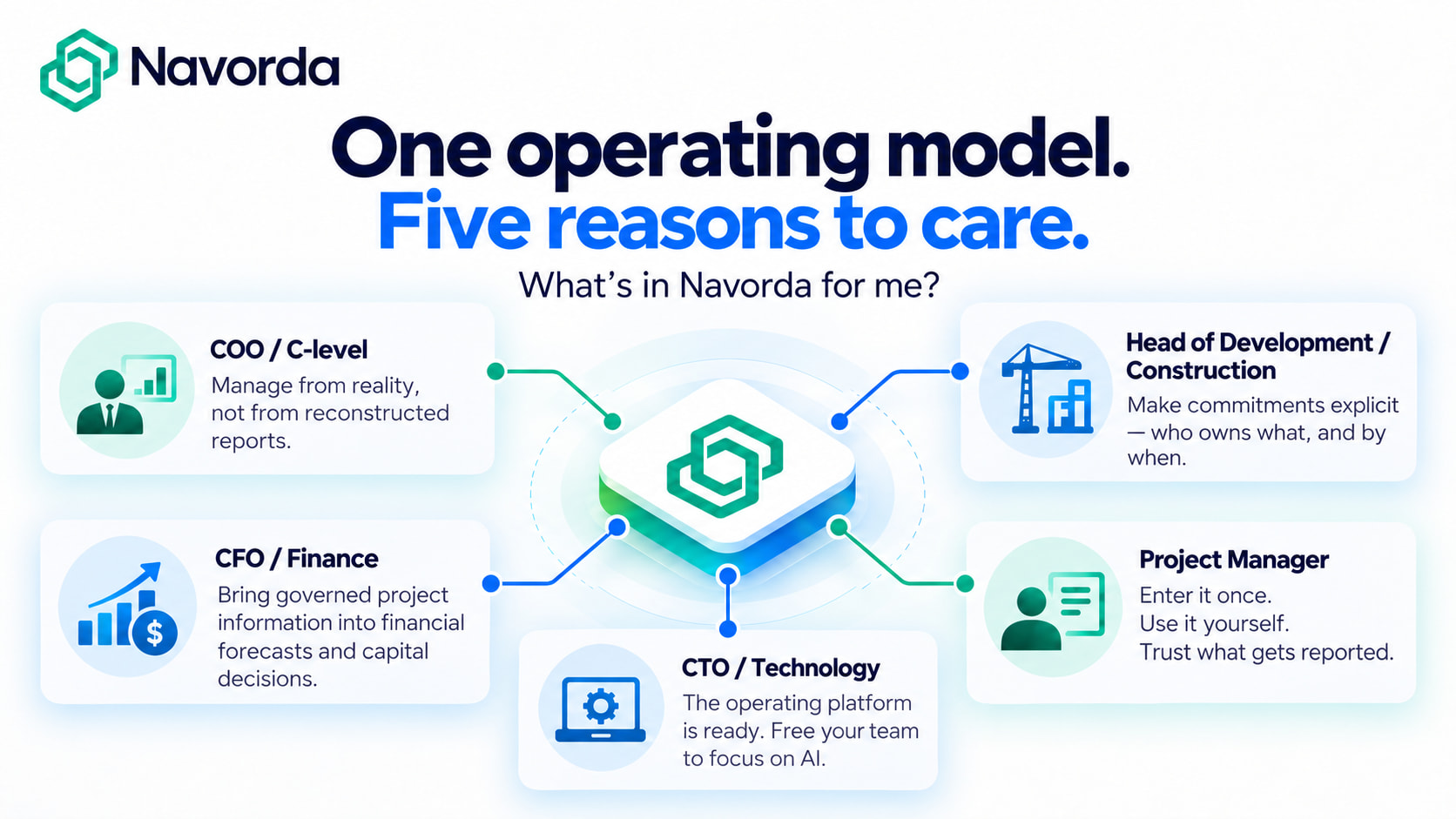
Navorda governs land, permits, milestones, risks, SPAs and portfolio performance in one data model, built for European multi-country portfolios: permitting modelled per country and technology against versioned approved baselines, plots and contracts on a native map with Spanish Catastro GML parsed on upload, risk quantified in days and euros, and ownership structures that update when SPAs execute. It currently manages 300+ projects across 14+ European countries, goes live in 4–8 weeks, and ships a read-only MCP server so Claude or ChatGPT can query the portfolio directly. The honest limits: a smaller vendor than most on this list, European-focused, not built for high-volume construction rollout, and ISO 27001 and SOC 2 are in progress rather than completed.
How Navorda compares with each vendor on this list, dimension by dimension
Sitetracker — best for high-volume deployment
The category heavyweight for rolling out many near-identical sites at speed — telecom, fiber, EV charging and renewables — built natively on Salesforce, with SOC 1 Type II, SOC 2 Type II, ISO 27001 and ISO 27701 and 55+ live integrations. For renewables it covers site assessment, permitting, construction, interconnection and asset management. Permitting is a stage in its workflow rather than a per-jurisdiction model, and land is handled as project records — which is exactly the right trade when deployment throughput is the job.
QBi Solutions — best for whole-business breadth
Business management software for renewable energy companies, operated from Madrid and New York, spanning business development and M&A, project development, EPC and operation. Land plot management, automated invoicing for energy and leases with complex tariffs and PPAs, automated P&L reporting, daily SCADA-fed technical analytics, and 45+ integrations on a single-tenant Azure architecture. The pick when you want one system for the whole company, operating assets included, rather than a dedicated development platform beside your operations stack.
Quorum On Demand Land — best for US land administration
Quorum's land management solution for U.S. solar, wind and storage developers, built on 15+ years of oil-and-gas land heritage. Land acquisition, agreement management, GIS mapping and obligation tracking with critical-date notifications; its QAI framework extracts payment schedules, expiry dates and acreage commitments from contracts. SOC 2 attested, with SAP and Esri integrations. The strongest choice when US land agreements and payment obligations are the whole job.
Pandell Land & GIS — best for lease administration volume
Cloud land asset management with Esri GIS integration and a large North American installed base — Pandell reports 20% of the top 25 US wind power producers use it. Wind and solar leases, option agreements, met tower leases, PPAs, easements and permits in one database, with built-in expiry logic and a financial suite for royalty and payment automation. The depth pick for hundreds or thousands of agreements in the US and Canada.
IFS Land for Renewables — best inside an existing IFS estate
A land and obligation module from a major ERP vendor: site acquisition through lease management and compliance, with eCalendar obligation tracking and automated alerts. Its natural home is organizations already running IFS for ERP, EAM or field service, where one vendor relationship and estate integration outweigh best-of-breed depth.
Irth (altAMPS) — best for right-of-way and stakeholder volume
Land, right-of-way, permitting and stakeholder management for critical infrastructure, with data continuity from site identification and title research through permitting and surveying, automated lease lifecycles, and AI that surfaces stakeholder and compliance insights. Strongest where right-of-way and landowner-relationship volume dominate, in a North American context.
Cora Systems — best for enterprise PPM governance
Enterprise project portfolio management used for complex multi-year programmes, with a renewable-energy vertical covering project selection, stakeholder collaboration, audit trails, and risk integrated into scheduling and forecasting. Strong governance and portfolio discipline. The caveat that applies to any generic PPM: plots, permits, counterparts and SPVs are emulated with custom fields rather than modelled natively.
Celoxis — best for schedule mechanics and PMO visibility
All-in-one project and portfolio management — critical-path scheduling, resource and capacity planning, budget tracking, workflow automation — with published guidance for solar EPCs and developers. Strong on schedule mechanics at accessible cost, with the same generic-PPM caveat: energy development's native entities live in custom fields.
Radian Digital — best for lighter early-stage tracking
Radian Generation's software platform — lighter-weight and aimed at early-stage development: permitting, land acquisition and interconnection milestones, consolidating the LENS, GREEN IT and GAR products onto one platform. A pragmatic starting point before portfolio scale demands deeper governance.
Which is best for you
- European multi-country portfolio, bottleneck in pre-construction (land, permits, baselines, exposure): Navorda.
- Rolling out high volumes of near-identical sites, or your programme lives in Salesforce: Sitetracker.
- One system for the whole business including operating assets, invoicing and P&L: QBi Solutions.
- US land agreements and payment obligations are the whole job: Quorum On Demand Land — or Pandell when lease-administration volume and royalty automation dominate.
- Already running IFS for ERP or field service: IFS Land for Renewables.
- Right-of-way and landowner-relationship volume in North America: Irth.
- PMO-grade programme governance across energy and non-energy projects: Cora Systems or Celoxis.
- Early-stage portfolio that needs structure without a platform commitment yet: Radian Digital.
How to shortlist from here
- Decide which family your binding problem lives in: agreement administration (land system), deployment throughput (execution platform), schedule governance (generic PPM), or pre-construction control across permits and land together (development platform).
- Check geography honestly — several established vendors state a US or North American focus, and European multi-jurisdiction permitting and cadastral formats are a different problem.
- Demand the history test in every demo: change a milestone date and ask to see the previous commitment, who changed it, and the deviation against the approved baseline.
- Bring your own data — a GML file, a real permit process, a real SPV structure — and watch whether the tool models it or emulates it with custom fields.
And weight independent references and your own trial above any list — including this one. If your question is specifically permits and land, we also keep a fourteen-vendor shortlist covering the siting-intelligence and land-system families in more depth.
How to choose renewable energy project development software: the ten questions
Permit & land software for European energy developers: the 2026 shortlist