How to Choose Renewable Energy Project Development Software: A Buyer's Guide
What renewable energy project development software actually is, the six workflows it must support, and the ten questions that separate purpose-built platforms from rebranded project management tools.

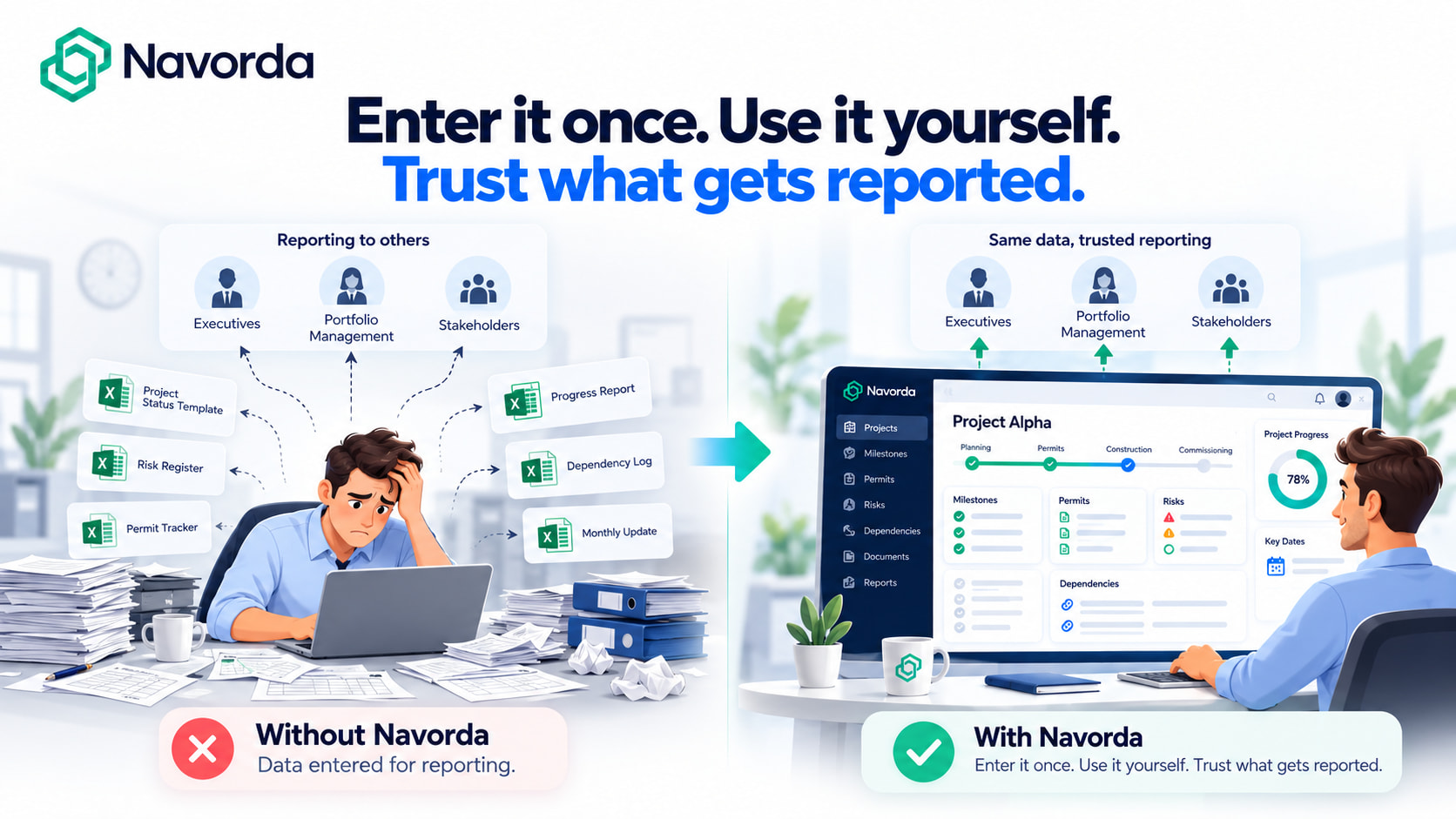
At some point every development team has the same conversation. The portfolio has grown from five projects to fifty. The land tracker lives in one spreadsheet, the permit tracker in another, the risk register in a third — and none of them agree. Someone says: we need a system.
Then comes the harder question: which one? The market offers everything from generic project management suites to GIS add-ons to full development platforms, and the labels rarely explain the differences. This guide is the evaluation framework we wish every buyer had.
What Is Renewable Energy Project Development Software?
Renewable energy project development software is an operational platform that manages the pre-construction lifecycle of solar, wind, storage and other energy assets — land securization, permitting, milestone and baseline control, risk quantification, SPAs and shareholder structures, and portfolio reporting — in one governed data model. It is not a task manager with an energy skin: the entities it manages are plots, permits, baselines, counterparts and SPVs, not generic tasks and tickets.
That distinction matters because energy development is not a sequence of tasks. It is a web of dependencies between land rights, administrative processes, grid access, corporate structures and capital — where a single delayed permit can move COD by a year and a single unsigned lease can undermine an entire ready-to-build package.
Who Needs It
- Energy developers running land and permitting workflows across dozens or hundreds of projects.
- EPC contractors coordinating multi-project construction programmes with upstream development dependencies.
- Infrastructure funds and IPPs that need portfolio-wide visibility over assets they acquired from different sellers, in different formats.
- Data-center and digital-infrastructure operators developing the private power generation and grid infrastructure that supplies their campuses.
The common thread: more projects than any one person can hold in their head, and decisions that depend on data currently scattered across spreadsheets, GIS tools, shared drives and email.
The Six Workflows It Must Support
1. Land securization
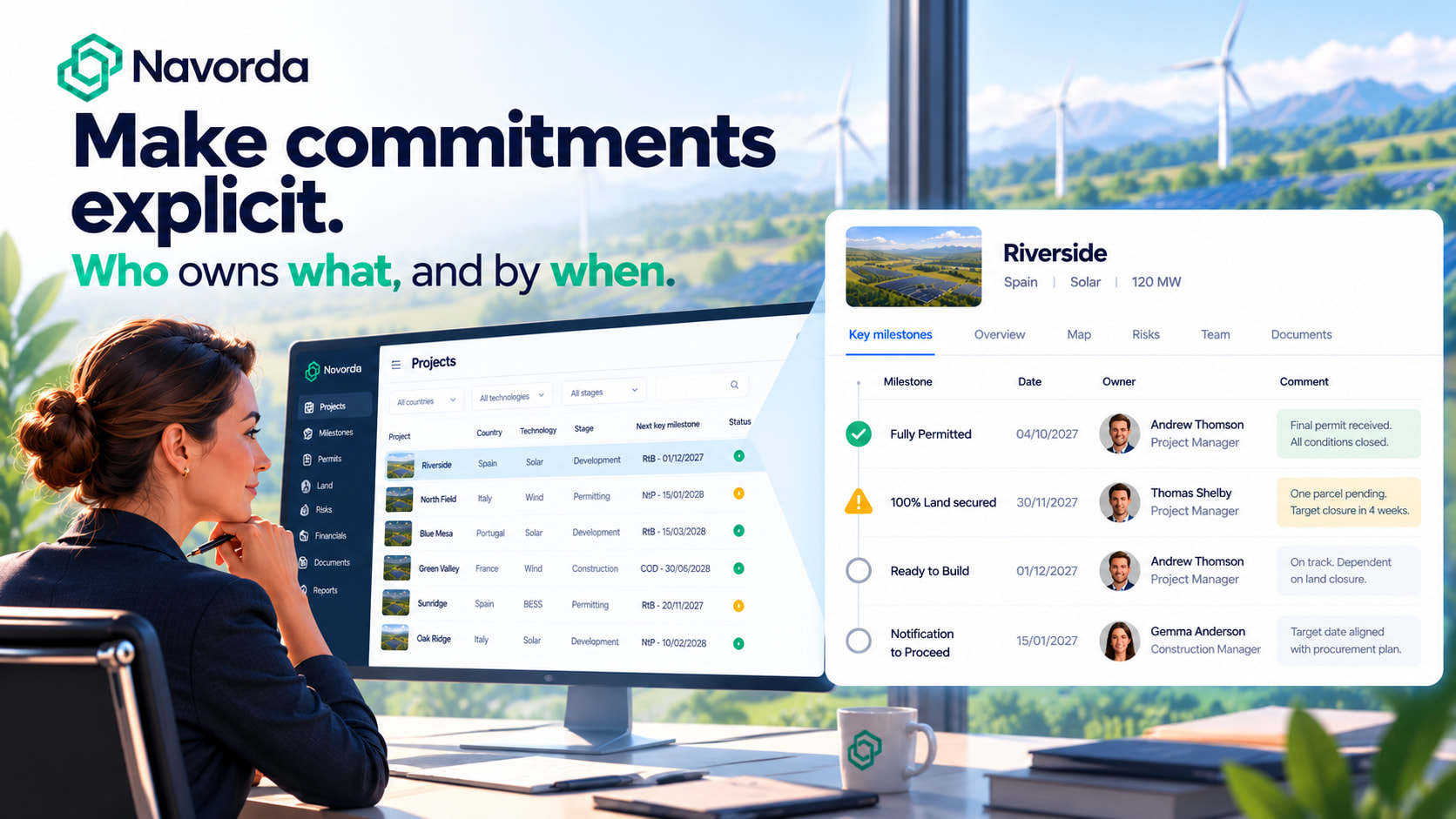
Every plot, every counterpart, every agreement — on a map, linked to contracts and payment obligations. If the platform cannot parse cadastral data and show you which plots in a project are signed, in negotiation, or at risk, it is not built for this industry.
2. Permitting and lifecycle control
Permits differ by country, region and technology. The system must model your actual administrative processes — not force them into a generic workflow — and surface deviations against the planned timeline while there is still time to react.
3. Milestones and baselines
A milestone that silently moves is not a plan; it is a diary. The platform must keep approved baselines, track every deviation against them, and make schedule slippage visible the week it happens.
4. Risk quantification
A risk register that says high/medium/low is a formality. Useful risk management expresses exposure in days of schedule and currency of impact, before and after mitigation, aggregated across the portfolio.
5. SPAs and shareholder structures
Projects live inside SPVs; SPVs get bought and sold. The system should model multi-level ownership — equity, voting rights, entry and exit dates — and update structures automatically when a transaction closes.
6. Portfolio reporting
Every question your board or investment committee asks — capacity by stage, RTB dates, exposure, funnel conversion — should be answerable from live data, not from a slide deck someone assembled last Thursday.
Ten Questions to Ask Any Vendor
- Can it show me every plot in a project on a map, with contract status, without exporting to a GIS tool?
- Can it model our permitting processes per country and technology, or does it impose a fixed workflow?
- Does it keep approved baselines and measure deviations against them, or does it just show current dates?
- Can it express risk exposure in days and money, aggregated at portfolio level?
- Does it model SPVs, shareholder structures and SPAs as first-class objects?
- Can it import our existing spreadsheets without months of data cleansing?
- How long does implementation actually take — and who does the work, us or the vendor?
- Does it support SSO, role-based access and audit trails our IT team will accept?
- Can our own AI tools query the data securely, and does the platform have AI that works on governed data rather than a bolted-on chatbot?
- What happens when we need a field, entity or process the platform does not have — configuration or a change request?
Red Flags
- A generic project management tool with an energy template and a new logo — the data model gives it away within one demo.
- A GIS tool with task lists bolted on: maps without contracts, milestones or risk are half the picture.
- No concept of a baseline. If the plan can be edited without a trace, deviations are invisible by design.
- Implementation measured in quarters. Purpose-built platforms go live in weeks because the domain model already exists.
- AI features that are a chatbot over your documents rather than agents reading structured, governed project data.
How Navorda Answers These Questions
We built Navorda around exactly these workflows. Navorda Land puts every plot, counterpart and contract on a native map with cadastral parsing built in. Navorda Platform tracks permits against versioned baselines, quantifies risk exposure in days and euros before and after mitigation, holds the shareholder structure and rolls everything up into the view your board actually asks for — with Navorda Transactions writing the ownership change into that structure as deals close — and Navorda AI plus the Navorda MCP Connector let AI work on that governed data instead of guessing.
A structured onboarding programme takes four to eight weeks from kickoff to supported go-live, including data migration from your existing spreadsheets.
Read the full guide: what renewable energy project development software is, and how to choose it →
The best renewable energy project development software in 2026, by buyer situation →
However you evaluate, insist on seeing your own workflows in the demo — your plots, your permit processes, your ownership structures. A platform built for this industry will handle them without apology. Anything else will ask you to adapt to it, and that is the wrong direction.