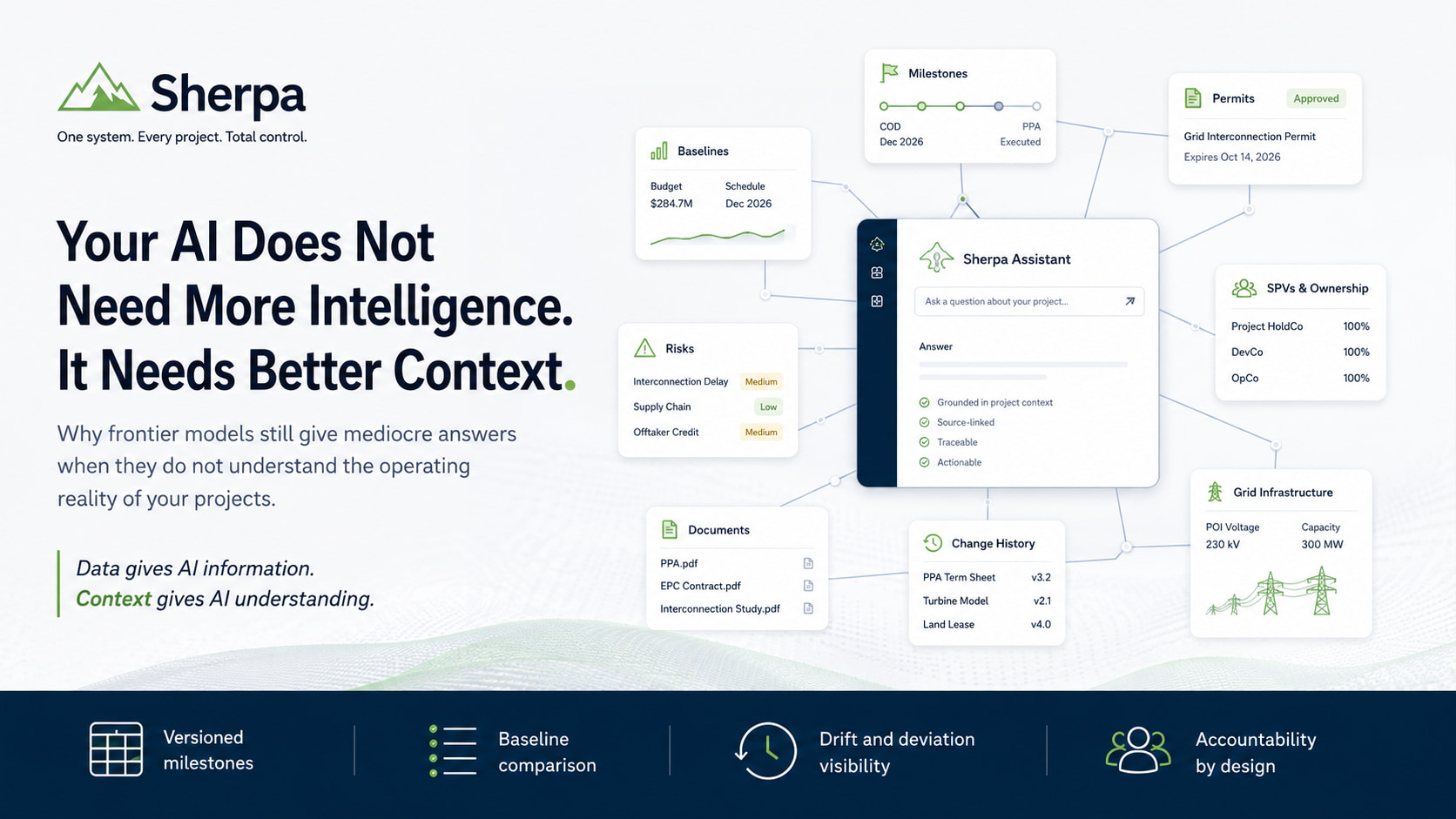
Your AI Does Not Need More Intelligence. It Needs Better Context.
Why frontier models still give mediocre answers when they do not understand the operating reality of your projects. You can give an AI ten million rows of corporate data and it may still not know which RtB date is the current commitment, which permit threatens it, or who moved the forecast last week.
 Luis Cabello7 min read
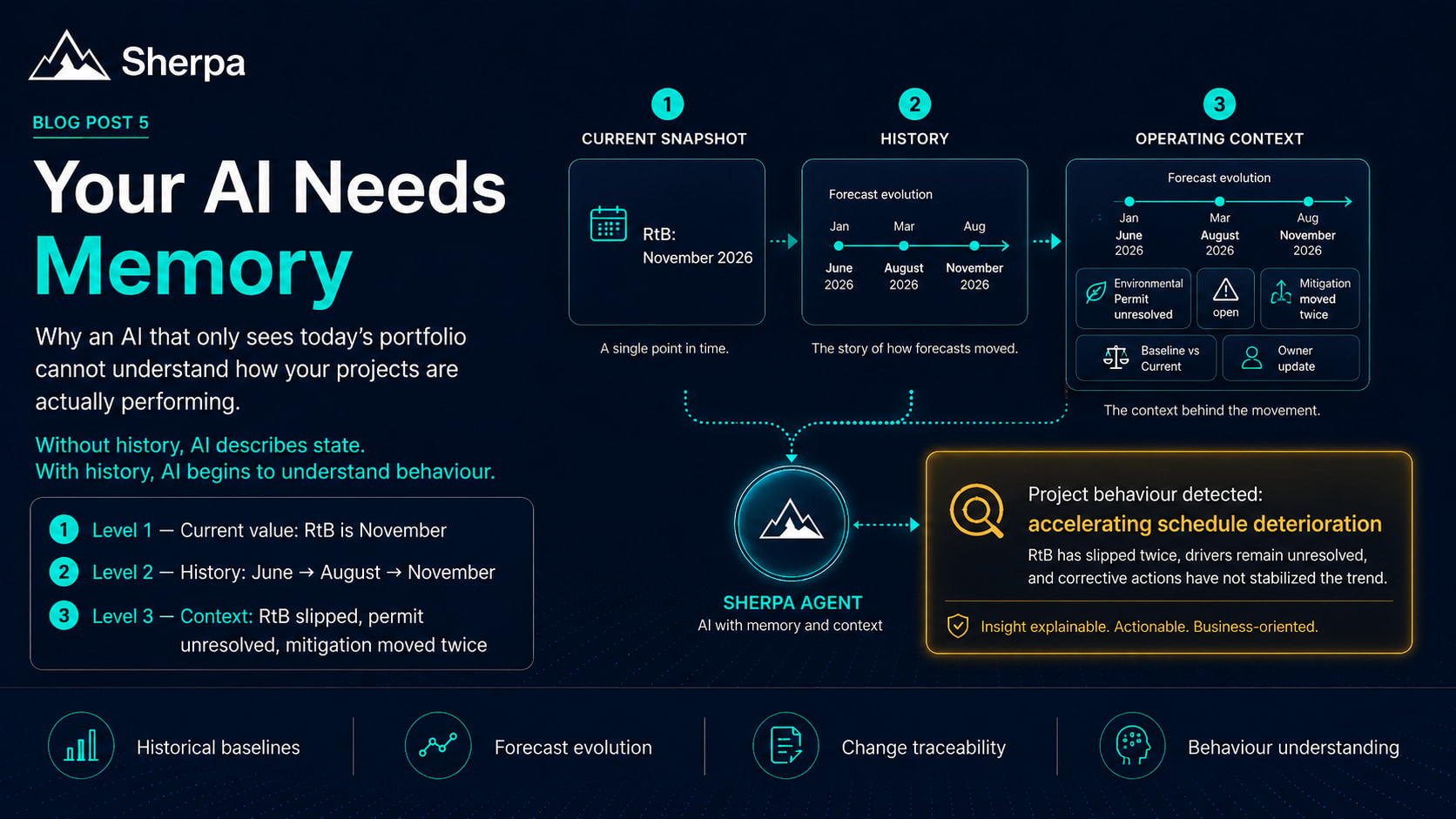
You can give ChatGPT access to 10 million rows of corporate data and it may still not know what RtB means for this project.
It may find the RtB date.
It may find five different RtB dates.
It may even produce a perfectly written explanation of what Ready-to-Build normally means.
But does it know:
- which date is the current commitment?
- which one belongs to the approved baseline?
- which permit is currently threatening it?
- which grid infrastructure must be completed first?
- which risk could move it again?
- who changed the forecast last week?
- what management had been told one month earlier?
That is a very different problem.
And increasingly, it may be the real bottleneck for enterprise AI.
Data gives AI information. Context gives AI understanding.
Better Models Cannot Fix Missing Business Context
The AI industry has spent the last few years making models extraordinarily capable.
Every generation can reason better, process more information and work across larger context windows.
For enterprises, however, model intelligence is only one part of the equation.
Microsoft recently described the problem very directly: agents can access enterprise data while still failing to understand the business — its rules, relationships and processes. The bottleneck, in Microsoft's words, is shifting from access to models towards business context.
Microsoft — Dataverse is your agent data platform →
McKinsey makes a related point around AI data readiness: information can be technically correct and still produce a poor answer when the wrong fragment is retrieved, important context is missing, or stale information influences the response.
McKinsey — AI data readiness: the key to scaling impact →
This changes the enterprise-AI question.
Perhaps the first question should no longer be:
Which LLM should we use?
But:
What does the LLM actually know about how our business works?
Consider a Simple Question
Imagine asking an AI:
Which projects are most likely to miss COD?
The company may already possess everything required to answer.
Somewhere.
There are project lists. Milestone spreadsheets. Permit trackers. Risk registers. Land files. Grid information. Monthly reports. Construction schedules. Emails and comments.
Giving the AI access to all of them gives it more information.
But answering the question properly requires something else.
The AI needs to understand that:
- COD is a milestone with a current forecast and historical baselines.
- A permit delay may threaten RtB before it threatens COD.
- A plant may depend on a separate substation or power-line project.
- A land issue can block a permit even if the permit itself still appears on schedule.
- A risk has probability, impact, mitigation actions and an owner.
- The company owning the project is not necessarily the same object as the project itself.
- The latest value is not necessarily the approved commitment.
- A value changed yesterday, and the previous value may still matter.
Those are not additional rows.
They are relationships, definitions, history and governance.
An Energy Portfolio Is a Network, Not a Folder of Documents
This distinction becomes particularly important in renewable-energy development because operating reality is highly connected.
A project is connected to land.
Land is connected to contracts and counterparties.
Permits are connected to milestones.
Milestones are connected to baselines.
Risks threaten those milestones.
Plants depend on substations and power lines.
Projects sit inside SPVs, JVs and holding structures.
And all of those objects change over time.
Why plants, substations and power lines should not be managed as a single project →
An experienced Development Director understands those connections almost instinctively.
When she reads that an environmental authorization has moved by four months, she does not see an isolated date.
She immediately starts reasoning:
What does this do to RtB? Does it affect financing? Is land already secured? Does the grid milestone have enough float? Is COD now exposed? Has this already been reflected in the latest forecast?
That is operational context.
For AI to reason like someone inside the business, it needs access to more than the documents that person reads.
It needs access to the relationships that person understands.
A Bigger Context Window Is Not the Same as Better Context
This is an important distinction.
Putting more information into an AI context window does not automatically create business context.
Neither does connecting another database.
Neither does adding another vector store.
And neither does MCP — the Model Context Protocol — by itself.
MCP is enormously useful because it creates a standardized way for AI systems to interact with external tools and data sources.
But connectivity and understanding are different layers.
An MCP server can give an AI access to a milestone.
The underlying system still needs to explain what that milestone means.
- Is it a forecast?
- A baseline?
- A contractual commitment?
- An obsolete value?
- A project-level milestone?
- A dependency belonging to a connected infrastructure project?
- Who owns it?
- When did it change?
Without those semantics, the AI has connectivity without operating knowledge.
The Missing Layer Is the Operating Model
This is why the enterprise systems underneath AI may become more important, not less important, as AI improves.
A governed operational system can provide something a generic model cannot learn from the public internet: how this particular company understands its portfolio.
For energy development, that includes concepts such as:
- projects and their development stages
- country- and technology-specific permitting structures
- plants, substations and power lines and their dependencies
- plots and land securization instruments
- milestone forecasts and approved baselines
- deviation history
- risks, exposure and mitigation
- SPVs, shareholders and ownership structures
- authorship, timestamps and historical changes
Once those relationships are explicit, AI receives something fundamentally different from a pile of corporate information.
It receives a representation of the business.
That argument has a companion inside the organization. Building the context is one problem; getting the business to maintain it is the other, and it is ultimately a question of adoption rather than technology.
The CTO's next challenge is not AI. It is adoption. →
This Is the Foundation Navorda Gives AI
Navorda was not designed merely as a database that an AI can query.
It models the operating reality of energy project development.
A project is a project. An SPV is an SPV. A permit is a permit. A baseline does not disappear when the forecast changes. A power line can be represented as a dependency rather than hidden inside the plant schedule. A risk can be connected to the milestone it threatens.
And changes retain history, ownership and timestamps.
That context can then be consumed in two different ways.
Navorda AI works directly on the governed operational model, continuously looking for missing information, deviations, inconsistencies, risks and exposure.
And through the Navorda MCP Connector, authorized external AI tools such as ChatGPT or Claude can query that same operational reality — read-only, live — without creating another disconnected copy of it.
Same data, both directions.
The seven Navorda AI agents — how governed data becomes guided action →
Connect Claude or ChatGPT to your portfolio — read-only by architecture →
The objective is not to make Navorda the smartest AI.
It is to give smart AI something worth reasoning about.
The Next AI Upgrade May Not Be an AI Upgrade
Frontier models will continue improving.
Context windows will grow. Reasoning will improve. Agents will become more autonomous.
Companies will naturally benefit from those advances.
But moving from one frontier model to the next will not solve an ambiguous project perimeter. It will not reconstruct a baseline that was overwritten six months ago. It will not discover that two differently named records actually refer to the same SPV. It will not know that a substation managed as another project is on the critical path of three plants unless that relationship exists somewhere.
The more capable AI becomes, the more visible the quality of the operating context underneath it may become.
So perhaps the next enterprise-AI discussion should start with a different question.
Not:
How intelligent is our AI?
But:
How well does our AI understand the reality of our business?
Because the model may already be intelligent enough.
What it needs is context.
Put your own portfolio context to the test — take the five-minute Corporate Distance Assessment →
Renewable energy project development software — the buyer's guide →