Your AI Needs Memory
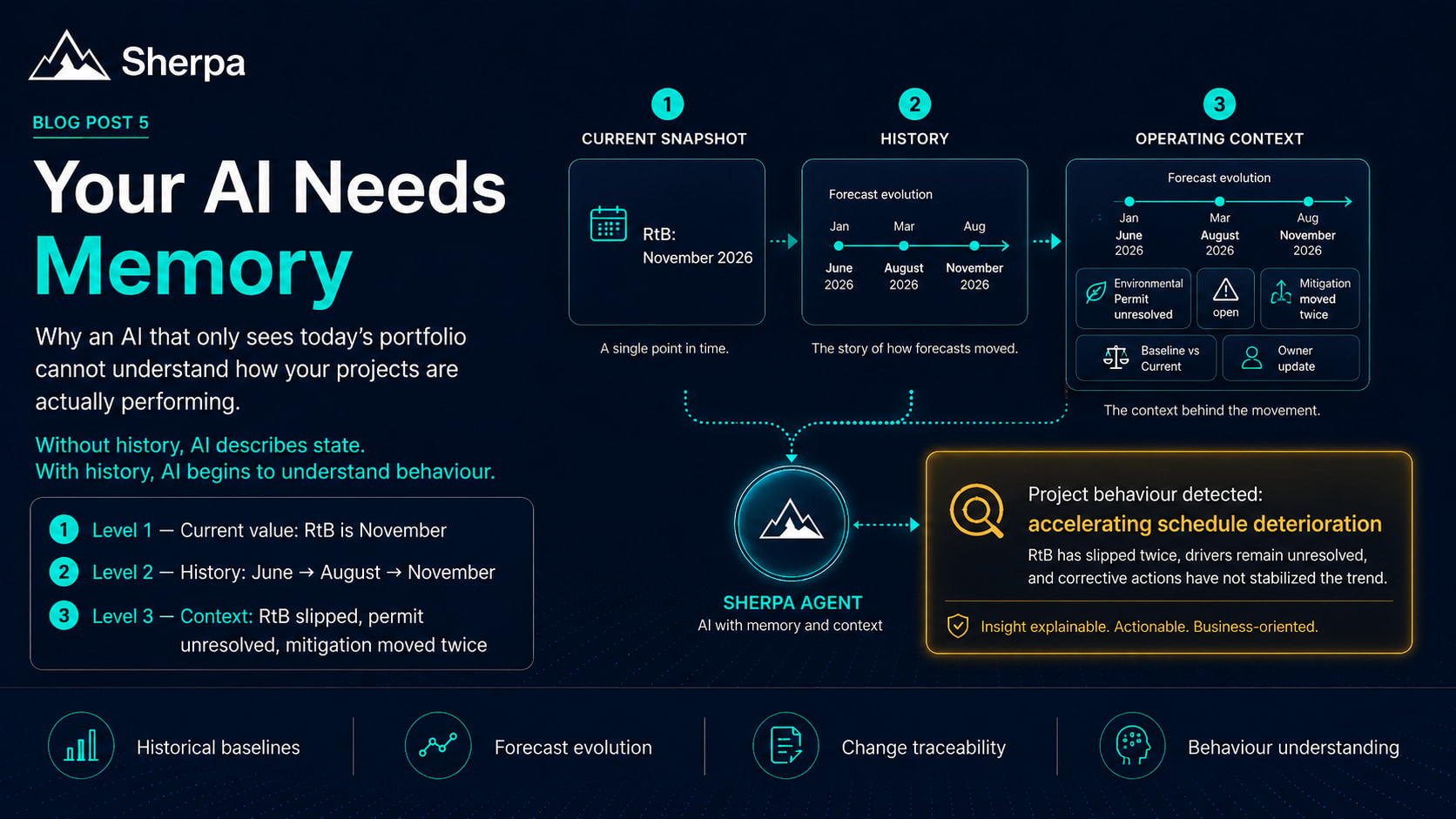
Why an AI that only sees today's portfolio cannot understand how your projects are actually performing. RtB in November can be a stable plan or the fifth revision of the year — the current value is identical, the meaning is completely different. History is the capability you cannot retrofit.
 Luis Cabello4 min read
Imagine asking your AI:
Which projects currently have RtB in November?
Easy.
Now ask:
Which projects are showing accelerating schedule deterioration?
Much harder.
Because today's date is not enough. The AI needs to remember yesterday.
Suppose Project Alpha currently shows RtB in November. Maybe November was always the plan. Or perhaps the forecast history looks like this:
- January forecast → June
- February forecast → June
- March forecast → August
- June forecast → September
- August forecast → November
The current value is identical.
The meaning is completely different.
Without history, AI can describe your portfolio. With history, it can begin to understand its behaviour.
AI Needs to Reason About Change
Most important management questions are not really questions about values. They are questions about change.
- Which projects are deteriorating?
- Which teams forecast accurately?
- Which risks remain unresolved reporting cycle after reporting cycle?
- Which milestones repeatedly move shortly before commitment?
- Which projects appear stable only because their baseline was quietly revised?
None of those questions can be answered reliably from a current snapshot.
AI needs a timeline.
Three Levels of AI Context
Consider the same project at three levels.
Level 1 — AI sees the current value
RtB is November.
Correct. But not very insightful.
Level 2 — AI sees history
RtB moved from June to August to November.
Now something interesting appears. Five months of cumulative drift. Two previous revisions. A pattern.
Level 3 — AI sees history plus operating context
RtB has slipped five months, the Environmental Permit remains unresolved, and the mitigation commitment has also moved twice.
That is a fundamentally different answer. The AI is no longer describing a date. It is explaining behaviour over time.
Baselines Are AI Memory
This is why baseline management is more than a project-control feature. It is part of the AI architecture.
When a forecast changes, deleting the old value destroys information. Preserving it creates memory.
You cannot buy back the history you did not keep.
Navorda's milestone architecture is built around version-aware tracking: baselines that survive forecast changes, point-in-time snapshots, and every change retaining its author and timestamp. When management asks why COD is now March, the answer is a query — not archaeology across old spreadsheets and last quarter's slides.
Who changed that date? A source of truth vs a governed source of truth →
Your milestones aren't dates. They're commitments. →
Memory Turns Risks Into Patterns
A risk register row says: environmental authorization delay — High. Useful. Now give the AI its history:
- January: High.
- February: High.
- March: mitigation due April.
- April: mitigation moved to May.
- May: permit forecast moved 30 days.
- June: mitigation moved again.
- July: RtB moves 60 days.
The risk is no longer an isolated row. It has a trajectory. The AI still should not claim causation without evidence — but it can surface what humans should inspect:
This risk has remained open through four reporting cycles while both its mitigation and the affected milestone have progressively moved.
That is useful intelligence.
First Navorda Remembers. Then It Watches.
There is a reason Navorda's AI architecture starts with memory. The sequence matters: remember, compare, connect, interpret. Without the first step, everything after it becomes weaker.
An AI cannot detect drift if yesterday disappeared. It cannot recognize repeated forecast revisions if only the latest date survives. It cannot see mitigation deteriorating if previous commitments were overwritten.
With the history in place, Navorda AI watches it for change — and through the Navorda MCP Connector (Model Context Protocol), external AI receives version-aware answers pinned to the official ruling snapshot, with explicit baseline comparison.
Connect Claude or ChatGPT to your portfolio — read-only by architecture →
Most portfolios can eventually answer which projects are late. A more valuable question is:
Which projects are behaving like projects that are becoming late?
Not because AI can see the future. Because the past leaves signals — repeated forecast moves, persistent risks, mitigations that keep slipping, growing deviation from baseline. An AI with memory can connect them. An AI without memory sees only today.
Test Your Portfolio's Memory
Try asking:
Show me the projects whose RtB forecast has deteriorated across the last three reporting cycles, together with the risks and mitigation commitments that changed during the same period.
Can your current operating model answer? Or would someone need to find three historical spreadsheets and reconstruct the evolution manually?
Once project history is structured and governed, it stops being an archive. It becomes context AI can reason over.
And if you want to see the difference on real data: bring one question like that to a 30-minute diagnostic. It is usually more revealing than another generic software demo.
Bring your hardest portfolio question — take the five-minute Corporate Distance Assessment →
Without history, AI describes state. With history, AI begins to understand behaviour.