The CTO's Next Challenge Is Not AI. It Is Adoption.
Technology leaders have spent a decade building infrastructure the business barely sees. AI is the chance to change that — or to repeat the same pattern at a higher level of sophistication. The missing layer was never infrastructure. It is governed operational context.
 Luis Cabello7 min read
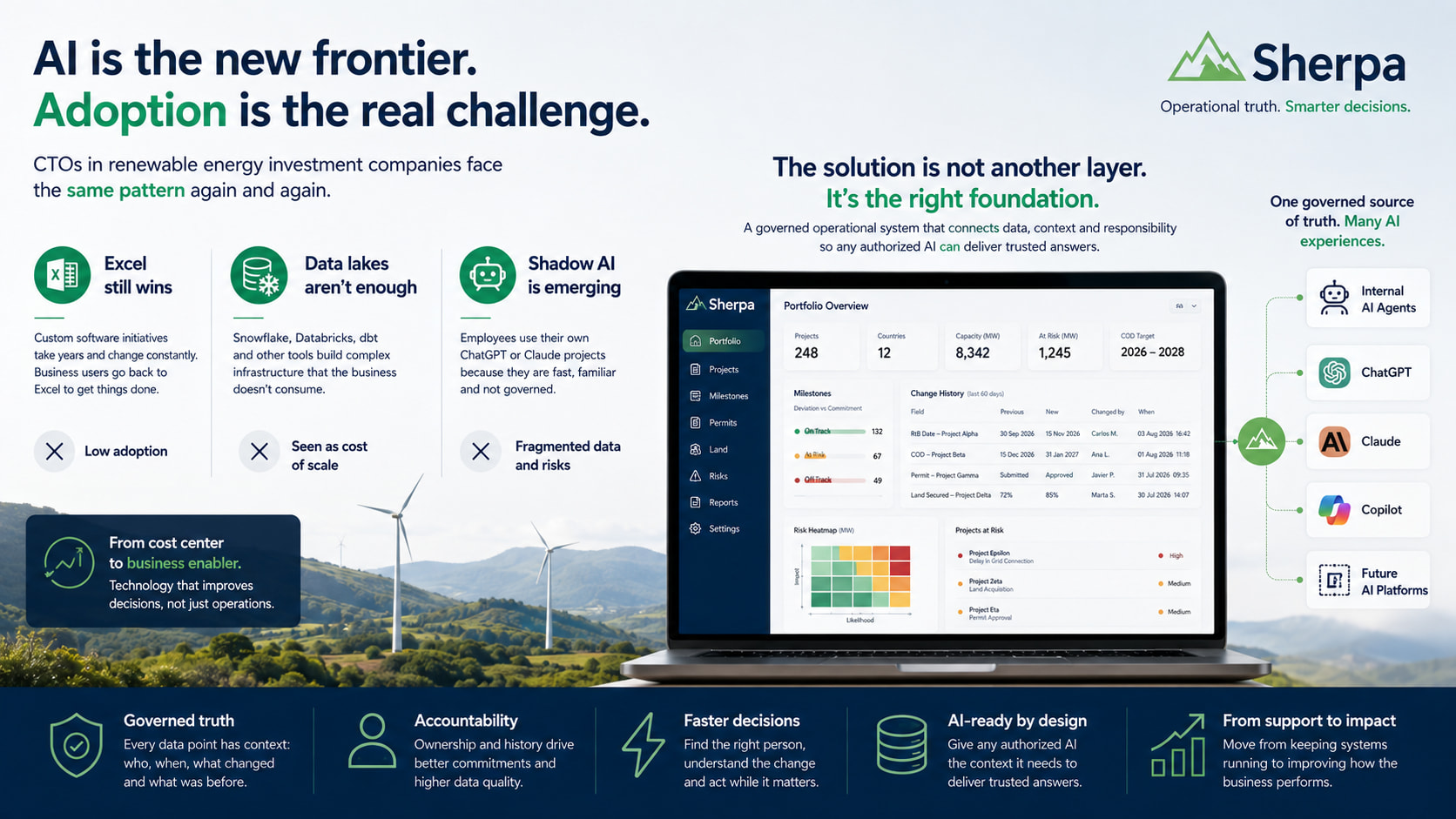
For years, technology leaders have built infrastructure the business barely sees. AI creates an opportunity to change that — but also a risk of repeating exactly the same pattern.
In many renewable energy investment companies, the CTO has a difficult position. Technology is essential to the organization. But much of what IT delivers is invisible when it works.
Microsoft 365 must work. Identity must work. Cybersecurity must work. Power BI must work. Jira, ERP, integrations, devices and networks must work.
Nobody celebrates when they do. But everybody notices when they don't.
As a consequence, technology can gradually become perceived by the business as a cost of operating the company, rather than an engine for improving how the company operates. For many CTOs, changing that perception has been one of the hardest challenges of the last decade.
The Search for the Business Application
The obvious response has been to move closer to the business. Build applications. Digitize workflows. Replace spreadsheets. Create a common operational system.
The ambition is correct. But custom software initiatives inside large organizations have often struggled to reach their original objective — and not necessarily because the technology was poor. The problem is structural.
Development teams need specifications. Business teams are busy developing projects, securing land, obtaining permits, preparing investment committees and managing construction. Priorities change constantly. The application starts with a clear strategic objective, but the roadmap gradually becomes dominated by the most urgent request of the month.
Three years later, significant investment may have been made, but Excel is still open on everybody's desktop. That is one of the most uncomfortable signals in enterprise technology:
The corporate system exists, but the business still prefers the spreadsheet.
Infrastructure Is Necessary. But the Business Does Not Consume Infrastructure.
The same pattern can appear at the data layer. Over the last decade, companies have invested heavily in increasingly sophisticated data architectures.
- Data warehouses, data lakes and lakehouses
- Platforms such as Snowflake, Databricks or Microsoft Fabric
- Transformation layers such as dbt
- ETL and ELT pipelines
- Catalogues, semantic layers and governance frameworks
All of these technologies can solve very real technical problems. The difficulty is that the business rarely wakes up in the morning thinking: I need a better data lake.
The Development Director wants to know which projects are drifting from RtB. The COO wants to understand why COD moved. The Investment Director wants to know which assumptions behind the portfolio have changed. The Land team needs to understand which plots remain unsecured. The board wants to know where intervention is required.
A technically excellent data architecture can support all of this. But infrastructure alone does not answer those questions. And when the connection between technology investment and operational improvement becomes difficult to see, the technology organization risks being perceived as simply another cost required to support scale.
And Now Comes AI
Artificial intelligence creates an extraordinary opportunity for CTOs. But it also creates a familiar risk. The new temptation is to build the corporate AI platform.
- A private LLM environment
- Enterprise copilots
- RAG architectures and vector databases
- Internal agents and agent orchestration
- AI gateways and model governance
All of these capabilities can be valuable. But there is a question worth asking before spending the next three years building them: what will the business actually use them for?
Because we may be about to recreate an old problem in a new form. Yesterday, the symptom was: we built the corporate application, but people still use Excel. Tomorrow, it could become: we built the corporate AI platform, but people still use their own ChatGPT and Claude projects.
Different technology. Same adoption problem.
Shadow Excel May Become Shadow AI
Employees use Excel because it is immediate. They understand it. They control it. They can solve today's problem without waiting six months for the corporate roadmap.
Generative AI has many of the same characteristics. A project manager can open ChatGPT or Claude, upload a spreadsheet, provide some instructions and get something useful within minutes. That creates enormous productivity. It also creates a new governance problem.
- Different people create different prompts
- Different files contain different versions of the truth
- Business context sits inside individual AI conversations
- Corporate definitions are not consistently applied
- AI answers may be generated from data nobody can trace
We could therefore reproduce exactly the fragmentation companies have spent years trying to eliminate. Only this time, instead of hundreds of spreadsheets, there may be hundreds of private AI environments.
The Missing Layer Is Operational
The answer is not to prevent the business from using AI. Nor is it necessarily to build every AI experience internally. The opportunity for the CTO is to provide something much more valuable: a governed operational foundation that any authorized AI can consume.
This distinction matters. A data lake can tell an AI where information is stored. An operational system can tell it what that information means.
- Which project is active
- Which milestone is the current commitment
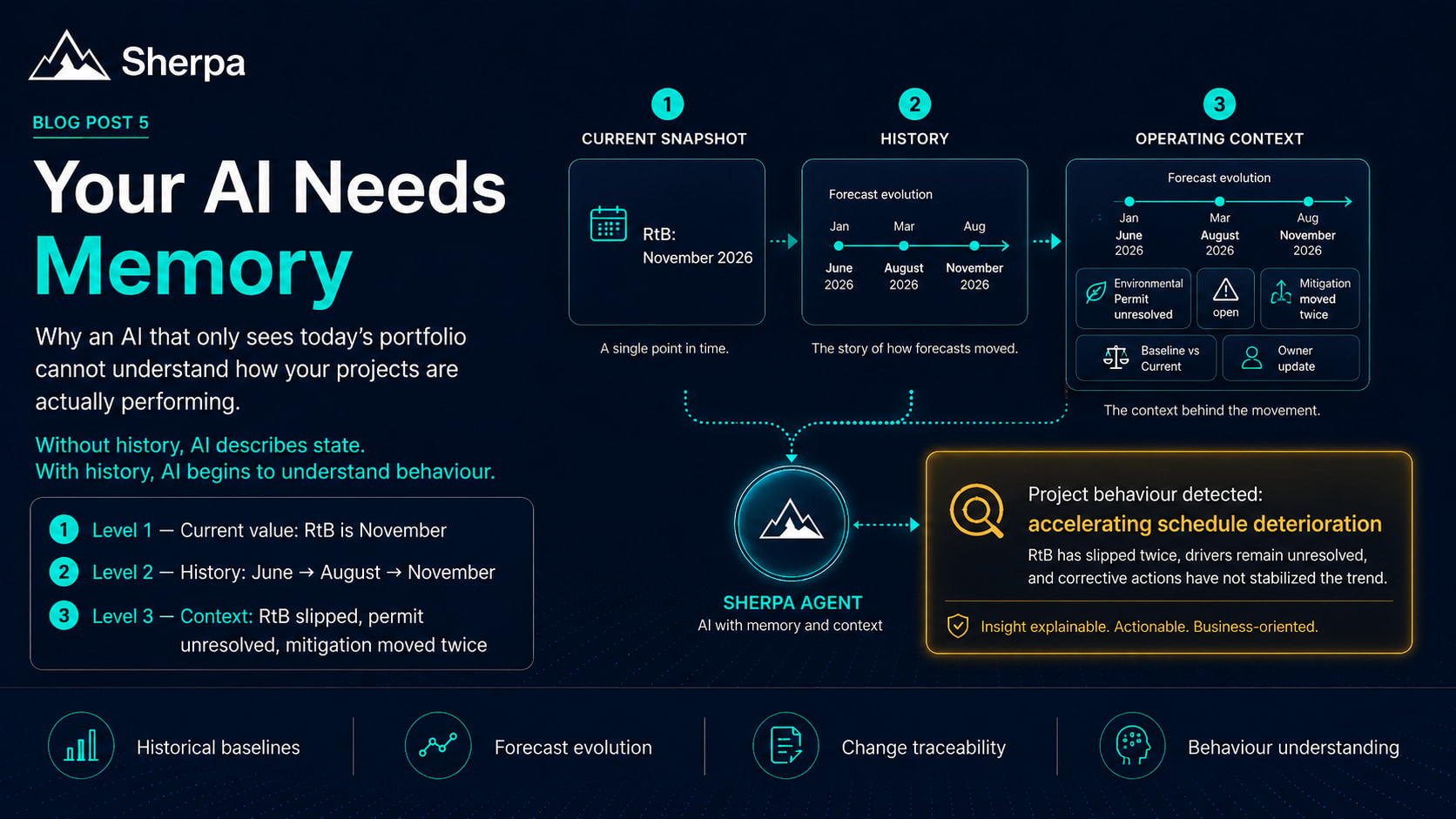
- Which value was previously reported, and who changed it
- Which permit belongs to which project
- Which land contracts remain unsecured
- Which infrastructure projects are dependencies of a plant
- Which risks threaten COD
That is the context AI needs before it can become genuinely useful to the business.
Do Not Build Every AI. Govern What AI Knows.
This changes the role of the CTO. Instead of trying to predict and build every AI use case the company may need, IT can create the governed environment from which those use cases emerge safely.
The business may use an internal corporate agent. Another team may prefer ChatGPT. Another may use Claude. A future platform may appear next year. That should not require rebuilding the company's operational intelligence every time.
The durable asset is not the interface with the AI. It is the governed business context underneath it.
This is one of the principles behind Navorda. It captures operational information across projects, permits, milestones, land, risks and portfolio governance in a structured model. Its internal agents operate directly on that context — and through a native MCP server, the same governed information can be exposed to the AI tools a company already uses, read-only and audited.
How the Navorda AI turns governed data into guided action →
Connect Claude or ChatGPT to the same governed data — read-only by architecture →
The objective is not to make Navorda the only AI a company can use. Quite the opposite. It is to make sure that whichever AI the company chooses has access to the same trusted operational reality.
From Technology Provider to Business Enabler
This may be the real opportunity AI creates for technology leadership. For years, CTO organizations have been responsible for increasingly sophisticated infrastructure that the business rarely sees. AI can finally make much of that technology visible — but only if it reaches the problems people actually have.
The objective should not be another impressive architecture diagram. It should be a Development Director asking:
Which projects changed their RtB commitment this month, why, and where should I intervene?
and getting an immediate answer grounded in governed corporate data. Or a COO asking:
What are the five largest threats to COD across the portfolio?
and receiving an answer that can be traced back to real projects, milestones, risks and owners. At that point, IT is no longer simply providing systems. It is improving decisions.
The Next Technology Strategy Should Start With the Business
There will always be infrastructure. There will always be cybersecurity, integrations, data engineering and architecture. They are essential. But AI gives CTOs a chance to move one level higher — not by building more technology for the sake of technology, but by connecting the technology estate directly to the operating reality of the company.
The goal is not to build the AI that everybody must use. It is to build the governed operational foundation that makes every authorized AI useful.
Otherwise, we risk spending the next few years building extraordinarily sophisticated AI platforms while the business quietly opens another browser tab and carries on working somewhere else.