Robustness Without Rigidity: How Energy Developers Can Standardize Governance Without Freezing the Business
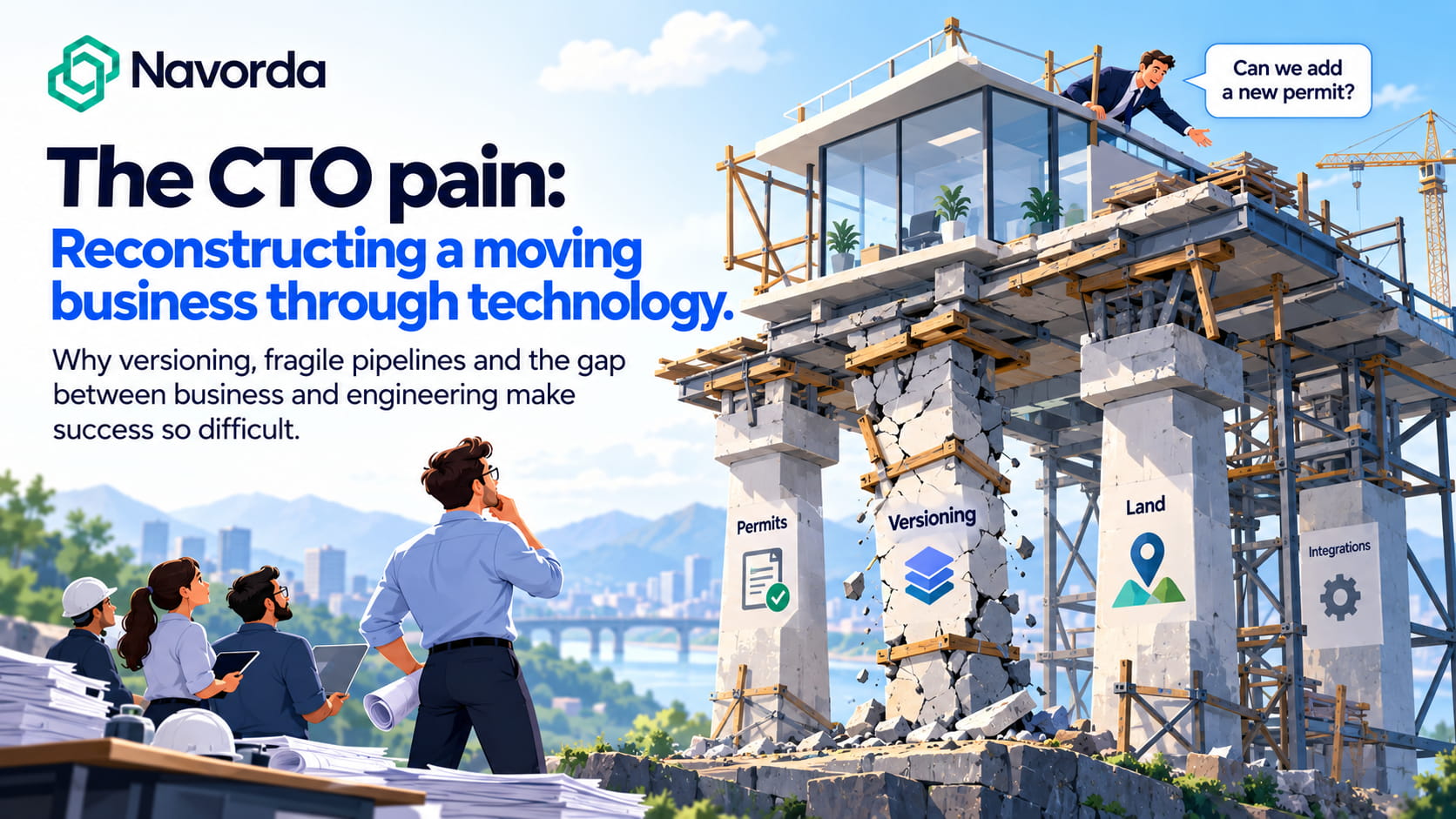
The strongest operating models are not those that resist change. They are those that preserve governance while the business keeps changing.
 Luis Cabello5 min read
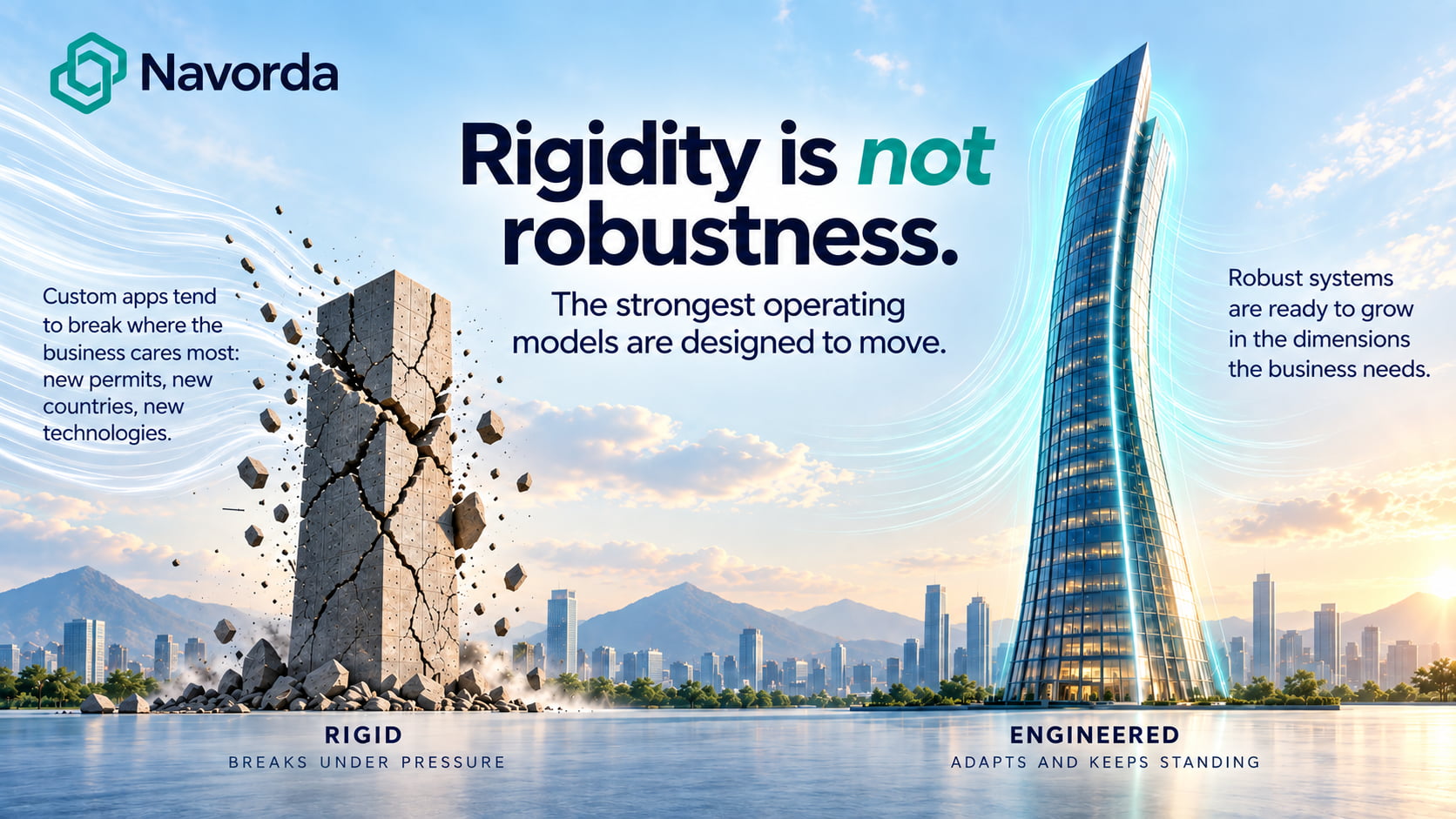
A robust system should survive change.
Yet many corporate systems are designed around the opposite assumption:
Define how the business works today, encode it into software, and keep everyone inside that structure.
Then the business changes.
A new country introduces different permits.
A new technology requires different milestones.
A new financing structure changes what management needs to govern.
A shared grid asset creates dependencies across several projects.
And suddenly, the system that was designed to create control starts becoming a constraint.
That is the paradox:
The more rigidly we try to control a changing business, the more fragile the operating model can become.
Energy development does not stand still
Energy development is constantly evolving.
Solar becomes solar + BESS.
One country becomes five.
A simple ownership structure becomes multiple SPVs and shareholders.
A milestone becomes a chain of dependencies.
A financial model changes because a new financing structure or partnership introduces assumptions nobody anticipated when the original process was designed.
This is not an exception.
It is the nature of the business.
So the real question is not whether your operating model will change.
It is:
Can it change without losing governance?
Rigidity is not robustness
Standardization often feels like strength.
One process.
One template.
One workflow.
One set of fields for everyone.
That works until something legitimate does not fit.
Then teams usually have three options:
- force reality into the system
- request a software change
- work around the system
The third option often wins.
Another Excel file appears.
A separate tracker is created.
A country develops its own process.
An important detail lives in an email thread.
The corporate system remains perfectly standardized.
The business quietly stops using it as its operating model.
That is not robustness.
It is rigidity.
Custom development can create the same problem
The opposite approach is to build exactly what the business asks for.
Initially, this feels very flexible.
Every requirement can become a feature.
Every exception can become a workflow.
Every request can eventually be implemented.
But the business keeps moving.
A new country joins.
A new permitting process appears.
Management wants a different reporting structure.
A transaction introduces another way of organizing projects.
Eventually, every legitimate business change becomes a software-development request.
The system may technically be customizable.
But if changing the operating model requires developers, that is another form of rigidity.
So what should actually be stable?
This is where the design question changes.
Instead of asking:
How do we make everything configurable?
Ask:
What should remain stable while the business changes around it?
Some things should be extremely robust:
- security and permissions
- auditability
- historical versions
- ownership
- dependencies
- baselines
- traceability of commitments
- knowing what changed, who changed it and when
These are not things the organization should reinvent every time it enters a new country or develops a new technology.
They are the governance foundation.
The business itself, however, needs room to move.
A Spanish solar project does not need the same permits as a Finnish BESS project.
One technology may require different milestones.
A specialist financial model may evolve hundreds of times without requiring the corporate platform to reproduce every formula.
That variation is not necessarily disorder.
It is legitimate business complexity.
Standardize the structure. Not every situation.
This principle has become central to how we think about Navorda.
The goal is not to design the perfect workflow and force every project through it.
Nor is it to give every organization a blank toolkit and ask them to build their own application.
The goal is the middle:
Standardize the governance structure while allowing the business to evolve inside it.
A new permit should not require redesigning the platform.
A new project stage should not require rebuilding the reporting architecture.
A new financial model should not require reproducing thousands of formulas inside Navorda.
A new add-on should extend the same project reality rather than creating another silo.
That is also why, with External Models Governance, Navorda can leave specialist models where they belong while governing the assumptions and outputs that matter to the wider organization.
The model remains flexible.
The corporate context remains governed.
That is robustness without rigidity.
A simple test for your operating model
Ask what happens when something changes.
A new country enters the portfolio.
A project changes technology.
A shared substation begins affecting several assets.
A financial model evolves.
Management asks a question nobody anticipated six months ago.
Can your operating model absorb that change?
Or does someone need to create:
another spreadsheet, another manual reconciliation, another workaround, or another development request?
The answer tells you whether the system is supporting the evolution of the business — or whether the business is slowly learning how to work around the system.
Flexibility is not enough either
An empty spreadsheet is extremely flexible.
So is a blank database.
The difficult part is preserving:
Flexibility + structure + history + accountability + consistency.
That combination is what creates robustness.
A strong operating model should allow the organization to evolve without continuously rebuilding the mechanisms through which it governs itself.
Nobody knows exactly how an energy developer will operate five years from now.
The countries may change.
The technologies will change.
The financing structures will change.
The AI tools will certainly change.
But the need to understand:
What is happening, what changed, what depends on it, who owns it and what decision comes next.
That need will remain.
That is the layer worth making robust.
Everything else needs room to move.
Does your operating model bend — or break?
If every new country, technology or process creates another spreadsheet, workaround or software-development request, the problem may not be a missing feature.
The operating model itself may have become too rigid.
Navorda is designed to provide the governed foundation underneath that change — without forcing every organization to operate in exactly the same way.
Start with a 20-minute conversation.
No preparation or confidential project information needed. We can talk through how your current operating model handles milestones, permits, risks, dependencies, ownership and reporting — and identify where governance is strong, where flexibility is necessary and where gaps appear as the portfolio scales.
Run the test against your own portfolio — the five-minute Corporate Distance Assessment