Robustness Without Rigidity: The Missing Middle in Portfolio Governance
Portfolio governance has traditionally forced energy companies to choose between rigid off-the-shelf tools and endless custom development. Navorda offers a third path.
 Luis Cabello6 min read
Portfolio governance has traditionally forced energy companies to choose between rigid off-the-shelf tools and endless custom development. Navorda offers a third path.
For years, energy companies looking for better portfolio governance have faced an apparent choice:
- Buy an existing project management platform.
- Build a custom application internally.
The first promises robustness.
The second promises flexibility.
But both approaches reveal important limitations as the organization and its portfolio grow.
Generic platforms are often too rigid to represent how energy projects actually develop. Custom applications can adapt to almost anything, but frequently become expensive, difficult to govern and permanently unfinished.
The real challenge is not choosing between software and custom development.
It is deciding:
What should be standardized, and what should remain configurable?
Why Generic Project Management Tools Fall Short
Traditional project management platforms were designed around generic concepts such as tasks, deadlines, resources and budgets.
Energy development is more complex.
A portfolio may involve:
- permits that differ by country and technology
- hundreds or thousands of land plots
- multiple types of land agreements
- plants, substations and power lines with connected critical paths
- evolving risks and mitigation plans
- SPVs, counterparties, shareholders and SPAs
- dependencies between development, construction, energization and revenue
This operational reality does not fit naturally into a generic project template.
Eventually, teams create workarounds. New fields are added without a coherent information model. Country-specific processes are forced into global structures. Reporting requires increasingly complex transformations.
The platform may remain technically robust.
But the operating model becomes rigid.
The Promise—and Reality—of Custom Development
The alternative is to build the system internally.
The proposition is attractive:
We can create exactly what the business needs.
The organization hires software engineers, data analysts and project managers, or commissions an external vendor to build the application.
In theory, the result should be a perfect fit.
In practice, defining that perfect system is much harder than expected.
Business teams are already managing projects, negotiating contracts, securing permits and preparing reports. They rarely have enough time to produce complete and stable software specifications.
Requirements arrive progressively. Priorities change.
One month, the main concern is land securization. The next, it is permitting. Then construction reporting becomes urgent. Shortly afterwards, management needs a new dashboard before the investment committee.
The development team responds logically to each request.
But without a stable product framework, the application begins to follow urgency rather than architecture.
The Flexibility Paradox
Custom applications also create a less obvious problem.
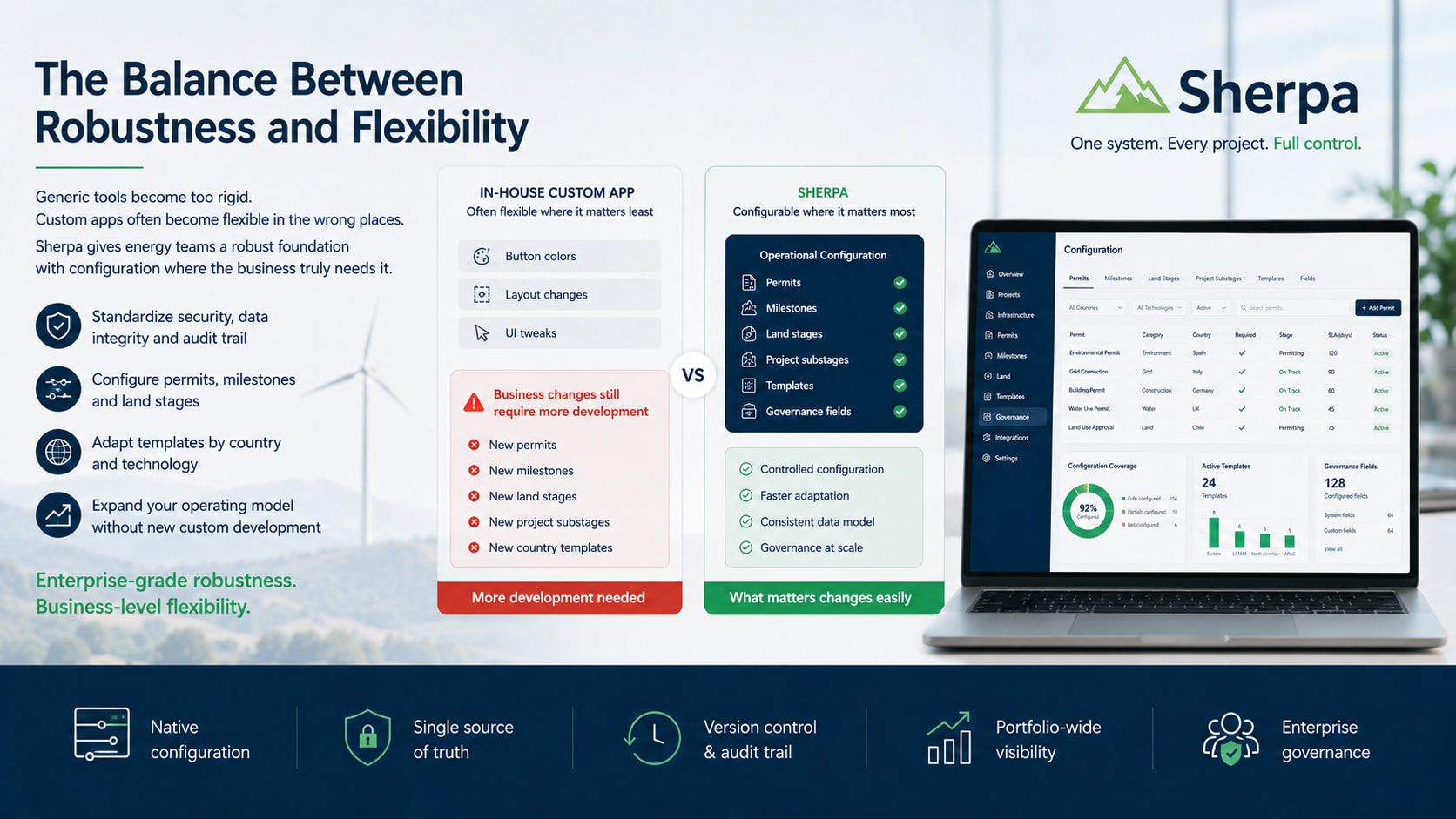
They often provide flexibility where the business cares least, while remaining rigid where flexibility matters most.
An internal application may make it relatively easy to:
- change button colours
- move fields between layouts
- redesign screens
- reposition navigation elements
- adjust labels and visual components
These changes make the interface appear customizable.
But they rarely improve how the portfolio is governed.
The business gains little strategic value from moving the navigation panel from the right side of the application to the left.
What the organization really needs is the ability to adapt its operating model:
- add a new permit for a specific country
- introduce a new development milestone
- define a new land contractual stage
- create project stages or substages
- add information required for a particular technology
- create completion templates by country and technology
- expand the dates, amounts and qualitative information being governed
Surprisingly, these are often the changes that custom applications handle least effectively.
They can affect the database model, validation rules, reports, permissions, integrations and user interfaces. Each business change therefore becomes another software development request.
This is the paradox:
Custom software can be highly flexible as an interface while remaining deeply inflexible as a business system.
When Urgency Becomes the Roadmap
Custom development rarely fails because the development team lacks technical capability.
The deeper problem is that the same team must build both the platform foundation and every new business requirement.
Visible features compete with less visible but essential capabilities such as:
- data integrity
- security and permissions
- audit trails
- historical versioning
- performance
- documentation
- user experience consistency
- long-term upgradeability
These foundations may not solve the most urgent request of the month, but they determine whether the application will remain reliable over the following years.
When they are repeatedly postponed, technical debt grows. Every new feature becomes harder to implement, and the application becomes increasingly difficult to replace, upgrade or finish.
The project continues.
But the original business need becomes harder to identify.
Standardize the Foundation
Some capabilities should not be reinvented by every energy company.
They should exist as part of the platform:
- enterprise-grade security
- identity and access management
- data integrity
- auditability
- historical versioning
- governed imports and exports
- consistent user experience
- scalable infrastructure
- APIs and integrations
- continuous product upgrades
A renewable energy developer should not need to build its own permission engine before improving land governance.
Nor should it need to create an entire versioning framework before comparing the current forecast with the previous reporting cycle.
These foundations should already exist.
Configure What Makes the Business Different
The operating model is different.
Every corporation has its own terminology, portfolio structure, geographic footprint and governance requirements.
Those differences should not be removed.
They should be configurable.
Navorda allows organizations to adjust the elements that legitimately vary by company, country and technology:
- permits and milestones
- land contract stages
- project stages and substages
- quantitative and qualitative fields
- country- and technology-specific templates
- project and infrastructure classifications
- corporate terminology and governance rules
This is not unrestricted customization.
It is controlled configuration within a coherent data and operational model.
Customization changes the software. Configuration changes how the organization operates within a governed system.
Navorda may not allow every corporation to reposition every button or redesign the navigation panel.
Instead, it concentrates flexibility where it creates business value.
The Missing Middle
Navorda was designed to occupy the space between traditional project management software and pure in-house development.
It provides a ready-to-use foundation built specifically for energy project development and construction, while preserving the configuration capabilities required by different corporations, countries and technologies.
The objective is not to provide an empty toolkit from which every client must build another custom application.
Nor is it to impose a fixed operating model that teams must work around.
The objective is to standardize the complexity that should not be rebuilt and preserve the flexibility the business genuinely needs.
Instead of asking:
How many months will it take to develop this change?
The organization can ask:
How should this process be governed across our portfolio?
Energy companies should not need to choose between a platform that is robust but rigid and one that is flexible but permanently under construction.
The objective is not to make every pixel configurable. It is to make the business configurable without making the platform fragile.