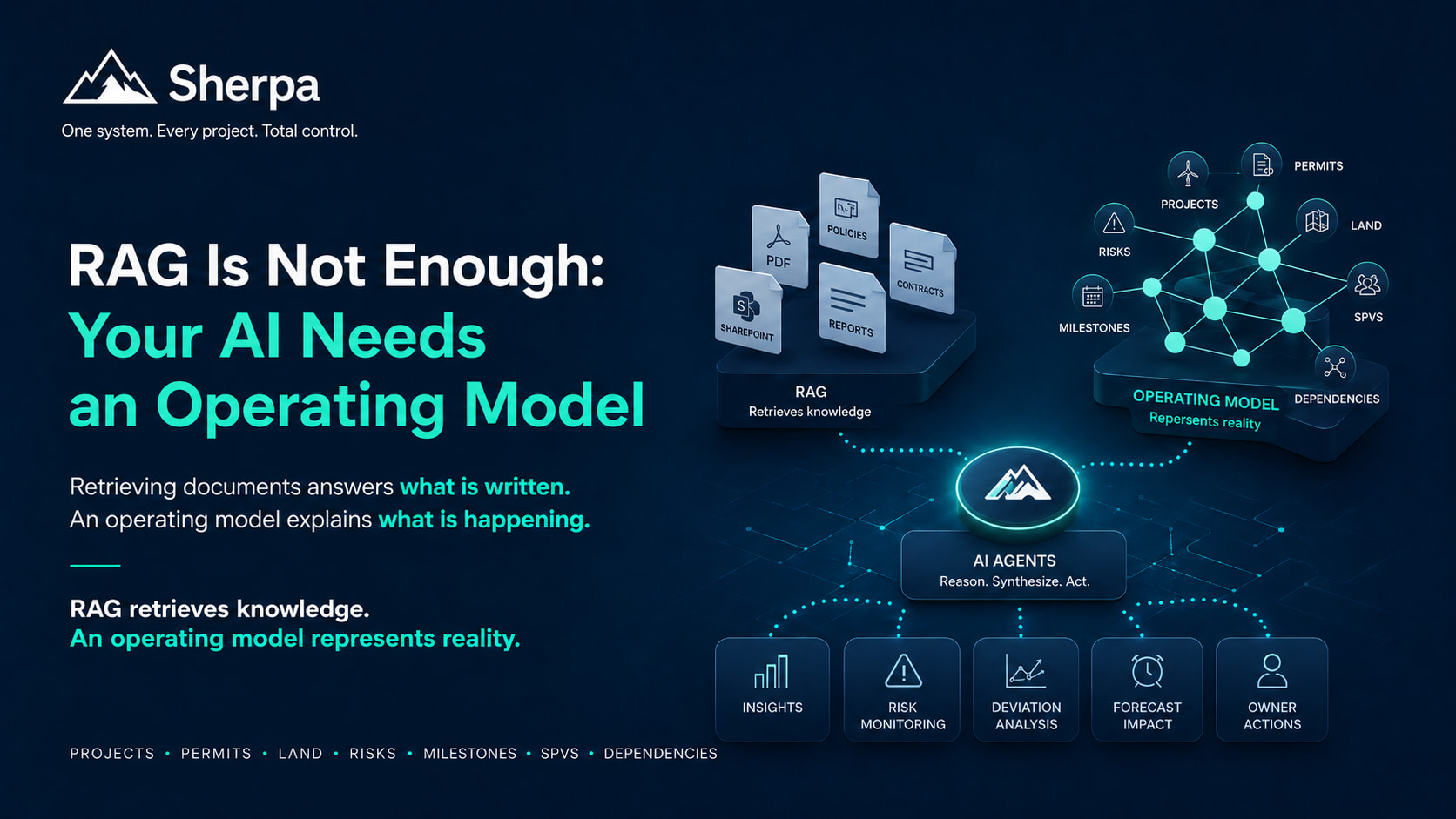
RAG Is Not Enough: Your AI Needs an Operating Model
Why enterprise AI needs more than access to documents if it is expected to reason about how the business is actually operating. RAG can tell you what the permit says. It cannot tell you which RtB commitment depends on it, how far the forecast has drifted from baseline, or who owns the mitigation.
 Luis Cabello6 min read
Connect SharePoint.
Ingest the PDFs.
Put a RAG layer in front. Connect an LLM.
Corporate AI: solved.
Not quite.
RAG solves a very important problem. But it does not solve every problem an enterprise AI will be asked to solve.
There is a fundamental difference between answering:
What does the environmental permit say?
and:
Which projects currently have an environmental permit at risk, which RtB commitments depend on them, how far have those milestones drifted from baseline, and who owns the mitigation?
The first is a knowledge retrieval problem. The second is an operational reasoning problem.
And they require different foundations.
RAG retrieves knowledge. An operating model represents reality.
RAG Is Extremely Useful
Retrieval-Augmented Generation exists for a good reason.
A foundation model does not automatically know your contracts, policies, permits or engineering reports. RAG lets an AI system search enterprise information, retrieve the relevant content and ground its answer in it — that is essentially how AWS describes the pattern.
AWS — What is Retrieval-Augmented Generation? →
Upload thousands of environmental documents and ask:
What restrictions apply to construction during the nesting season?
A good retrieval architecture finds the relevant paragraphs and returns a sourced answer. Companies should build these capabilities.
The problem appears when retrieving what the company knows becomes confused with understanding what is happening inside the company.
Those are not the same thing.
Documents Describe Reality. They Are Not Reality.
Consider an environmental permit.
The PDF can tell you which authority issued it, which conditions apply, when it expires and what mitigation measures are required.
But the document does not know:
- whether the permit is currently considered at risk
- which project milestone depends on it
- which RtB baseline management approved six months ago
- whether the current forecast has moved by 90 days
- who owns the mitigation action — and how much exposure the delay creates
Those facts live in the operating state of the business.
They change.
They have owners.
They have relationships.
They have history.
And sometimes they are governed by rules that do not exist in any document at all.
A Vector Database Does Not Know What the Current Commitment Is
Imagine an AI finds three references to RtB for the same project:
- 30 September 2026, in an investment committee paper.
- 31 December 2026, in a development report.
- 15 November 2026, in a project manager's presentation.
All three documents are genuine. All three dates were correct when they were written.
A retrieval system can find them. A sophisticated model can summarize them.
But which one is the current forecast? Which one is the approved baseline? Which one was superseded — when, by whom, and why?
Those are not questions of semantic similarity. They are questions of state and governance.
If that distinction does not exist somewhere in the company's operating model, the AI has no reliable way to invent it.
Giving the model more documents gives it more competing versions of the truth.
Who changed that date? A source of truth vs a governed source of truth →
Operational Questions Are Relationship Questions
Now ask something more useful:
Which environmental issues could cause us to miss RtB this quarter?
To answer properly, an AI needs to traverse something like:
- Environmental issue → affects a permit
- Permit → belongs to a project
- Permit → threatens the RtB milestone
- Milestone → current forecast vs approved baseline → 63 days of deviation
- Risk → mitigation action → owned by a Development Manager — with no committed completion date
That chain is where the business value sits. It contains very little prose.
What matters are the relationships.
This is not a document library.
It is an operating model.
Your AI does not need more intelligence — it needs better context →
What About GraphRAG?
The industry has already recognized that isolated text chunks are sometimes insufficient.
Microsoft's GraphRAG work structures information into entities and relationships so AI can reason over richer connections, and Microsoft's Agent Framework documentation now describes retrieving relevant subgraphs rather than only isolated chunks when relationships between entities matter.
Microsoft Research — GraphRAG: unlocking LLM discovery on narrative private data →
Microsoft Learn — GraphRAG retrieval in the Agent Framework →
AWS makes a similar distinction: its agentic-AI guidance includes graph databases for scenarios where connections between business entities are central to the query.
AWS — graphs and AI on Amazon Neptune →
An important step forward. But another distinction matters more.
A graph extracted from documents and an operating model maintained by the business are not the same thing.
An AI can read a monthly report and infer:
Project Alpha — has milestone — RtB.
Useful. But an operational system can know:
Project Alpha's current RtB forecast is 15 November 2026; its approved baseline is 31 August 2026; it has drifted 76 days; the value was changed by this user on this date; this environmental permit is one of the causes; and this person owns the mitigation.
One reconstructs knowledge from information.
The other records the state of the business directly.
Knowledge and Operations Should Work Together
The conclusion is not that RAG is unnecessary. Quite the opposite — the architecture becomes much more interesting when both layers are available.
What conditions does this permit impose?
Retrieve the permit.
Which projects have permits exposed to those conditions?
Query the operational model.
What exactly does the authority require, which milestone does it threaten, and what are we doing about it?
Now the AI needs both. The document provides the knowledge. The operational system provides the state and relationships.
Agents Make This Difference More Important
For a chatbot, imperfect context produces an imperfect answer. For an agent, it produces an imperfect decision.
That raises the bar considerably.
An AI agent whose job is to identify projects at risk of missing COD should not have to infer from fifty monthly reports which milestone is current. It should know.
It should not guess whether a risk remains open because an old risk register appears in SharePoint. It should query its current status.
And it should not decide that a date changed because two PDFs contain different values. It should have access to the change history.
The more autonomous AI becomes, the more valuable deterministic business structure underneath probabilistic reasoning becomes.
This Is the Layer Navorda Provides
Navorda structures renewable-energy development around the objects the business actually operates — projects, permits, land, milestones, baselines, risks, SPVs, infrastructure dependencies — and the relationships between them.
The objective is not merely to store those objects. It is to preserve their operational meaning: a milestone carries both a baseline and a current forecast, a risk threatens a specific milestone, a power line can be a dependency of several plants, and when governed information changes, the system retains who changed it and when.
That is the structured operating context Navorda AI reason against.
And through the Navorda MCP Connector, a native Model Context Protocol (MCP) server,, the same governed reality can be exposed — read-only, live — to authorized external AI systems such as ChatGPT, Claude or corporate agent platforms.
The seven Navorda AI agents — how governed data becomes guided action →
Connect Claude or ChatGPT to your portfolio — read-only by architecture →
Navorda does not need to replace the company's RAG architecture. It complements it.
Let RAG explain what the documents say. Let the operational system explain what the business is doing.
The AI Architecture Is Missing a Layer
The enterprise AI stack keeps growing — models, vector databases, RAG, GraphRAG, agents, MCP servers, orchestration, guardrails. All of these layers have a role.
But underneath them sits a more basic question:
Where is the authoritative representation of how the business is operating right now?
If the answer is still:
It depends. Some of it is in SharePoint, some in Excel, some in the project schedule, some in emails — and the rest you need to ask the team.
then connecting AI to all those systems does not eliminate the fragmentation.
It makes the fragmentation searchable.
Searchable fragmentation is still fragmentation.
The next generation of enterprise AI will need excellent retrieval. But when AI is expected to move from answering questions about the company to reasoning about its operations, retrieval is only part of the architecture.
RAG retrieves knowledge. An operating model represents reality.
The most useful enterprise AI will need both.
Renewable energy project development software — the buyer's guide →