The Best Corporate AI Strategy May Be Not to Choose an AI
Why the durable enterprise-AI decision may not be the model you choose — but the context you make available to it. Models will change extraordinarily fast; your projects, permits and milestones will remain. Own the context, not the interface.
 Luis Cabello4 min read
Corporate AI discussions often start with the same questions:
- ChatGPT or Claude?
- Bedrock or Azure?
- Which model?
- Which corporate assistant?
Important questions.
But perhaps not the strategic ones.
Because models change extraordinarily fast. The AI your company chooses today may not be the one it prefers in two years.
Your projects will still exist. Your permits will still matter. Your land agreements, risks, milestones and SPVs will still determine whether projects move forward or get delayed.
So perhaps the most durable AI decision is not choosing the intelligence. It is making sure that whatever intelligence comes next can understand your business.
Choose an AI. Just don't build your business around the assumption that you chose the last one.
Think about how you change phones.
Every two years, a better one. You do not rebuild your contacts, photos and messages each time — they live in accounts the new phone simply plugs into.
Corporate AI should work the same way. The intelligence is the phone. The context is the account.
You Already Have Most of the Pieces
Companies are not starting from zero. Documents, policies, reports, contracts, technical studies — RAG architectures are making all of this increasingly accessible to AI.
Ask:
What does the environmental authority require?
A good knowledge layer retrieves the relevant document and answers.
Now ask:
Which projects are affected, which RtB commitments depend on those permits, how far have they drifted from baseline, and who owns the mitigation?
Something is missing. The documents explain the issue. They do not represent what is happening operationally right now.
RAG is not enough — the full argument →
The Missing Piece Is Operational
For renewable-energy development, AI needs to understand relationships such as:
- Project → Permit
- Project → Land
- Risk → Milestone
- Milestone → Baseline → Current forecast
- Plant → Substation → Power line
- Change → Previous value → New value → User → Timestamp
This is not simply more corporate knowledge. It is the operating model of energy development.
It tells AI not only what exists, but:
- what belongs to what
- what depends on what
- what is current — and what was committed
- what has changed, and who changed it
- what is at risk, and who owns the response
Your company already brings the knowledge. Navorda brings the operating context of energy development.
Where Navorda Fits in the Stack
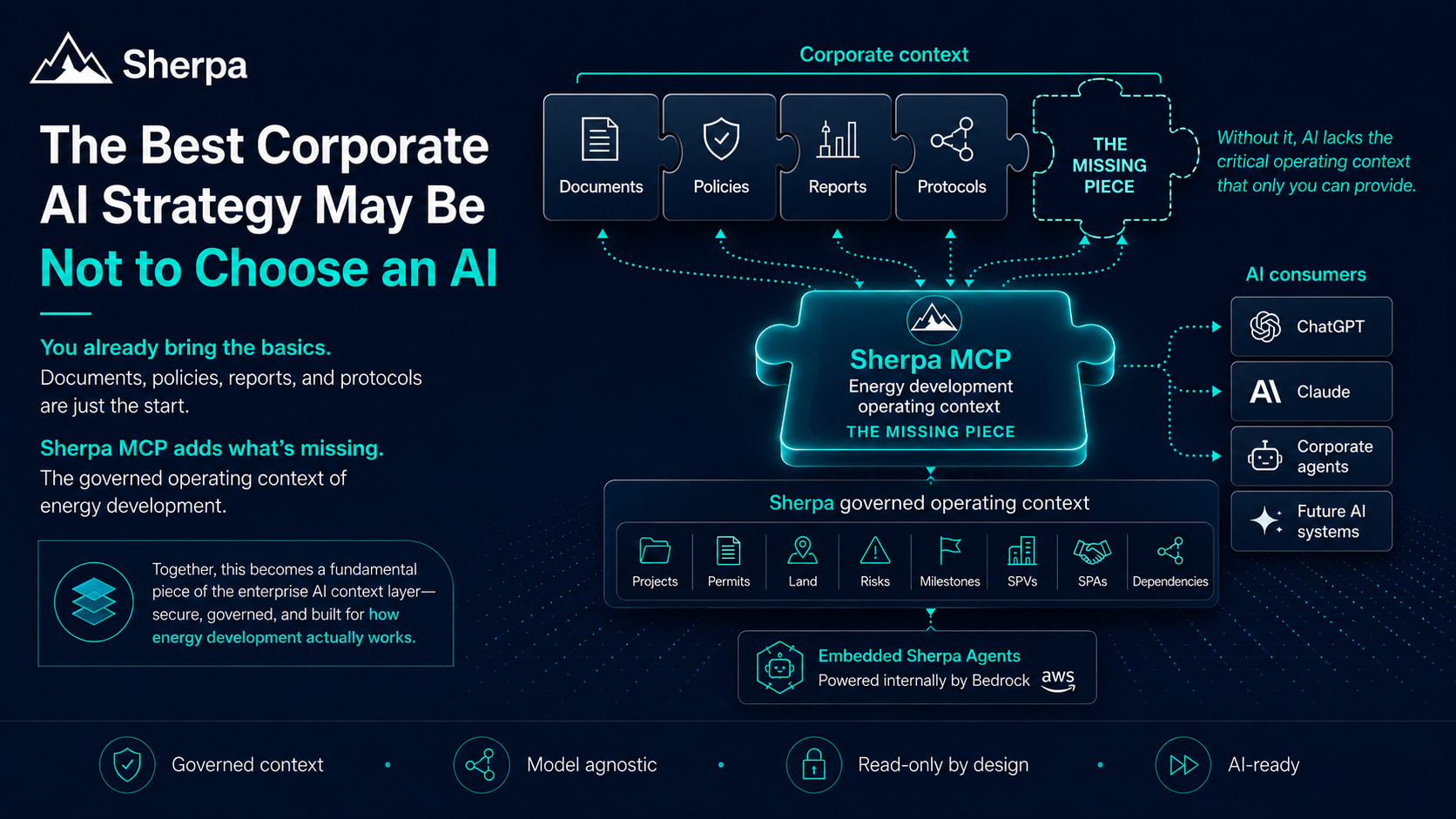
Navorda models projects, permits, land, risks, milestones, baselines, SPVs, SPAs and infrastructure dependencies as connected operational objects.
The Navorda MCP Connector, a native Model Context Protocol (MCP) server, makes that governed context available — read-only — to authorized AI systems. Navorda does not need to become the company's entire AI stack. It becomes a context provider inside it.
The architecture looks like this:
- Corporate documents, reports and policies → corporate knowledge (RAG)
- ERP and CRM → financial and commercial context
- GIS and specialist systems → their own slices
- Navorda MCP Connector → the energy-development operating context
And on top, the interchangeable intelligence: ChatGPT, Claude, Bedrock agents, corporate assistants — or whatever comes next.
The Navorda MCP Connector is not another chatbot.
It is the piece that helps any AI understand how energy development actually works inside your portfolio.
Connect Claude or ChatGPT to your portfolio — read-only by architecture →
The Same Question, Answered Twice
Imagine asking your corporate AI:
Why is Project Alpha's RtB at risk?
With documents alone, you get an answer like this:
The environmental authority has requested additional documentation regarding avian protection measures.
Correct. And operationally useless.
With the operating context connected, the same question returns:
The environmental permit is under revision. It threatens RtB — current forecast 15 November against an approved baseline of 31 August, 76 days of drift. The mitigation action is still open, and the Development Manager owns it.
The first answer tells you what the authority said. The second tells you what it means for the project — and who is doing something about it.
RAG tells AI what the company knows. Navorda tells AI what is happening.
Bedrock Inside. MCP Outside.
Navorda AI uses AWS Bedrock inside Navorda to analyze governed portfolio information, detect inconsistencies, identify deviations and surface risks. That is Navorda's internal intelligence layer.
The Navorda MCP Connector points the other way: it exposes Navorda's operating context externally, so customers can incorporate it into their own AI ecosystem — ChatGPT, Claude, Bedrock, a corporate agent platform, or something that does not exist yet.
They solve different problems.
Bedrock helps Navorda reason. MCP helps other AI systems understand Navorda's world.
The seven Navorda AI agents — how governed data becomes guided action →
Own the Context, Not the Interface
Companies should still evaluate AI models. Security, performance, cost and cloud strategy all matter.
But model selection should not become context lock-in.
Make the context durable. Make the intelligence replaceable.
The more durable questions are:
- Does our AI have access to the context it needs?
- Are our operational relationships explicit and governed?
- Can authorized AI systems consume them safely?
- Can we upgrade the intelligence without rebuilding the business context underneath it?
How Navorda keeps AI access read-only — the security posture →
For energy developers, the Navorda MCP Connector is designed to be part of that answer. Your company brings its documents, policies and enterprise context. Navorda adds the governed operating model of projects, permits, land, risks, milestones, SPVs and dependencies.
Together, they give AI a much more complete representation of the business. And the model consuming that context can keep changing.
Models will change. Your projects will remain. Own the context, not the interface.
Renewable energy project development software — the buyer's guide →